
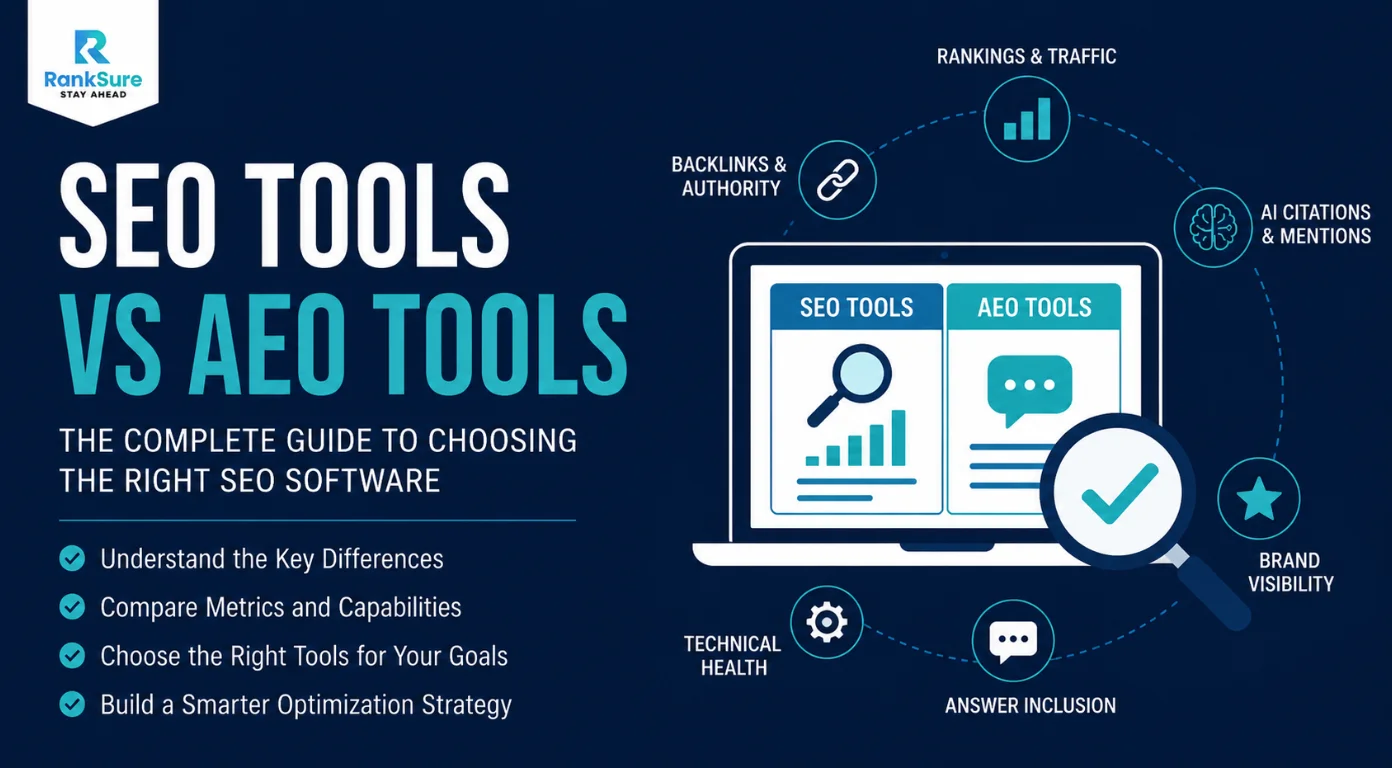
Search visibility extends beyond Google’s organic results. Users discover brands through ChatGPT, Google AI Overviews, Gemini, Perplexity, Copilot, and traditional search engines. These platforms measure and present visibility through separate systems.
SEO tools track webpage rankings, backlinks, search queries, crawlability, and organic traffic. AEO tools track brand mentions, source citations, prompt coverage, entity associations, and answer inclusion across AI platforms.
SEO and AEO serve separate functions. SEO develops the crawlable and indexable web foundation. AEO measures whether AI systems retrieve, mention, and cite that information.
Platform selection should follow 3 factors:
- The search channels that influence customer discovery
- The metrics the marketing team must report
- The technical and financial resources available
Key Takeaways
- SEO tools measure keyword rankings, backlinks, crawl health, indexing, and organic traffic.
- AEO tools measure AI citations, brand mentions, prompt coverage, entity visibility, and answer share.
- SEO targets webpages and keyword queries. AEO targets entities, conversational prompts, and cited answers.
- Technical SEO supports content discovery. AEO monitoring measures retrieval across AI-generated responses.
- A combined workflow uses SEO tools for execution and AEO tools for visibility measurement.
Understanding SEO Tools and AEO Tools
Why Search Optimization Is Expanding Beyond Traditional SERPs
Search behavior has diversified. Many users now ask AI assistants to complete questions instead of typing fragmented keyword queries into Google. AI systems synthesize information from multiple sources rather than returning a list of search results.
That changes what marketers need to measure.
Traditional SEO software focuses on metrics such as:
- Rankings
- Organic traffic
- Keyword visibility
- Backlinks
- Crawl health
AI search introduces a different layer of visibility:
- Whether your brand is cited
- Which pages AI retrieves
- How frequently competitors appear
- Entity associations
- Prompt-level performance
- Share of AI-generated answers
Traffic is no longer the only success metric. Visibility inside AI-generated responses has become another acquisition channel.
How Search Engines and AI Answer Engines Retrieve Information
Search engines and AI answer engines present information through separate retrieval processes.
Search engines crawl webpages, store URLs in an index, evaluate ranking signals, and display ordered results. Users select a result by clicking its title or description.
AI answer engines retrieve passages from selected sources. The model uses those passages to produce one synthesized response. Supporting sources appear as citations when the platform provides citation functionality.
A webpage hold a high search position without appearing in an AI-generated answer. AI retrieval depends on the prompt, source access, content structure, entity clarity, and the platform’s retrieval process.
| Search Engines | AI Answer Engines |
| Rank webpages | Generate synthesized answers |
| Index URLs | Retrieve relevant passages and entities |
| Prioritize PageRank and relevance | Prioritize authoritative, grounded information |
| Return multiple choices | Produce one consolidated response |
| CTR is the primary objective | Direct answer quality is the objective |
What SEO Tools Measure
SEO platforms primarily analyze signals influencing search rankings.
Common capabilities include:
- Keyword research
- SERP position tracking
- Backlink analysis
- Technical audits
- Internal linking analysis
- Crawl diagnostics
- Competitor keyword gaps
- Organic traffic estimation
These tools answer questions like:
- Why did rankings drop?
- Which keywords generate traffic?
- Which backlinks strengthen authority?
- Which pages require optimization?
These tools support crawlability, indexing, ranking analysis, backlink research, and technical diagnosis.
What AEO Tools Measure
AEO platforms measure brand visibility inside AI-generated responses.
Their reports cover metrics such as:
- Brand citations
- Prompt coverage
- Answer inclusion
- Entity associations
- Competitor mentions
- Source attribution
- AI share of voice
- Referral traffic from AI platforms
Marketers use these metrics to answer direct questions:
- Does ChatGPT mention the brand?
- Which pages receive citations?
- Which competitors appear for purchase-related prompts?
- Which entities appear beside the company name?
- Which prompts exclude the brand?
AEO tools measure generated-answer exposure rather than webpage position.
Why Modern Search Requires Both
SEO and AEO solve different visibility problems. SEO helps search engines discover, crawl, and rank your content, while AEO measures whether AI systems retrieve, trust, and cite that content when generating answers.
Website
↓
Technical SEO
↓
Google Index
↓
Authority Signals
↓
LLM Retrieval
↓
AI Citation
↓
Generated Answer
SEO improves website discoverability. AEO monitoring measures AI answer visibility and identifies citation gaps.
How SEO and AEO Work: The Technical Foundation
Understanding how each optimization model works explains why their software capabilities differ so dramatically.
SEO Workflow: Crawling → Indexing → Ranking
Traditional search follows four stages:
- Crawlers discover webpages.
- Relevant pages are indexed.
- Ranking algorithms evaluate quality and relevance.
- Search results are ordered on the SERP.
SEO tools monitor crawlability, indexing, rankings, and technical issues throughout this process.
AEO Workflow: Retrieval → Grounding → Generation → Citation
AI answer generation follows 4 stages:
- A user submits a prompt.
- The system retrieves passages, documents, or indexed information.
- The model uses retrieved information to support its response.
- The platform generates an answer. Platforms with citation features display supporting sources.
Prompt wording and context affect the retrieved sources. AEO platforms therefore test groups of prompts and record brand mentions, cited URLs, competitors, and answer frequency.
Keywords vs. Entities
| Keyword Optimization | Entity Optimization |
| Optimizes search phrases | Optimizes real-world concepts |
| Targets rankings | Targets semantic understanding |
| Focuses on pages | Focuses on knowledge relationships |
Keywords help search engines match queries, while entities help AI understand context and relationships. Both are necessary for modern search visibility.
Links vs. Citations
Backlinks contribute to Google’s assessment of webpage authority and relevance. AI visibility adds another measurement layer through citations, source mentions, and entity associations inside generated answers.
Search Intent vs. Conversational Intent
Traditional SEO targets keyword queries like “best SEO tools.” AEO targets conversational prompts such as “Which SEO platform is best for a SaaS company?” Monitoring these prompt variations reveals opportunities that keyword research alone cannot.
Vector Search, Embeddings & Knowledge Graphs
AI retrieval uses semantic relationships alongside exact words.
- Embeddings convert text into numerical representations of meaning.
- Vector search compares those numerical representations to locate semantically related passages.
- Knowledge graphs organize entities such as companies, products, people, and locations through defined relationships.
These systems connect a prompt with related information even when the wording differs from the source page.
AEO vs SEO Tools: Complete Feature Comparison
SEO and AEO tools analyze separate stages of search visibility.
SEO tools evaluate how webpages are discovered, indexed, ranked, and visited. AEO tools evaluate how brands and sources appear inside generated answers.
The distinction affects 6 areas:
- SEO tracks keywords; AEO tracks prompts.
- SEO tracks rankings; AEO tracks answer inclusion.
- SEO evaluates backlinks; AEO records citations and entity associations.
- SEO audits crawlability; AEO assesses retrieval-ready content structure.
- SEO reports organic clicks; AEO reports AI referrals and citation share.
SEO compares SERP competitors; AEO compares brands appearing in generated answers. Both categories analyze search visibility, but they solve separate problems.
| Feature | SEO Tools | AEO Tools | Why It Matters |
| Primary Goal | Improve SERP rankings | Increase AI answer visibility | Different optimization targets |
| Optimization Target | Pages & keywords | Entities, prompts & citations | AI retrieves concepts, not just URLs |
| Search Platforms | Google, Bing | ChatGPT, Gemini, Perplexity, Copilot, AI Overviews | Visibility now spans multiple ecosystems |
| Query Analysis | Keyword research | Prompt monitoring | Users search differently in AI |
| Visibility Tracking | Rankings | Citation share & answer frequency | Rankings don’t measure AI exposure |
| Authority Analysis | Backlinks | Entity authority & co-citations | Trust signals differ |
| Technical Analysis | Crawl health & indexing | Retrieval readiness & structured content | AI requires machine-readable content |
| Content Optimization | Keyword relevance | Answer extraction & semantic coverage | Different optimization goals |
| Data Sources | Search engines | LLM outputs & AI responses | Different datasets |
| Reporting | Traffic & rankings | AI visibility & citations | Success metrics evolve |
| Success Metrics | Organic clicks | Citation share, answer inclusion, AI referrals | Zero-click search changes attribution |
| Competitor Analysis | Keyword overlap | Prompt-level AI visibility | Reveals emerging competitors |
SEO Tools Compared
Traditional SEO platforms measure crawlability, rankings, content performance, and backlink data. Some platforms have introduced AI-focused features, but their main datasets still focus on traditional search performance.
| Tool | Best For | Core Strengths | Limitations | Ideal Users |
| Ahrefs | Competitive SEO | Backlinks, keyword research, content gap analysis | Limited native AI visibility | Agencies, enterprises |
| Semrush | All-in-one SEO | Keyword research, PPC, content, site audits | AI monitoring still evolving | Marketing teams |
| Google Search Console | Performance monitoring | Search queries, indexing, Core Web Vitals | Google-only data | Every website owner |
| Screaming Frog | Technical audits | Crawling, redirects, structured data validation | Desktop application | Technical SEOs |
| Moz Pro | Rank tracking | Domain authority, local SEO | Smaller database than competitors | SMBs |
| Surfer SEO | Content optimization | NLP recommendations, on-page scoring | Not a technical SEO suite | Content teams |
SEO platforms provide different feature sets for backlink analysis, technical auditing, keyword research, rank tracking, and content optimization. Ahrefs provides backlink reports, referring-domain analysis, keyword research, and content-gap tools. Semrush combines keyword research, PPC analysis, site auditing, backlink reporting, rank tracking, and content tools. Google Search Console provides first-party data on search queries, indexing, clicks, impressions, and Core Web Vitals. Screaming Frog specializes in technical audits, while Surfer SEO focuses on on-page optimization. Select the platform according to the required features, available budget, reporting needs, and team workflow.
AEO Tools Compared
Dedicated AEO platforms don’t optimize your content for you—they measure how your brand performs across AI answer engines. These platforms function primarily as visibility-monitoring systems rather than technical optimization tools.
Improving AI visibility still requires technical SEO, entity optimization, structured data, and authoritative content.
| Tool | AI Engines Supported | Citation Tracking | Prompt Monitoring | Entity Monitoring | Use Cases |
| Profound | ChatGPT, Gemini, Perplexity, AI Overviews | ✓ | ✓ | ✓ | Enterprise AI visibility |
| Goodie | Major LLMs | ✓ | ✓ | Limited | Brand monitoring |
| Peec AI | ChatGPT, Perplexity, Gemini | ✓ | ✓ | ✓ | Competitive intelligence |
| Scrunch AI | Multiple LLMs | ✓ | ✓ | ✓ | AI search analytics |
| Otterly AI | ChatGPT, Google AI Overviews, Perplexity | ✓ | ✓ | Limited | SMBs and agencies |
| Semrush AI Toolkit | Selected AI platforms | Partial | Partial | Partial | Existing Semrush users |
| Ahrefs Brand Radar | AI brand mentions | Partial | Limited | ✓ | Brand visibility analysis |
AEO platforms differ in AI-engine coverage, prompt limits, citation tracking, entity monitoring, reporting depth, integrations, and pricing.
Profound targets enterprise AI visibility. Peec AI provides competitor monitoring, prompt tracking, citation reporting, and entity analysis. Otterly AI provides prompt and citation monitoring for agencies and smaller teams. Semrush AI Toolkit and Ahrefs Brand Radar provide AI visibility features for organizations already using their broader SEO ecosystems.
Select the platform according to AI-engine coverage, prompt limits, reporting depth, integrations, user access, and budget.
Can SEO Tools Measure AI Visibility?
Traditional SEO tools provide indirect indicators of AI visibility. Dedicated AEO platforms test generated responses and record citations, mentions, prompt coverage, and answer inclusion.
What SEO Tools Can and Cannot Measure
| SEO Tools Can Measure | SEO Tools Cannot Measure |
| Organic visibility | ChatGPT, Gemini, and Perplexity citations |
| Keyword rankings | Prompt-level visibility |
| Structured data implementation | AI answer share |
| Entity mentions | Citation frequency across LLMs |
| Backlinks and topical authority | Competitor visibility in AI responses |
| Pages to be cited | AI-generated brand sentiment |
SEO metrics indicate factors related to AI retrieval, but they do not confirm appearance inside a specific generated answer.
Why Dedicated AEO Platforms Matter
AEO platforms analyze AI-generated responses across multiple LLMs to measure citation frequency, prompt coverage, entity associations, competitor visibility, and share of voice. AEO platforms track where a brand appears within generated answers rather than where a webpage ranks.
How Hybrid Platforms Bridge the Gap
A hybrid workflow assigns each platform a defined role:
- SEO tools identify and correct discoverability problems.
- AEO tools test whether AI platforms retrieve and cite the improved content.
- Analytics tools measure resulting sessions, conversions, and revenue.
Evaluating SEO and AEO Tools Before Buying
Evaluate each platform through 7 criteria:
- Data sources
- Search and AI platform coverage
- Prompt or keyword limits
- Reporting and export options
- API and software integrations
- Historical data retention
- Total subscription cost
A feature comparison should record exact limits. Examples include tracked keywords, monitored prompts, user seats, project limits, refresh frequency, historical months, and export formats.
Select the platform whose documented capabilities match the team’s workflow. Feature quantity alone does not establish business value.
| Evaluation Criteria | What to Look For |
| Data Accuracy | Transparent data sources, reliable crawlers, keyword databases, and AI prompt testing methodologies. |
| Search Engine & AI Coverage | Support for Google, Bing, ChatGPT, Gemini, Perplexity, Copilot, AI Overviews, and other relevant platforms. |
| Reporting & Dashboards | Customizable reports, visibility trends, competitor insights, prompt segmentation, citation history, and export options. |
| API, Integrations & Automation | Integrations with analytics, CRM, BI platforms, and workflow automation tools, plus API access for custom reporting. |
| Ease of Use | Intuitive dashboards, collaboration features, clear documentation, responsive support, and minimal onboarding. |
| Scalability | Multi-user access, international tracking, historical data retention, workspace management, and enterprise permissions. |
| Pricing vs. ROI | Evaluate value based on time savings, workflow efficiency, AI visibility improvements, and business outcomes—not subscription cost alone. |
Platform comparisons should prioritize workflow support, data quality, coverage, reporting limits, and integrations over feature quantity.
Select a platform the team can use consistently across current reporting, optimization, and monitoring workflows.
Choosing and Implementing Your SEO + AEO Stack
Organizations should assign SEO and AEO platforms separate roles within the search workflow.
SEO tools improve discoverability in traditional search, while AEO tools measure and optimize visibility across AI-generated answers.
Choosing the Right Tool Stack
| Use SEO Tools Only When… | Add AEO Tools When… |
| Organic search drives most revenue | AI assistants influence customer discovery |
| Google remains your primary acquisition channel | Buyers perform extensive research before purchasing |
| Technical SEO and keyword rankings are the main priorities | Brand visibility in ChatGPT, Gemini, or Perplexity matters |
| Budgets are limited | Competitors are gaining AI citations |
| AI referrals contribute little traffic | You need AI visibility reporting and competitive monitoring |
Dedicated AEO monitoring is relevant to businesses whose customers use AI platforms during detailed product, service, legal, financial, healthcare, or software research.
Building a Hybrid SEO + AEO Workflow
| Stage | Primary Tool Type |
| Keyword & competitor research | SEO platform |
| Technical auditing | SEO platform |
| Content optimization | SEO platform + AI writing workflow |
| Schema validation | Technical SEO tools |
| AI citation monitoring | AEO platform |
| Prompt analysis | AEO platform |
| Performance reporting | Combined dashboard |
SEO platforms improve crawlability, rankings, and authority, while AEO platforms validate how that content is retrieved, synthesized, and cited by AI systems.
Recommended Tool Stacks
By Business Type
| Business Type | Recommended Stack |
| Small Businesses | Google Search Console + Screaming Frog + Otterly AI |
| SaaS Companies | Ahrefs or Semrush + Profound or Peec AI |
| Ecommerce Brands | Semrush + Google Search Console + Otterly AI |
| Content Publishers | Ahrefs + Surfer SEO + Peec AI |
| Marketing Agencies | Semrush + Screaming Frog + Profound |
| Enterprise Organizations | Enterprise SEO suite + Profound + BI dashboards |
By Budget
| Budget | Suggested Stack |
| Beginner | Google Search Console + Screaming Frog |
| Growth | Semrush or Ahrefs + Otterly AI |
| Enterprise | Enterprise SEO suite + dedicated AEO platform + BI integration |
Best Practices for AI Search Visibility
These 6 practices support search-engine discovery and AI retrieval:
- Build pages around defined entities, products, services, and user questions.
- Place a direct answer beneath each question-based heading.
- Use descriptive headings, semantic HTML, tables, lists, and structured data.
- Support claims with first-party sources, research papers, datasets, and named experts.
- Maintain consistent company, product, author, and organization information.
- Review citations, pricing, product features, and statistics before updating the publication date.
Common Mistakes When Comparing SEO and AEO Tools
The wrong purchasing decision usually stems from misunderstanding what each category is designed to measure.
Common mistakes include:
- Assuming AEO replaces SEO.
- Comparing keyword rankings with prompt visibility.
- Ignoring entity and citation monitoring.
- Buying multiple tools with overlapping capabilities.
- Choosing software based solely on price.
- Treating dashboards as optimization solutions rather than measurement platforms.
- Failing to verify whether AI-generated citations are accurate and contextually relevant.
Remember: software identifies opportunities. Execution still depends on technical SEO, structured content, and authority building.
Future of Search Optimization Platforms
Search-optimization platforms are expanding their reporting beyond keyword positions.
Current product development focuses on:
- Combined SEO, GEO, and AEO dashboards
- Monitoring across multiple AI platforms
- Prompt-level citation histories
- Entity and competitor analysis
- Automated technical recommendations
- AI referral and conversion reporting
- Integration with analytics and business-intelligence platforms
Present these items as product-development directions rather than guaranteed outcomes. Support each trend with vendor announcements, product documentation, funding reports, or published research.
Conclusion
SEO tools measure crawlability, rankings, backlinks, indexing, and organic performance. AEO tools measure prompt visibility, citations, entity associations, and brand inclusion across generated answers. Platform selection should reflect documented features, reporting needs, search-channel data, and budget.
Frequently Asked Questions
What is the difference between AEO and SEO tools?
SEO tools measure keyword rankings, backlinks, technical health, and organic traffic. AEO tools monitor AI citations, prompt visibility, entity recognition, and brand presence across generative search platforms.
Can AEO tools replace SEO tools?
No. AI systems still depend on content that search engines can crawl, index, and evaluate. AEO complements SEO rather than replacing it.
Can SEO tools measure AI visibility?
Only indirectly. They measure factors related to AI retrieval but do not confirm prompt-level citations or answer share across AI platforms.
Do Semrush and Ahrefs support AEO features?
Both have introduced AI-focused capabilities, but dedicated AEO platforms still provide deeper citation tracking and prompt monitoring.
Which AEO tools track ChatGPT, Gemini, and Perplexity?
Platforms such as Profound, Peec AI, Scrunch AI, and Otterly AI support monitoring across multiple AI engines, though exact coverage differs by vendor and subscription tier.
What metrics should I track for AI search visibility?
Focus on citation share, prompt coverage, entity visibility, answer frequency, AI referral traffic, competitor citations, and share of voice.
Which tool stack is best for small businesses?
Google Search Console, Screaming Frog, and an entry-level AEO platform provide a cost-effective combination for most small businesses expanding into AI search.
Should I invest in SEO tools, AEO tools, or both?
Start with SEO software when traditional search remains the primary acquisition channel. Add AEO tools once AI search becomes a meaningful source of discovery or leads.
Can one page rank in Google and appear in AI answers?
Yes. Pages with technical accessibility, clear answers, structured data, and authoritative supporting information are eligible to appear in both search results and AI-generated answers.
Will AI replace traditional SEO?
No. Search engines and AI assistants rely on the same web ecosystem. AI changes how information is consumed, not the need for high-quality, discoverable content.
How will AI change SEO software in the future?
SEO platforms are evolving into broader search intelligence suites that combine keyword data, entity analysis, citation monitoring, and AI visibility reporting within a unified workflow.