
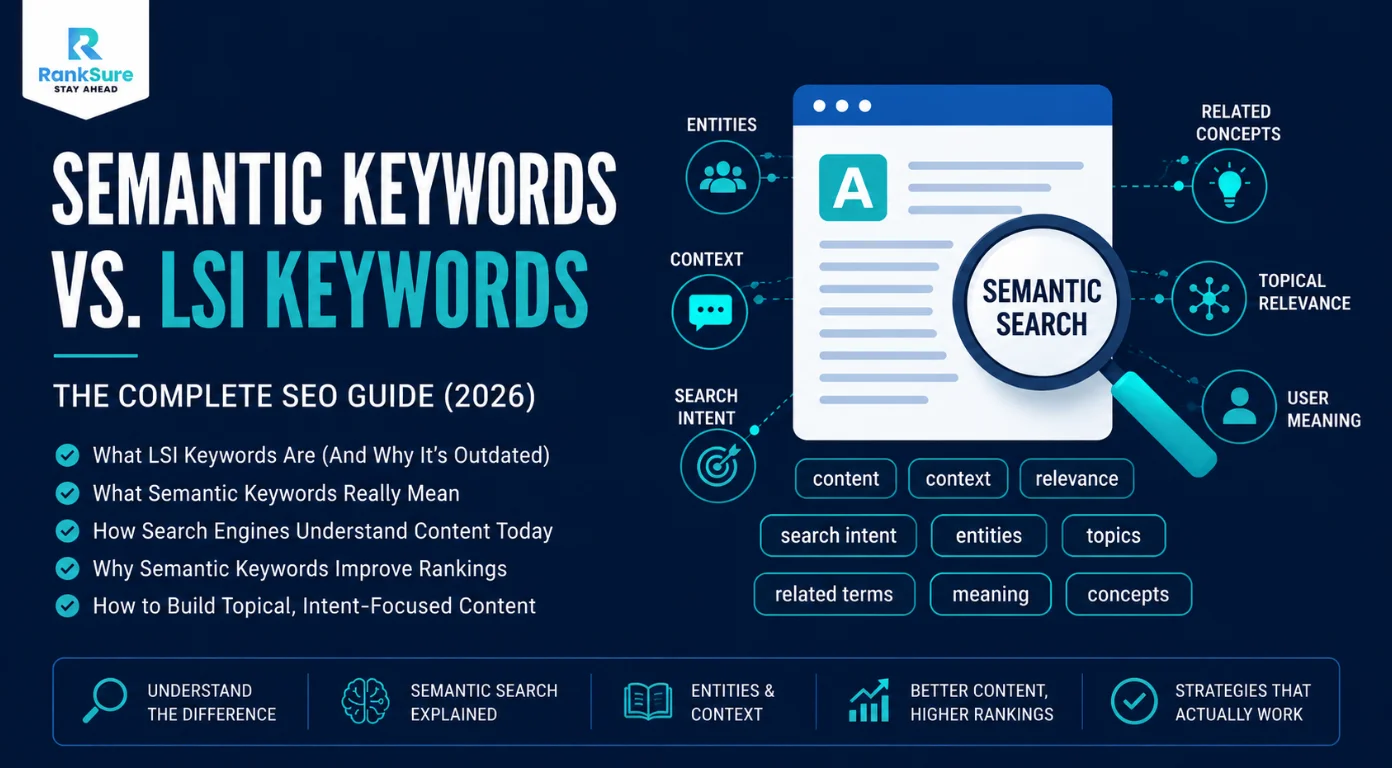
Search engines now evaluate meaning, context, and search intent, not just exact keyword matches. As a result, comprehensive, topic-focused content generally performs better than content built around repeating a single keyword.
Despite this, “LSI keywords” remain a common SEO myth. Google doesn’t use Latent Semantic Indexing (LSI) to rank pages. Instead, semantic keywords, related concepts, and entities help search engines understand content.
This guide explains the difference between LSI and semantic keywords and how to use semantic SEO to create more relevant, authoritative content.
Understanding LSI and Semantic Keywords
What Are LSI Keywords?
In SEO, LSI keywords are described as words or phrases related to a primary keyword. For example, for a digital camera, related terms might include lens, aperture, ISO, shutter speed, and mirrorless camera.
However, this definition is technically inaccurate. These are semantic keywords—related words, entities, and concepts that add context to a topic. Google does not use Latent Semantic Indexing (LSI) to understand content.
What Is Latent Semantic Indexing (LSI)?
Latent Semantic Indexing (LSI) is an information retrieval technique developed in the late 1980s. It analyzed relationships between words in small document collections using a mathematical process called Singular Value Decomposition (SVD).
While innovative at the time, LSI wasn’t designed for web-scale search. Modern search engines instead rely on machine learning, Natural Language Processing (NLP), vector embeddings, and entity understanding to interpret content.
What Are Semantic Keywords?
Semantic keywords are words, phrases, entities, and concepts that are contextually related to a topic. Rather than repeating the primary keyword, they expand the subject and improve topical relevance.
For example, an article about electric vehicles might naturally mention battery capacity, charging stations, range anxiety, regenerative braking, and EV incentives. These terms help create comprehensive content that better satisfies search intent.
LSI Keywords vs. Semantic Keywords
| Feature | LSI | Semantic Keywords |
| Purpose | Historical information retrieval method | Modern content optimization |
| Technology | Statistical analysis (SVD) | NLP, machine learning, and entity understanding |
| Used by Google? | No evidence | Yes, as part of semantic search |
| Focus | Word relationships | Meaning, context, and search intent |
Bottom line: When SEO tools recommend “LSI keywords,” they always mean semantic keywords or contextually related terms.
Why the Terms Are Often Confused
The term LSI keywords became popular because marketers needed a way to describe related vocabulary that helped pages rank. Although the name stuck, modern search engines rely on semantic search and not LSI to understand content.
Today, terms such as semantic keywords, contextual keywords, related entities, and supporting concepts more accurately describe modern SEO.
How Modern Search Engines Understand Content
Modern search engines evaluate meaning, context, and search intent—not just exact keyword matches. Instead of counting keywords, they analyze topics, entities, and the relationships between concepts to determine whether a page fully answers a user’s query.
Why Google Doesn’t Use LSI
Google has never said it uses Latent Semantic Indexing (LSI) to rank pages. While both LSI and semantic search identify relationships between words, modern search relies on machine learning, Natural Language Processing (NLP), entity recognition, vector embeddings, and the Knowledge Graph to understand content at scale.
How Semantic Search Works
Semantic search focuses on meaning rather than exact wording. For example, a page targeting “best laptop for video editing” would naturally cover topics such as GPU performance, RAM, SSD storage, display quality, and rendering speed. Covering these related concepts demonstrates topical relevance without repeating the same keyword.
Modern search also uses vector embeddings, which represent words and documents by their meaning rather than their exact text. This allows search engines to recognize conceptually similar content even when different wording is used.
Entities, Context, and Search Intent
Entities are uniquely identifiable people, places, organizations, products, or concepts that help search engines understand a page’s topic. For example, an SEO article might naturally reference Google Search Console, BERT, RankBrain, or the Google Knowledge Graph.
Search Intent in Action
| Search Query | Intent | What the User Expects |
| Buy running shoes | Transactional | Product pages, prices, and purchase options |
| How to choose running shoes | Informational | Buying guides, comparisons, and expert advice |
Why Semantic Keywords Matter
Semantic keywords aren’t a direct ranking factor, but they help create comprehensive, context-rich content by:
- Improving topical relevance
- Covering related concepts and entities
- Better matching search intent
- Increasing the likelihood of answering related queries
- Creating a better user experience
Types of Semantic Keywords
Semantic keywords come in different forms, each helping search engines understand a topic more completely.
| Type | Purpose | Examples |
| Synonyms | Alternative words with similar meanings. Use them naturally to improve readability. | Car → Automobile, Doctor → Physician, Buy → Purchase |
| Related Terms | Concepts commonly associated with the main topic that expand topical coverage. | Editorial calendar, audience research, content distribution, lead generation |
| Entities | Recognizable people, brands, products, technologies, or places that provide context. | BERT, MUM, Google Knowledge Graph, Search Console, Google Keyword Planner |
| Attribute Keywords | Words describing features or characteristics users care about. | Affordable, lightweight, waterproof, beginner-friendly, enterprise-grade |
| Question-Based Keywords | Questions that reflect informational search intent. | What are semantic keywords?, Does Google use LSI?, How do semantic keywords improve SEO? |
| Search Intent Modifiers | Terms that indicate what the user wants to accomplish. | Best, guide, tutorial, comparison, checklist, free, pricing, near me |
Tip: Don’t try to include every type in every article. Use the keywords and entities that support the topic and help answer the user’s search intent.
How to Find Semantic Keywords
Finding semantic keywords isn’t about collecting related phrases. It’s about identifying the concepts, entities, and questions that define a topic.
Start with Search Intent
Before collecting keywords, identify what users are actually trying to accomplish.
Ask questions such as:
- Are they looking for information?
- Are they comparing products?
- Do they want to make a purchase?
- Are they trying to solve a specific problem?
Search intent determines which supporting topics deserve the most attention.
For example, someone searching for semantic keywords typically wants to understand semantic search, why LSI is outdated, how to find related terms, and how to use them in modern SEO.
Google Autocomplete
Google Autocomplete is one of the simplest ways to discover how people naturally search for a topic. As you begin typing a query into Google’s search bar, suggested completions reveal common searches, related concepts, modifiers, and user intent.
For example, typing semantic keywords may surface searches such as:
- semantic keywords examples
- semantic keywords SEO
- semantic keywords vs LSI keywords
- how to find semantic keywords
- semantic keyword tools
Rather than targeting every suggestion individually, look for recurring themes such as examples, tools, comparisons, or implementation. These often indicate topics worth covering.
People Also Ask
The People Also Ask (PAA) section reveals questions closely related to the original search. These questions often represent the follow-up information users expect after reading the primary topic.
For a guide about semantic keywords, common questions might include:
- Does Google use LSI keywords?
- Are semantic keywords a ranking factor?
- How many semantic keywords should I use?
- Can semantic keywords replace primary keywords?
PAA questions highlight the follow-up information users expect. Answer them naturally within relevant sections or a concise FAQ.
Related Searches
The Related Searches section at the bottom of Google’s search results provides another source of topical ideas.
Unlike Autocomplete, which predicts searches before a query is submitted, Related Searches reflects queries commonly associated with the completed search.
Related Searches often reveal broader topics, alternative terminology, comparison queries, and adjacent user interests.
For example, researching semantic SEO may also surface topics such as entity SEO, topical authority, NLP, keyword clustering, or search intent optimization. These connections help expand topical coverage without drifting away from the article’s primary focus.
Analyze Top-Ranking Pages
Analyze top-ranking pages to identify recurring concepts, important entities, missing explanations, and outdated information.
If competing articles simply state that LSI keywords are outdated, explain why by introducing semantic search, entities, and vector embeddings in practical terms. Adding this depth creates information gain and helps your content stand out.
Keyword Research Tools
Keyword research tools help identify related topics, keyword clusters, question-based queries, content gaps, competing pages, and search intent.
Alongside keyword research, identify the entities most closely associated with your topic. These may include companies, technologies, products, people, or concepts that naturally belong in the discussion. Relevant entities strengthen contextual relevance while making your content more comprehensive for readers.
Group Keywords into Topical Clusters
After gathering related terms, organize them into logical groups instead of treating each keyword independently.
| Primary Topic | Supporting Concepts |
| Semantic Keywords | Search intent, contextual relevance, NLP, entities, topical authority |
| Entity SEO | Knowledge Graph, entity recognition, relationships, structured data |
| Content Optimization | Keyword clustering, topical coverage, content depth, internal linking |
Organizing related keywords into topical clusters helps structure comprehensive content around broader concepts instead of individual phrases. This reduces repetition, improves topical coverage, and results in more natural writing.
A Simple Semantic SEO Workflow
A practical semantic SEO workflow looks like this:
- Identify the primary keyword and search intent.
- Research related concepts, questions, and entities.
- Group related terms into topical clusters.
- Create an outline that covers every major subtopic.
- Write naturally, using semantic keywords where they improve clarity and context.
- Review the content to ensure it answers the user’s questions completely rather than focusing on keyword frequency.
Following this process helps produce content that is comprehensive, readable, and aligned with how modern search engines interpret topics.
Using Semantic Keywords Effectively
Write for topics, not keyword density
Keyword density was once considered an important ranking factor.
Modern search engines evaluate whether a page thoroughly addresses a topic rather than counting how often a phrase appears. Repeating the same keyword unnaturally rarely improves rankings and often makes content more difficult to read.
Instead of asking:
“Have I used my keyword enough?”
Ask:
“Have I answered everything a reader needs to know?”
A comprehensive page naturally introduces related terminology because those concepts are essential to understanding the topic.
For example, a guide on email marketing will inevitably discuss audience segmentation, automation, deliverability, click-through rates, subject lines, personalization, and analytics.
Place Keywords Naturally
Primary and semantic keywords should appear where they make sense for readers.
Natural locations include:
- the title
- introductory paragraphs
- headings where relevant
- image alt text when appropriate
- descriptive anchor text
- body copy
- conclusion
The emphasis should always be on clarity rather than frequency.
For instance, if a paragraph is explaining entity SEO, mentioning “semantic keywords” repeatedly adds little value. Readers already understand the topic from the surrounding context.
Cover Supporting Subtopics with Entities and Context
Topical authority comes from covering the broader concepts surrounding a topic—not simply repeating the primary keyword. Search engines evaluate whether your content answers the related questions users are likely to have and demonstrates a comprehensive understanding of the subject.
For example, if you’re writing about technical SEO, readers may also expect information about crawlability, indexing, XML sitemaps, robots.txt, Core Web Vitals, canonical tags, and structured data. Leaving out these supporting concepts can make an article feel incomplete, even if it targets the main keyword effectively.
A practical way to identify supporting subtopics is to consider the questions users ask before, during, and after learning about a topic. For semantic keywords, those questions might include:
- How does semantic search work?
- What are entities?
- Does Google use LSI?
- How can I optimize existing content?
- Which SEO tools are most useful?
Answering these naturally improves topical depth while creating a better experience for readers.
As you cover related subtopics, incorporate relevant entities and contextual language where they add value. For example, an article about modern search may naturally reference Google’s Knowledge Graph, BERT, MUM, RankBrain, Natural Language Processing (NLP), and vector embeddings. These interconnected concepts help search engines better understand the context of your content.
Likewise, vary your language instead of repeatedly using the same keyword. Rather than writing “semantic keywords improve SEO” multiple times, naturally discuss related concepts such as contextual relevance, topical completeness, entity recognition, concept relationships, and natural language optimization. This creates richer, more authoritative content while improving readability.
Match search intent
Even the most comprehensive article will struggle to perform well if it doesn’t align with user intent. Before creating content, identify what searchers actually want.
A search for:
“What are semantic keywords?”
primarily requires education and explanation.
A search for:
“Best semantic keyword tools”
suggests readers are comparing software.
A search for:
“How to optimize existing content using semantic SEO”
requires practical implementation advice.
Matching intent influences:
- article structure
- level of technical detail
- examples
- recommended tools
- depth of explanation
When intent and content align, readers are more likely to remain engaged because the page answers the questions they came to solve.
Build topical authority
Topical authority comes from consistently publishing comprehensive, interconnected content that demonstrates expertise across a subject, not from repeating the same keyword across multiple pages.
For example, a website focused on SEO might create interconnected resources covering:
- keyword research
- search intent
- semantic SEO
- technical SEO
- internal linking
- content optimization
- on-page SEO
- entity SEO
Each article supports the others through logical internal links and complementary coverage.
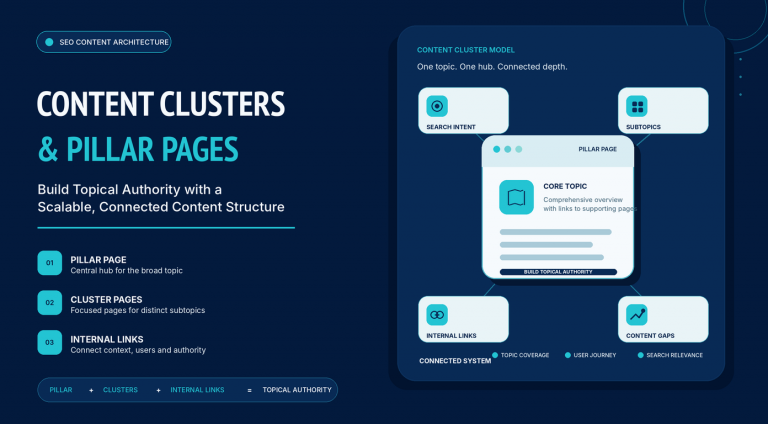
This hub-and-spoke structure helps users navigate related topics while reinforcing the site’s expertise.
Within individual articles, topical authority comes from depth rather than length. A concise section that clearly explains why vector embeddings help search engines understand conceptual similarity provides more value than several paragraphs repeating the same introductory advice.
LSI vs. Semantic Keywords in Practice
The difference between LSI and semantic keywords becomes much clearer in practice. While both aim to improve how search systems understand content, they rely on very different technologies.
Side-by-Side Comparison
| Aspect | LSI | Semantic Keywords |
| Origin | Information retrieval research from the late 1980s | Modern semantic SEO practices |
| Primary Goal | Discover statistical relationships between words | Improve contextual understanding of topics |
| Technology | Singular Value Decomposition (SVD) | NLP, machine learning, vector embeddings, and entity recognition |
| Scale | Small document collections | Billions of constantly changing web pages |
| SEO Relevance Today | Historical concept | Core part of modern content optimization |
| Best Use | Understanding search history | Creating comprehensive, topic-focused content |
Although the technology has evolved dramatically, the goal remains the same: helping search engines understand meaning rather than isolated keywords.
Real Content Example
Imagine you’re writing an article targeting the primary keyword home coffee brewing.
A traditional keyword-focused approach might repeatedly use variations such as:
- home coffee brewing
- coffee brewing at home
- brew coffee at home
- best home coffee brewing
These variations add little informational value.
A semantically optimized article would naturally include related concepts such as:
- burr grinders
- extraction
- water temperature
- pour-over coffee
- French press
- AeroPress
- grind size
- bloom
- brewing ratio
- coffee beans
- filtration
These terms appear because they are essential to the topic—not because they increase keyword density. As a result, the content becomes more useful for readers while providing stronger contextual signals to search engines.
Why “LSI Keywords” Usually Means Semantic Keywords
Most SEO tools that advertise LSI keyword generators do not perform Latent Semantic Indexing. Instead, they generate related terms using techniques such as:
- search query analysis
- keyword co-occurrence
- Google Autocomplete and search suggestions
- entity databases
- machine learning models
In practice, these tools generate semantic keywords. The term LSI keywords has persisted because it became common SEO terminology, even though the underlying technology is entirely different.
Common Misconceptions
Misconception: Google ranks pages using LSI keywords.
Reality: There is no evidence that Google’s ranking systems use Latent Semantic Indexing. Modern search relies on far more advanced language understanding techniques.
Misconception: More semantic keywords automatically improve rankings.
Reality: Semantic keywords help create comprehensive, context-rich content. They are not a direct ranking factor.
Misconception: Every synonym should be included.
Reality: Use related terms only when they improve clarity or explain an important concept. Forcing synonyms into content can make it sound unnatural.
Misconception: Keyword density no longer matters because keywords are irrelevant.
Reality: Primary keywords still help establish a page’s focus. The difference is that they should be used naturally within content that thoroughly covers the topic.
Semantic Keyword Usage Example
Applying semantic keywords is about covering a topic comprehensively and not repeating related phrases.
Example Topic
Suppose your primary keyword is content marketing strategy.
Rather than repeating the exact keyword throughout the page, a comprehensive article would naturally cover related concepts such as:
- content planning
- buyer personas
- keyword research
- search intent
- editorial calendars
- content distribution
- performance measurement
- lead generation
It would also reference relevant entities where appropriate, including:
- Google Analytics
- Google Search Console
- HubSpot
- WordPress
A well-structured article might explain what a content marketing strategy is, discuss audience research, cover keyword research and editorial planning, outline distribution channels, and show how to measure and improve performance.
Because these concepts are essential to the topic, semantic keywords appear naturally throughout the content. This results in a more comprehensive article that is easier for readers to understand and provides stronger contextual signals to search engines.
Common Mistakes to Avoid
| Mistake | What to Do Instead |
| Believing Google uses LSI keywords | Google doesn’t use LSI. Focus on semantic relevance, entities, and topical coverage instead. |
| Chasing keyword density | Don’t aim for a percentage. Write naturally, satisfy search intent, and cover the topic comprehensively. |
| Stuffing synonyms | Don’t force keyword variations. Use related terms only when they add meaningful context. |
| Ignoring entities | Reference relevant entities (such as Google’s Knowledge Graph, BERT, or RankBrain) where they naturally support the topic. |
| Focusing on keywords instead of topics | Build comprehensive content that answers users’ questions instead of trying to include more keywords. |
Tools for Semantic Keyword Research
No single tool finds every semantic keyword. The best approach combines Google’s search features with SEO and content optimization platforms.
| Tool Category | Best For | Examples |
| Google Search features | Discovering real user language, questions, and related topics | Google Autocomplete, People Also Ask, Related Searches, Google Keyword Planner |
| Keyword research platforms | Finding keyword variations, topic clusters, competitor gaps, and search intent | Ahrefs, Semrush, LSI Graph |
| Content optimization tools | Identifying missing topics, entities, and improving topical coverage | Surfer, Clearscope |
| Entity analysis tools | Discovering important entities and concept relationships | Google’s Natural Language API, Google Knowledge Graph |
Use these tools to understand the topic, not to collect as many keywords as possible. The goal is comprehensive, helpful content that satisfies search intent.
Key Takeaways
The term LSI keywords remains common in SEO, but it doesn’t reflect how modern search engines understand content. Instead of relying on Latent Semantic Indexing, today’s search systems use technologies such as Natural Language Processing (NLP), machine learning, vector embeddings, and entity recognition to interpret meaning and context.
For content creators, the takeaway is straightforward: focus on topics rather than keyword variations. Understand search intent, cover related concepts, include relevant entities where appropriate, and write naturally for your audience.
When your content thoroughly answers a user’s question and demonstrates topical expertise, semantic keywords become a natural part of the writing process—not a formula to follow.
Frequently Asked Questions
What are semantic keywords?
Semantic keywords are words, phrases, and entities that are closely related to your primary topic. They help search engines understand context and improve topical coverage, making content more useful for readers.
Does Google use LSI keywords?
No. There is no evidence that Google uses Latent Semantic Indexing (LSI) in its ranking systems. Modern search relies on technologies such as Natural Language Processing (NLP), machine learning, vector embeddings, and entity recognition to understand content.
How do I find semantic keywords?
Start by analyzing search intent, Google Autocomplete, People Also Ask, Related Searches, and top-ranking pages. Keyword research tools can also help uncover related concepts, entities, and topical clusters.
Are semantic keywords a ranking factor?
Not directly. Semantic keywords improve contextual relevance and topical completeness, helping create content that better satisfies search intent. Their value comes from improving overall content quality rather than acting as an individual ranking signal.
How many semantic keywords should I use?
There is no ideal number. Focus on covering the topic naturally and thoroughly. If your content answers the user’s questions and includes relevant concepts, you’ll typically use semantic keywords without forcing them.
Can semantic keywords replace primary keywords?
No. Primary keywords establish the page’s main topic, while semantic keywords provide context and depth. The best SEO content uses both naturally.
Are entities the same as semantic keywords?
No. Entities are specific people, organizations, products, places, or concepts, while semantic keywords include a broader range of related words and phrases. Entities are one important component of semantic SEO, but they are not the same thing.