
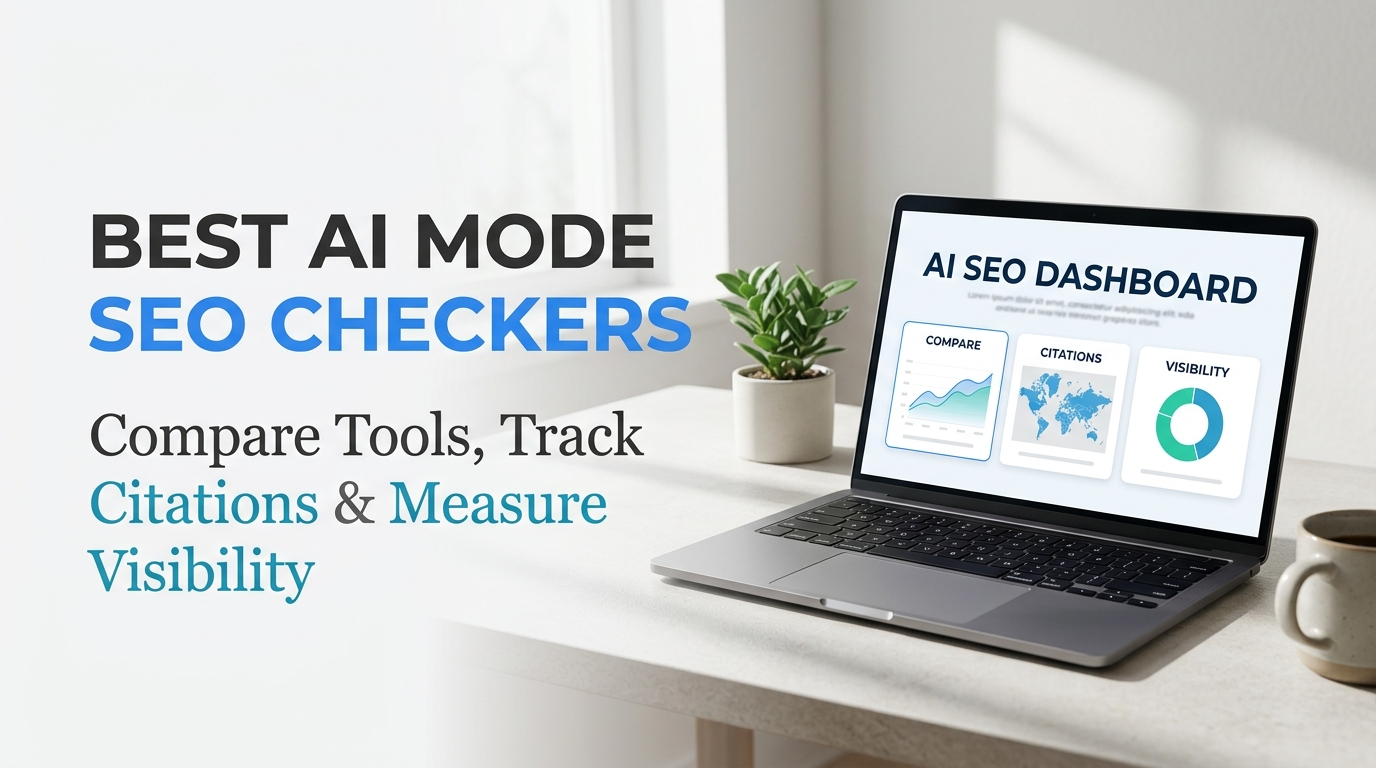
An AI Mode SEO checker measures whether your brand, website, and pages appear inside Google AI Mode responses. It tracks brand mentions, cited URLs, competitor visibility, prompt performance, and changes over time.
This differs from conventional rank tracking. A page can rank strongly in Google Search without receiving an AI Mode citation because Google retrieves different sources to support parts of a generated response.
SEO managers, agencies, GEO specialists, and business owners use these tools to answer three questions:
- Does the brand appear for important prompts?
- Which pages receive citations?
- Where do competitors gain visibility that the brand does not?
Leading options include Ahrefs Brand Radar, Semrush AI Visibility Toolkit, SE Visible, OtterlyAI, Peec AI, Profound, and Rankscale.
What Is an AI Mode SEO Checker?
An AI Mode SEO checker monitors generated Google AI Mode responses and records brand mentions, citations, cited pages, competitors, and visibility across selected prompts.
It differs from other SEO tools because it measures presence inside generated search responses rather than conventional rankings, technical issues, or content origin.
| Tool type | What it measures |
| Traditional rank tracker | Keyword positions in standard search results |
| Technical SEO tool | Crawlability, indexing, internal links, and site issues |
| AI content detector | Whether text may have been generated by artificial intelligence |
| AI Mode SEO checker | Brand mentions, citations, cited URLs, competitor presence, and prompt visibility inside Google AI Mode |
This makes AI Mode SEO checkers useful for measuring visibility that traditional SEO tools do not capture.
AI Mode SEO Checkers Versus Traditional Rank Trackers
Traditional rank trackers and AI Mode SEO checkers measure different types of search visibility.
| Measurement | Traditional rank tracker | AI Mode SEO checker |
| Main question | Where does this page rank? | Does this brand or page appear in the generated response? |
| Primary metric | Keyword position | Brand mentions and citations |
| Result type | Standard search results | Google AI Mode responses |
| Page visibility | Numerical ranking position | Presence or absence in the response |
| Citation tracking | Usually not the primary focus | Tracks cited pages and source URLs |
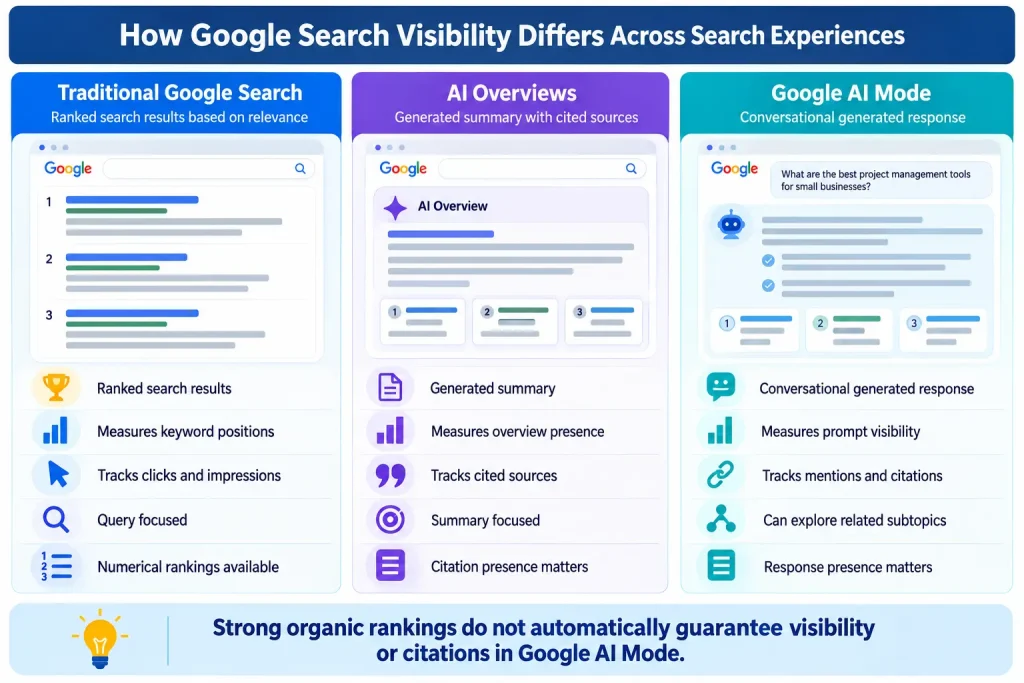
Organic rankings support page discovery, but a strong search position does not guarantee that Google AI Mode will mention the brand or cite the page.
How Google AI Mode Changes SEO Measurement
Google AI Mode generates conversational answers using information retrieved from multiple web sources.
Google documentation explains that AI Mode can use query fan-out, where one question leads to related searches across relevant subtopics. A query such as “best CRM for property managers” may involve pricing, integrations, automation, lead management, user limits, and support.
Different sources satisfy different parts of that information need. AI Mode measurement therefore focuses on response presence, citations, cited pages, and competitor visibility rather than keyword positions alone.
Google AI Mode Versus AI Overviews Versus Traditional Search
AI Overviews and AI Mode should be tracked separately. Visibility in one does not confirm visibility in the other.
Best AI Mode SEO Checkers Compared
AI Mode SEO tools differ mainly in prompt coverage, citation analysis, competitor tracking, reporting depth, and workflow integration.
| Tool | AI Mode support | Best for | Main strength | Main consideration |
| Ahrefs Brand Radar | Yes | Broad AI visibility research | Large datasets and custom prompts | Full research access can be costly |
| Semrush AI Visibility Toolkit | Yes | Integrated SEO workflows | AI and conventional SEO in one ecosystem | Strongest fit for existing Semrush users |
| SE Visible | Yes | Competitor benchmarking | Share of voice and citation comparison | Results depend heavily on prompt quality |
| OtterlyAI | Yes | Simple prompt monitoring | Focused visibility tracking | AI Mode access can increase plan cost |
| Peec AI | Yes | Brand and source intelligence | Citations, sentiment, sources, and competitors | Smaller teams may not need its full feature set |
| Profound | Yes | Enterprise programs | Deep analytics and workflows | Built primarily for larger organizations |
| Rankscale | Yes | Flexible multi-platform tracking | Usage-based monitoring | Credit usage requires planning |
Ahrefs Brand Radar is strongest for broad AI visibility research combined with custom prompts. Semrush is a practical choice for teams already using its SEO ecosystem. SE Visible is well suited to competitor benchmarking, while OtterlyAI focuses on simpler prompt monitoring. Peec AI provides deeper source, citation, sentiment, and competitor analysis. Profound is better suited to enterprise-scale programs, while Rankscale offers more flexible usage across multiple AI platforms.
Pricing and plan limits change frequently, so verify current vendor details before purchase.
How to Choose the Right AI Mode SEO Checker
Choose a platform based on the decisions its data needs to support. Check these capabilities:
- Direct Google AI Mode support
- Brand mention detection
- Citation and URL tracking
- Custom prompts
- Competitor monitoring
- Location and language controls
- Historical reporting
- Raw response access
- Clear usage limits
A small business may only need 30 commercially important prompts. An agency may need hundreds of prompts across clients and markets. An enterprise may need APIs, governance, regional reporting, integrations, and large datasets.
More prompts do not automatically produce better insight. Relevance matters more than volume.
How to Check Your Website Visibility in Google AI Mode
Use a consistent three step process.
Step 1: Select Relevant Prompts
Choose prompts connected to real customer decisions.
A CRM company might track:
- Best CRM for small agencies
- CRM with automated follow up
- Best CRM for property managers
- Salesforce alternatives for small businesses
- Brand pricing
- Brand versus competitor
Cover discovery, comparison, evaluation, and branded searches rather than random informational queries.
Step 2: Track Mentions, Citations, and Competitors
Record whether your brand appears, whether your site is cited, which URL receives the citation, and which competitors appear for the same prompt.
| State | Meaning | What to investigate |
| No mention and no citation | Brand and site are absent | Relevance, authority, eligibility |
| Mention but no citation | Brand is recognized but another source supports the answer | Citation authority and source gaps |
| Mention and citation | Brand and site both appear | Preserve successful coverage |
| Citation with weak brand prominence | Site supports the answer but the brand is not central | Entity clarity and positioning |
This separates brand recognition from source visibility.
Step 3: Keep Conditions Consistent and Establish a Baseline
For every tracked prompt, record:
- Brand mention
- Brand citation
- Cited URL
- Competitor mentions
- Competitor citations
- Collection date
- Location
- Language
- Prompt wording
Repeat the same prompt set under the same conditions to measure meaningful change over time.
Which AI Mode Metrics Matter Most?
Focus on four core metrics that show brand visibility, source visibility, and competitor exposure.
| Metric | What it measures | Simple calculation or method | What it reveals |
| Brand mention rate | How often the brand appears in tracked responses | Brand mentions divided by total responses, multiplied by 100 | Overall brand presence |
| AI citation rate | How often the website receives a citation | Website citations divided by total responses, multiplied by 100 | Source visibility and citation strength |
| AI share of voice | Relative visibility against selected competitors | Brand appearances divided by total appearances across the tracked competitor set, multiplied by 100 | Competitive exposure |
| Cited pages and source domains | Which URLs and domains repeatedly support responses | Review citation frequency by page and domain | Strong pages, competitor sources, and citation gaps |
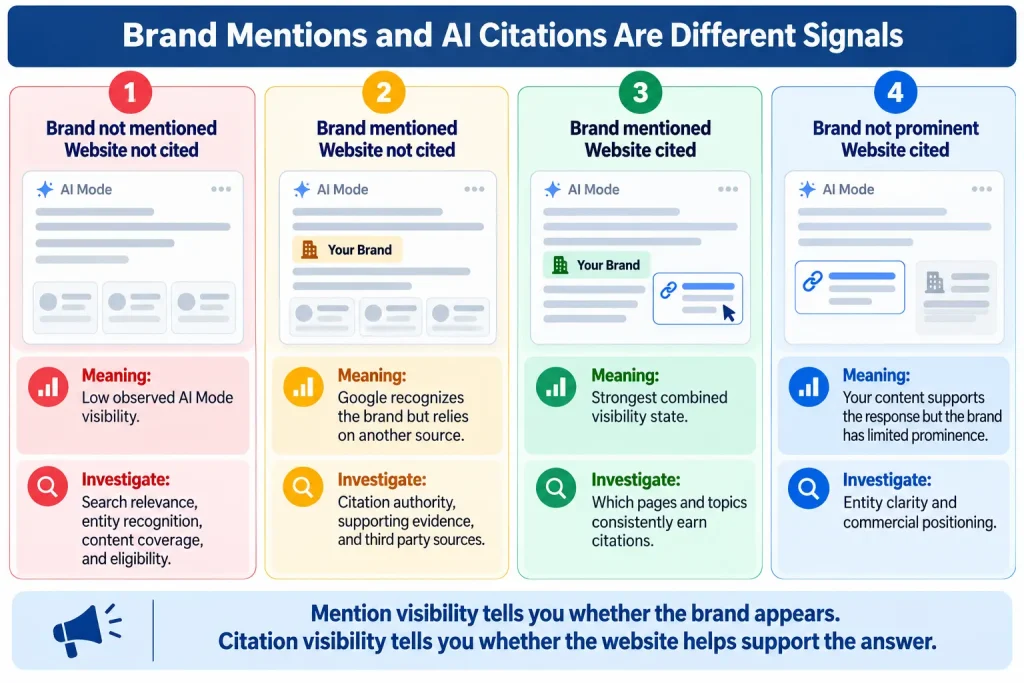
Example: 30 brand mentions across 100 responses equals a 30 percent mention rate. If the website receives 12 citations, the citation rate is 12 percent. A large gap between the two can indicate that the brand is recognized while other sources are being used to support the response.
For cited pages and source domains, review which of your pages appear most often, which competitor pages repeatedly receive citations, and which independent sources dominate important topics.
Commercial tools calculate share of voice differently, so compare scores within the same platform and methodology.
Google Search Console Versus AI Visibility Trackers
Google Search Console and third-party AI visibility tools measure different parts of AI search performance.
| Data source | What it measures | Best use |
| Google Search Console | First-party generative AI Search visibility such as impressions, pages, countries, devices, and dates | Measuring Google visibility |
| AI Mode trackers | Prompts, citations, competitor appearances, and response patterns | Explaining where and why visibility occurs |
| Analytics tools | Sessions, leads, conversions, and revenue | Measuring business outcomes |
Google Search Central states that dedicated generative AI performance reporting became available worldwide by August 31, 2026. Use the three data sources together:
Visibility → explanation → business outcome
How Accurate Are AI Mode SEO Checkers?
AI Mode SEO checkers observe response samples rather than official Google rankings. Results can vary with prompt wording, location, language, collection time, source availability, Google system changes, and brand attribution.
Avoid making strategic decisions from a single observation. Use repeated checks and confidence levels instead.
| Confidence | Evidence |
| Low | One isolated observation |
| Moderate | The same pattern appears across several checks |
| High | The pattern persists over time, and important citations are manually verified |
Treat high confidence patterns as stronger evidence for reporting and SEO prioritization.
Practical AI Mode Visibility Audit
An AI visibility audit identifies commercially relevant prompts where competitors gain mentions or citations and your brand does not.
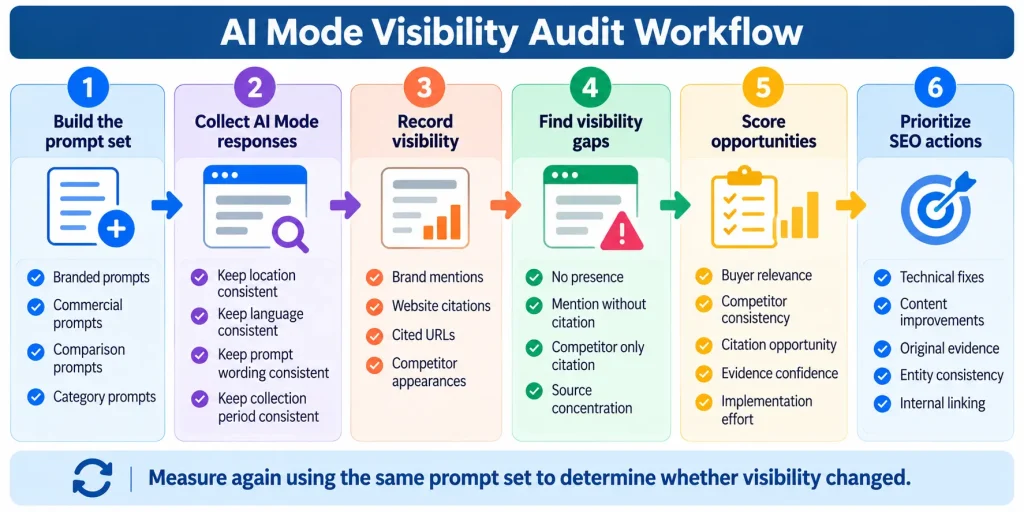
A six-step workflow for auditing Google AI Mode visibility, identifying citation gaps, and prioritizing SEO improvements.
Build a Competitor Citation Matrix
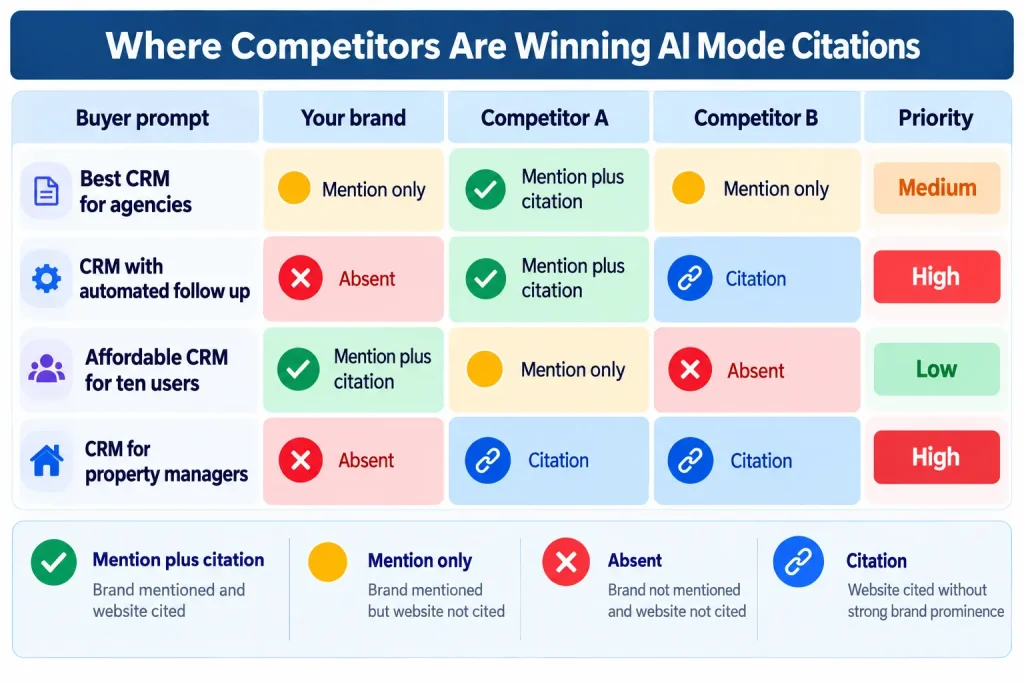
Prioritize prompts where multiple competitors receive visibility while your brand remains absent or uncited.
Prioritize Visibility Gaps
Score each opportunity from 1 to 5 for:
- Buyer relevance
- Competitor consistency
- Citation opportunity
- Evidence confidence
- Implementation effort
Priority score = buyer relevance + competitor consistency + citation opportunity + evidence confidence minus implementation effort
Use this score as an internal prioritization method, not as a Google metric. Higher scores indicate gaps that are more relevant, better supported by evidence, and more practical to address.
How to Improve Visibility in Google AI Mode
No technique guarantees an AI Mode citation. Focus on technical eligibility, useful content, original evidence, brand consistency, and clear site structure.
Fix Technical Eligibility
Make sure important pages can be crawled, indexed, rendered, and discovered. Review Googlebot access, indexing status, canonical signals, internal discovery, and relevant Search Console controls.
Google also provides controls related to participation in generative AI Search features.
Improve Search Intent Coverage
Answer the questions users need to evaluate a topic, product, or service.
A page about accounting software may need information about pricing, integrations, migration, compliance, reporting, and user roles. Add these topics because they improve relevance and usefulness, not simply to increase page length.
Create Original Evidence
Original information gives search systems more distinctive material to retrieve.
Useful examples include original research, product testing, unique datasets, case studies, expert analysis, primary source evidence, transparent comparisons, and clear methodology.
Strengthen Brand Consistency
Keep important brand facts consistent across your website and credible external profiles.
Review organization names, product names, categories, locations, leadership, and important commercial information.
Improve Internal Structure
Use contextual internal links, logical site architecture, and accurate structured data to clarify relationships between pages and entities.
These practices support discoverability and understanding, but they do not guarantee AI Mode citations.
Common AI Mode Tracking Mistakes
| Mistake | Correct approach |
| Treating visibility scores as Google rankings | Use them as observational and competitive metrics |
| Confusing brand mentions with website citations | Track and report both separately |
| Tracking irrelevant prompts | Focus on prompts tied to real customer and buyer intent |
| Ignoring response variability | Repeat checks under consistent conditions |
| Optimizing only for third-party scores | Connect AI visibility with traffic, leads, conversions, and revenue |
These mistakes can distort AI Mode reporting and lead to weak SEO priorities. Use consistent prompts, separate visibility signals, and connect tracking data with measurable business outcomes.
Frequently Asked Questions
What Is the Best AI Mode SEO Checker?
Ahrefs Brand Radar suits broad research, Semrush fits existing Semrush users, SE Visible focuses on competitive benchmarking, Peec AI supports deeper source analysis, and Profound is designed for enterprise programs.
The best choice depends on prompt volume, reporting needs, budget, and workflow.
Can You Check Your Ranking in Google AI Mode?
You can measure mentions, citations, and source visibility, but AI Mode does not work like a simple numerical ranking from position one to ten.
Why Does My Website Rank in Google but Not Appear in AI Mode?
Organic rankings and AI Mode citations are different outcomes. Another source may better support part of the generated response. Review content coverage, competitor citations, technical eligibility, and source authority.
How Often Should You Track AI Mode Visibility?
Monthly tracking suits many smaller businesses. Weekly monitoring is useful for active SEO programs and agencies. Consistency matters more than frequency.
Final Verdict
Choose an AI Mode SEO checker based on how you plan to use the data.
Small businesses should prioritize relevant prompts, citation tracking, competitor visibility, and affordable pricing. Agencies should prioritize multiple projects, historical reporting, exports, competitor analysis, and larger prompt capacity. Enterprise teams should prioritize scale, regional tracking, integrations, governance, and workflow controls.
The strongest measurement process combines representative prompts, consistent tracking conditions, separate mention and citation metrics, competitor analysis, and business performance data.
Start with a reliable visibility baseline. Use it to identify meaningful citation gaps, prioritize SEO opportunities, and measure whether future improvements increase Google AI Mode visibility.