
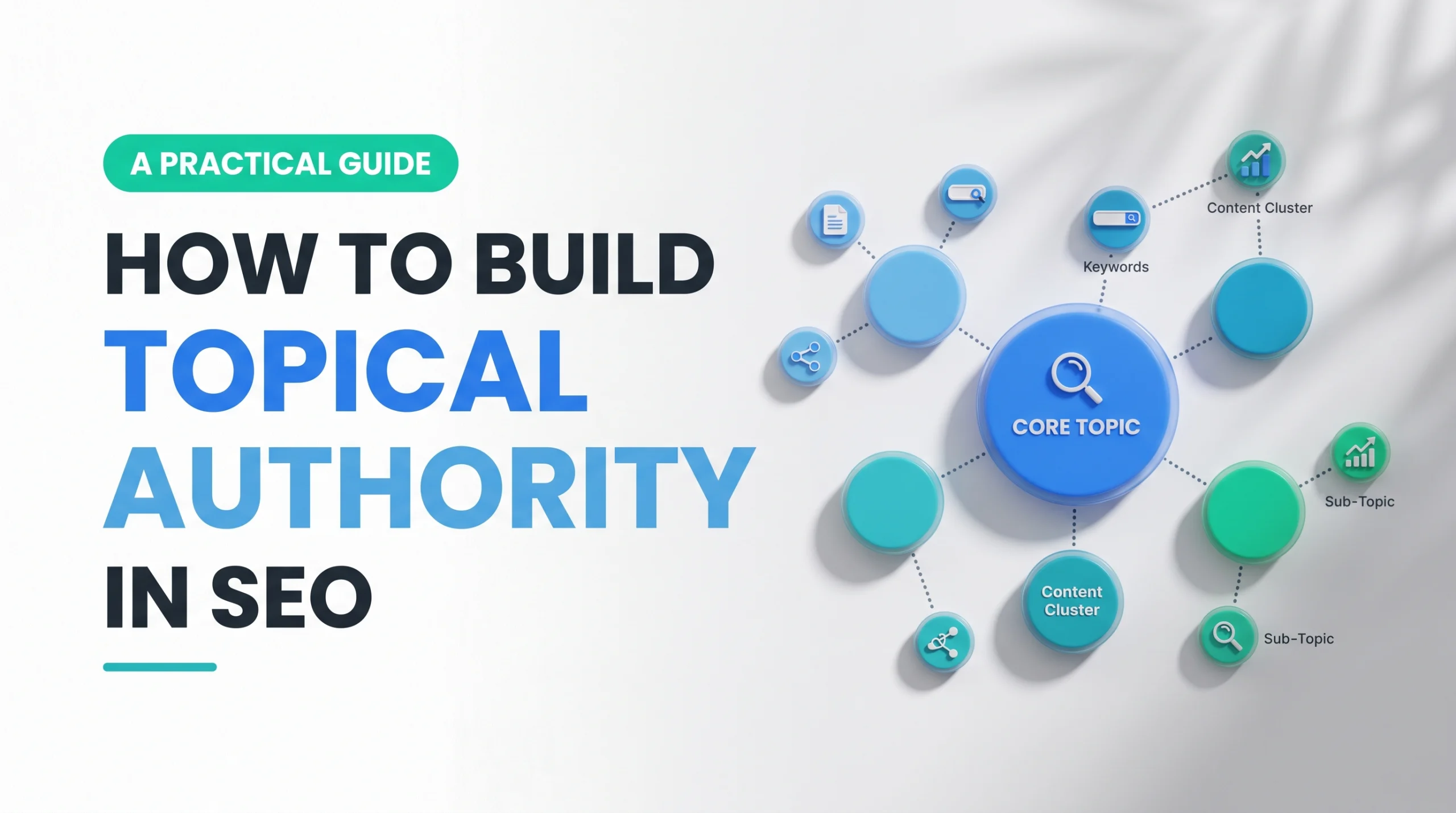
Topical authority is a website’s demonstrated relevance, depth, and credibility around a defined subject. A site builds it by covering the important entities, attributes, questions, problems, and search intents within that subject while connecting related pages through a clear information structure.
Building topical authority does not require publishing every keyword variation. It requires identifying what belongs within the topic, creating useful pages for distinct user needs, and organizing those pages so their relationships are easy to understand.
This guide explains how to build topical authority through six practical steps, from defining topical boundaries to creating content, connecting pages, and maintaining subject coverage.
What Is Topical Authority in SEO?
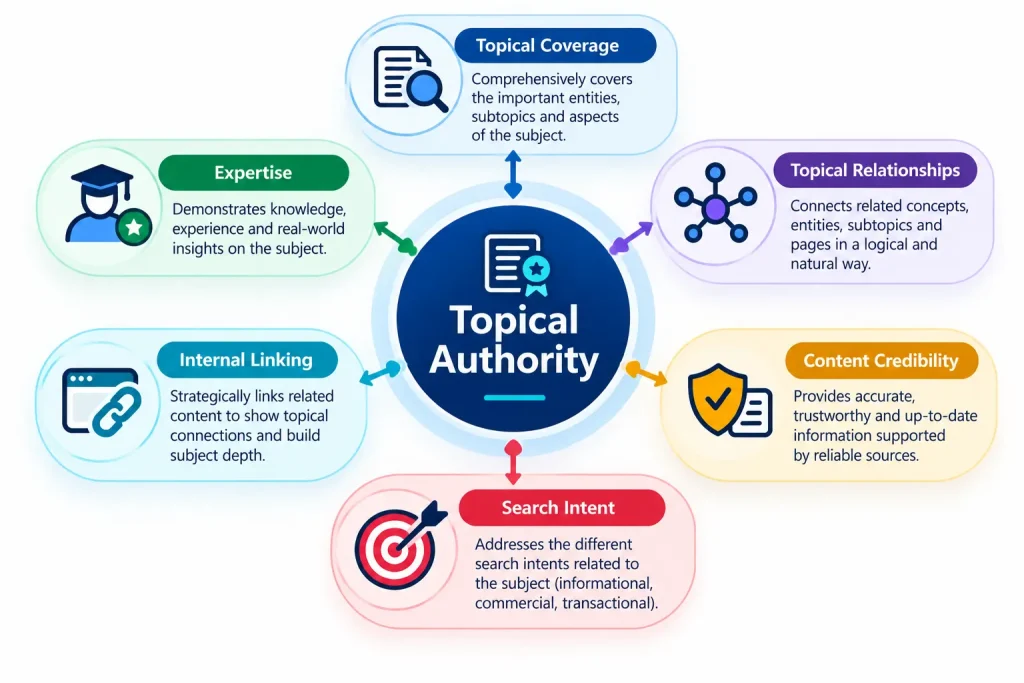
Topical authority in SEO is the extent to which a website demonstrates useful, credible, and connected knowledge about a specific subject. Three elements define it.
- Topical coverage shows whether the website addresses the important parts of the subject.
- Topical relationships show how related entities, attributes, questions, and pages connect.
- Content credibility shows whether the information is accurate, useful, and supported by relevant expertise or evidence.
Consider a Canadian website focused on Local Search Optimization.
Each page serves a specific search intent while supporting the same core topic. Together, they create a connected body of information around local SEO. Topical authority therefore comes from useful subject coverage and clear relationships between pages, not from page count alone.
Each page serves a specific search intent while supporting the same core topic. Together, they create a connected body of information around local SEO. Topical authority therefore comes from useful subject coverage and clear relationships between pages, not from page count alone.
How Topical Authority Works in Search Engines
Search engines evaluate pages based on relevance, usefulness, context, and many other signals. Google Search Central recommends creating helpful content for an intended audience, maintaining a clear site focus, and demonstrating substantial knowledge of a subject. Topical authority supports these goals by giving search engines consistent information about what a website covers.
A Canadian local SEO site might publish separate resources about Google Business Profile optimization, customer reviews, local citations, location pages, and local keyword research. These pages serve different user needs but remain connected to the same subject.
Search engines evaluate individual pages while also using content relationships, site structure, navigation, and links to understand how those pages connect. Publishing more pages does not increase topical authority. Each page needs to add useful information to the defined subject.
Topical Authority vs. Domain Authority
Topical authority and domain authority measure different aspects of website strength.
| Factor | Topical Authority | Domain Authority |
| Main focus | Relevance and depth within a specific subject | Overall website strength or estimated ranking potential |
| Scope | Topic specific | Domain wide |
| Built through | Useful subject coverage, related content, internal linking, expertise, and credibility | Commonly estimated through backlink data and proprietary metrics created by third-party SEO platforms |
| Best use | Evaluating how strongly a site covers a defined topic | Comparing the broader strength of websites |
Domain Authority is a third-party SEO metric and is not a Google ranking metric.
Topical authority should therefore be evaluated at the subject level rather than treated as a general website score.
Why Is Topical Authority Important for SEO?
Topical authority helps create a clear relationship between a website, its pages, and the subject users search for. A focused topical structure gives users useful information within the same subject and gives search engines clearer context about the purpose of related pages.
It also improves content planning. Instead of publishing isolated articles based on individual keywords, publishers can determine how each page contributes to a larger information system.
Google Search Central encourages publishers to maintain a primary site purpose and create substantial content that helps users achieve their goals. A focused topical strategy supports that principle.
Topical Relevance, Content Depth, and Search Visibility
Topical relevance, depth, and breadth work together to determine how completely and coherently a website covers a subject.
| Element | Meaning | Example |
| Topical relevance | How closely content relates to the central subject | Google Business Profile, reviews, citations, local keywords, and location pages |
| Topical depth | How thoroughly an important aspect is explained | A detailed Google Business Profile guide covering categories, business information, reviews, photos, and ongoing optimization |
| Topical breadth | How many necessary dimensions of the subject are covered | Business profiles, local keywords, citations, reviews, service areas, location pages, and local search measurement |
A strong topical authority strategy balances all three. Relevance keeps the site focused, depth helps pages solve real user problems, and breadth ensures that important parts of the subject are not missing.
How to Build Topical Authority Step by Step
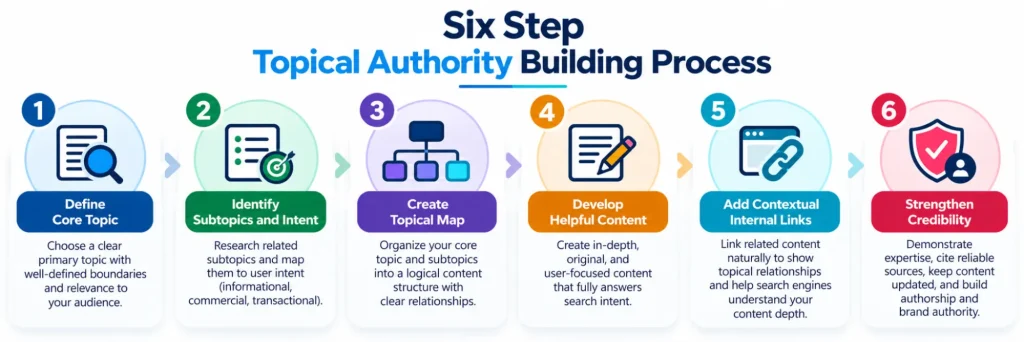
Building topical authority requires a structured process. Follow these six steps to move from defining your core topic to creating useful content, connecting related pages, and strengthening credibility.
Step 1: Define Your Core Topic and Topical Boundaries
Start by defining the subject your website or content section should become known for. The topic should be broad enough to support meaningful coverage but focused enough to maintain a clear identity.
For example:
- Digital marketing is broad.
- SEO is more focused.
- Local SEO in Canada is more specific because it focuses on businesses competing for visibility within Canadian cities, provinces, and service areas.
Once the core topic is defined, establish its boundaries. A subject belongs within the boundary when it helps explain an important entity, attribute, action, problem, comparison, or decision related to the core topic.
For a Canadian local SEO website, relevant areas might include:
- Google Business Profile optimization
- Local keyword research
- Customer reviews
- Local citations
- Location pages
- Service area pages
- Business information consistency
- Local competitor analysis
- Local search performance
- Local visibility problems
Broader subjects such as email automation or social media advertising would normally sit outside this boundary because they serve different search intents.
Use a simple relevance test before adding a topic. Ask whether the subject helps the intended reader understand, compare, solve, improve, or make a decision about the core topic.
A subject probably falls outside the immediate content scope when its relevance requires several explanations. Clear boundaries keep the site focused and reduce unnecessary publishing.
Step 2: Identify Relevant Subtopics and Search Intent
Break the core topic into the main questions, problems, and tasks users need to address. Search intent describes the purpose behind a query.
For local SEO in Canada, users might want to:
- Improve Google Business Profile visibility
- Find local keywords for a service business
- Earn and manage customer reviews
- Fix inconsistent business citations
- Create effective location pages
- Improve visibility in local search results
- Optimize service area pages
- Track local SEO performance
These searches belong to the same broad topic but represent different user needs.
Keyword clustering can help identify similar queries, but search intent should determine the final page structure.
Create a separate page when the topic addresses a distinct:
- Question
- Problem
- Comparison
- Process
- Decision
- User goal
This approach reduces overlapping intent and creates a clearer content architecture.
Step 3: Create a Topical Map and Organize Topic Clusters
A topical map organizes the important subjects within a topic and determines how those subjects should become pages. A useful topical map answers three questions:
- What needs to be covered?
- Which subjects deserve separate pages?
- How should those pages relate to one another?
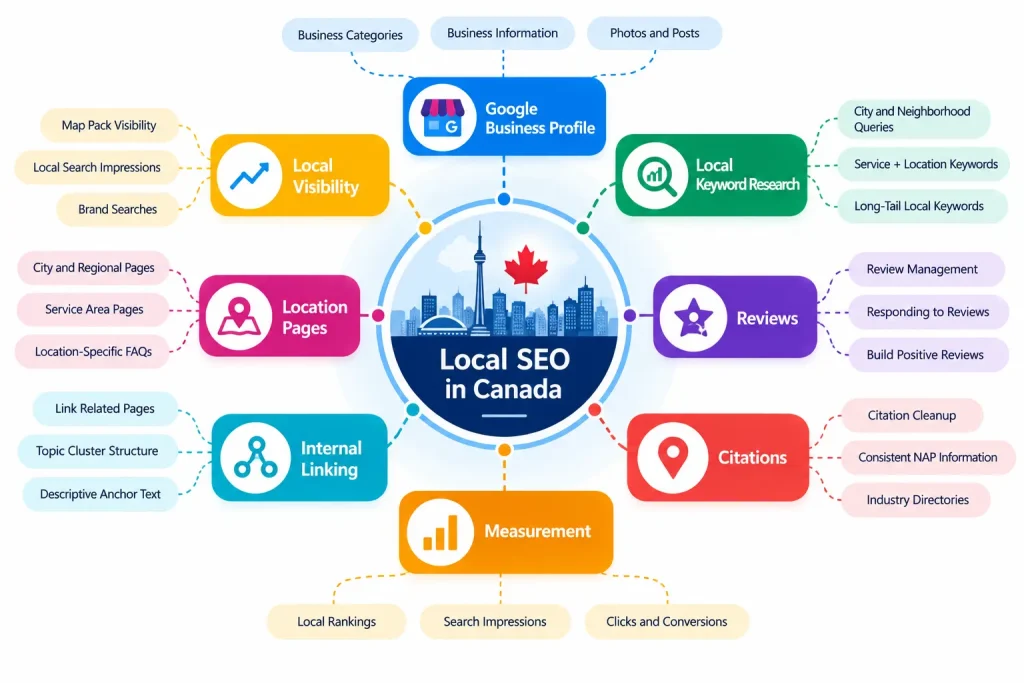
The purpose of a topical map is to create a logical information structure. Topic clusters provide the practical architecture within that structure. Each cluster should have a clear central subject, supporting pages, and natural relationships with other clusters.
For example, an article about improving local search visibility may connect with pages about Google Business Profile optimization, reviews, citations, location pages, and local keyword research.
Every planned page should have:
- A clear purpose
- A defined search intent
- A logical relationship with the core topic
- A useful place within the wider content structure
Step 4: Develop Helpful, Semantically Relevant Content
Each page should answer its primary question and cover the concepts needed to explain the subject properly. Semantic relevance comes from meaningful relationships between concepts. It does not come from inserting related terms simply because an SEO tool recommends them.
An article about Google Business Profile optimization naturally involves business categories, contact information, customer reviews, photos, service areas, local relevance, and ongoing profile management because these elements help define and represent the business.
A useful content structure follows:
- Fact: A Google Business Profile should accurately represent the business and its services.
- Meaning: Incomplete or inconsistent information can make the profile less useful to potential customers and create confusion across local search touchpoints.
- Use case: Review the business name, categories, address or service area, hours, services, photos, and customer-facing information for accuracy and consistency.
This structure keeps content practical and specific. Meaningful additional value comes from:
- Original observations
- Firsthand experience
- Clearer explanations
- Useful examples
- Unique comparisons
- Expert interpretation
- Original data
- Practical decision criteria
The goal is not to make every article longer than competing pages. Each page should contain enough useful information to satisfy its search intent.
Step 5: Connect Related Pages Through Contextual Internal Linking
Internal links connect related information and help users move through a topic. They also help search engines discover pages and understand relationships between them.
Context should determine where an internal link belongs. Suppose an article explains how to improve local search visibility.
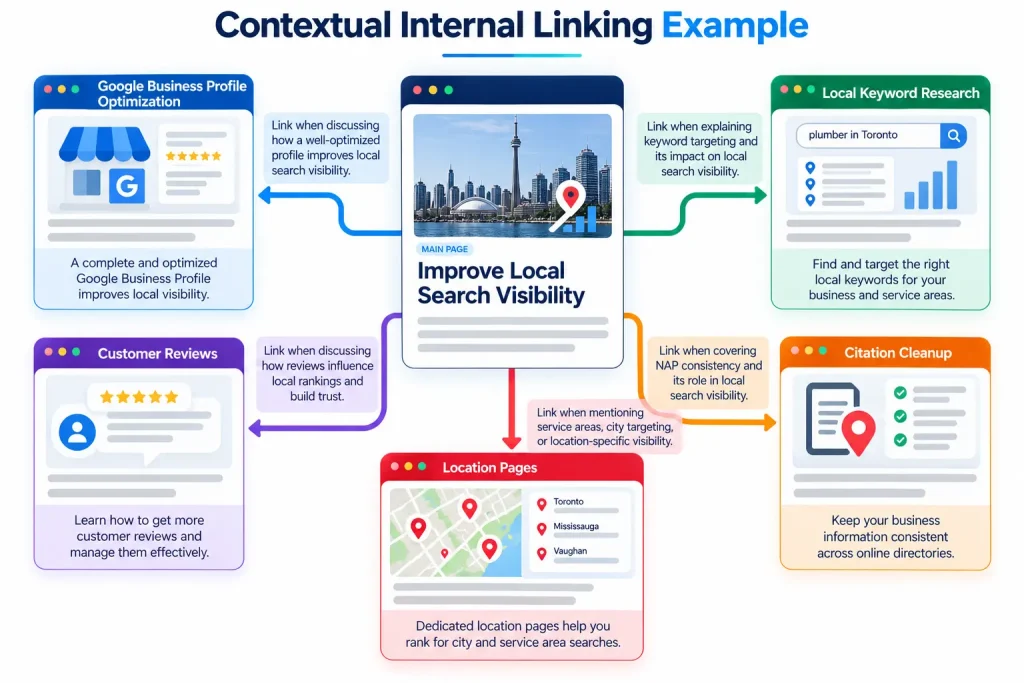
Each link should help the reader understand the current subject more deeply. The destination should provide information that supports the surrounding context.
Descriptive anchor text such as Google Business Profile optimization or creating effective location pages gives readers more context than generic wording such as read more. A strong internal linking structure connects:
- Broad guides with detailed supporting pages
- Supporting pages with relevant parent topics
- Closely related supporting pages with one another
The result is a connected topical structure rather than a collection of isolated pages.
Step 6: Strengthen Content Credibility and Topical Expertise
Topical authority becomes stronger when users can trust the information. Credibility is supported through:
- Accurate information
- Transparent sourcing
- Relevant expertise
- Firsthand experience
- Clear authorship where appropriate
- Original evidence or observations
- Regular correction of outdated information
Expertise should also appear in the quality and specificity of the explanation. The level of detail demonstrates stronger subject knowledge.
Google uses the concepts of experience, expertise, authoritativeness, and trustworthiness to describe qualities associated with helpful and reliable content. These qualities are commonly referred to as E E A T. Google treats E E A T as a content quality framework.
For topical authority building, the practical objective is simple: publish information that users can trust and that demonstrates genuine understanding of the subject.
How Semantic SEO Supports Topical Authority
Semantic SEO supports topical authority by helping content represent a subject through meaningful concepts and relationships. Topical authority determines which parts of a subject should be covered, while Semantic SEO helps explain those parts with stronger context.
The two concepts are related but not interchangeable.
For example, a topical authority strategy may determine that a Canadian SEO site should cover Google Business Profile optimization. Semantic relevance then helps that content address related concepts such as business categories, customer reviews, service areas, business information, local relevance, and profile management.
Entities, Attributes, and Semantic Relationships
Semantic relevance becomes clearer when content is organized around entities, attributes, and relationships.
| Element | Meaning | Example |
| Entity | A distinct thing or concept | Google Business Profile |
| Attribute | A characteristic of the entity | Business category, address, service area, hours, reviews |
| Relationship | How one concept affects or connects with another | Customer reviews relate to reputation, while service areas connect the business with geographic relevance |
Useful content explains these relationships because they help readers understand the subject. For a Google Business Profile, relevant relationships may include categories connecting the business to its services, reviews supporting customer trust, and service areas defining where the business operates.
The Role of E E A T and Information Gain
E E A T supports topical authority by strengthening content credibility. Information gain is understood as the useful value a page adds beyond repetitive or superficial coverage. Additional value comes from:
- Original data
- Firsthand observations
- Expert analysis
- Clearer comparisons
- Better examples
- Practical decision criteria
- Stronger synthesis of established information
Information gain should not be treated as a simple SEO score. A page adds value through original experience, better comparisons, clearer synthesis, useful examples, or decision criteria that make existing information easier to apply.
Topical Authority Building Example
Consider a Canadian SEO website that wants to build topical authority around local SEO.
The central topic is local SEO in Canada. Its supporting coverage should reflect the entities, processes, user problems, and search intents associated with improving visibility in local search results.
| Content element | Example |
| Core topic | Local SEO in Canada |
| Primary attributes | Local rankings, business profiles, local keywords, reviews, citations, location pages |
| Specific entities | Google Business Profile, local directories, business locations, service areas, customer reviews |
| User problems | Low local visibility, incomplete business profiles, inconsistent business information, weak review signals |
| Supporting decisions | Keyword targeting, location page creation, review management, citation cleanup |
This structure turns a broad SEO topic into a defined content system with clear relationships between concepts and user needs.
From a Core Topic to Supporting Content and Internal Links
A practical topical structure could include:
- Core topic: Local SEO in Canada
- Main clusters: Google Business Profile, local keyword research, reviews, citations, location pages, and local search performance
- Entity pages: Guides about Google Business Profile, local directories, service areas, and city-based landing pages
- Problem pages: Low map visibility, inconsistent business information, weak review profiles, and poorly optimized location pages
- Internal links: Connections between ranking factors, optimization tasks, local entities, and search visibility problems
For example, an article about improving local search visibility could link to supporting pages about optimizing a Google Business Profile, earning customer reviews, cleaning up inconsistent citations, and creating stronger location pages.
Each link should help the reader move from a broad SEO problem to a more specific action or explanation. The result is a connected information system centred on one defined SEO topic, with each page serving a distinct search intent and supporting the wider topical structure.
How to Measure and Maintain Topical Authority
Topical authority is best assessed through three areas: coverage, connectivity, and performance.
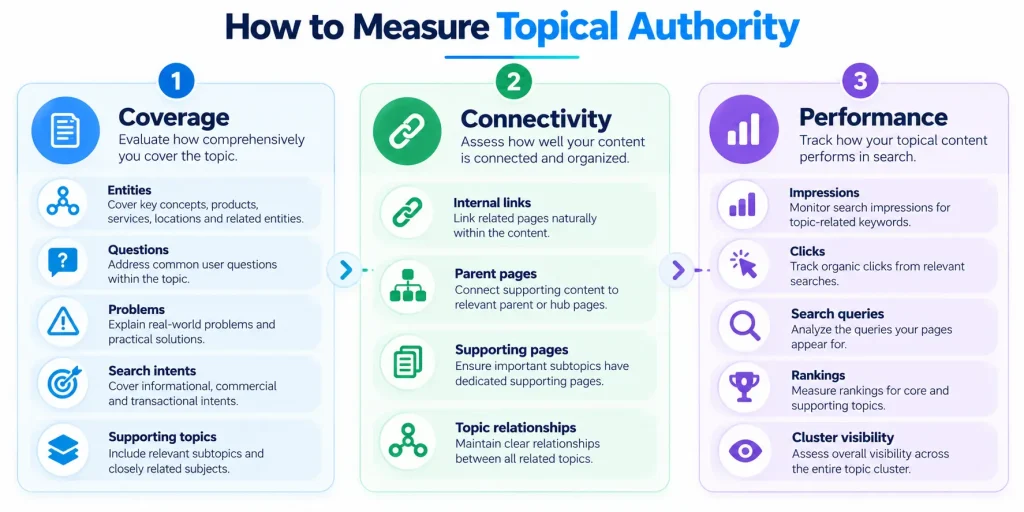
Together, these areas show whether the topic is well covered, properly connected, and gaining traction in organic search.
Tracking Topical Coverage and Organic Search Performance
For a Canadian local SEO site, useful coverage might include Google Business Profile optimization, local keyword research, reviews, citations, location pages, service areas, and common local ranking issues.
Not every missing subject is a real gap. A meaningful topical gap exists only when the missing content would help users understand or act on the core topic.
For instance:
- Social media trends may sit outside a focused local SEO cluster.
- Google Business Profile optimization is likely to be essential.
- Citation consistency may also deserve dedicated coverage if the site already discusses local rankings and business information.
Connectivity is about how well related pages support each other. Important pages should receive contextual internal links from relevant content, and those links should reflect a clear relationship between topics.
Performance can be reviewed in Google Search Console through:
- Organic impressions
- Clicks
- Search queries
- Average positions
- Landing pages
- Changes in visibility over time
Review performance by cluster as well as by individual page. A local SEO cluster may start appearing for more searches around business profiles, reviews, citations, and location pages before every page ranks strongly on its own. Broader visibility across closely related queries can indicate that the cluster is gaining organic search traction around the topic.
Updating Content and Filling Topical Gaps
Topical authority needs maintenance because search behaviour, user needs, and factual information change over time.
Update content when:
- Information becomes outdated
- Search intent shifts
- Important explanations are missing
- New user questions appear
- Better evidence becomes available
- Two or more pages begin covering the same intent
A topical gap involves:
- A missing entity or important attribute
- A missing user question
- A missing problem or use case
- A missing comparison
- A missing decision or process stage
- A missing relationship between existing topics
Do not create a page simply because an SEO tool reports a missing keyword. Add content only when it improves the site’s coverage of the core topic and serves a clear user need. A full content audit can provide a deeper review, but regular topical checks are enough to find outdated pages, weak internal links, overlapping intent, and missing coverage.
Common Mistakes When Building Topical Authority
Mistakes weaken topical authority even when a website publishes consistently.
| Mistake | Why it hurts topical authority | Better approach |
| Irrelevant topical expansion | Publishing weakly related subjects reduces topical focus and introduces search intents that do not support the core subject | Stay within clear topical boundaries and expand only into subjects that support the core topic |
| Duplicate search intent | Multiple pages answering the same question create overlap and make page purpose less clear | Consolidate closely related keyword variations into one stronger page when the intent is the same |
| Thin content | Pages that mention a topic without explaining it fully add little value to the overall subject | Cover the causes, conditions, examples, decisions, and practical actions needed to satisfy the intent |
| Weak internal linking | Related pages remain disconnected, which makes navigation harder and weakens contextual relationships | Link related pages where the connection helps the reader understand the topic more deeply |
| Publishing volume without strategy | High output without clear boundaries or intent planning often creates duplication and irrelevant coverage | Publish based on topical need, search intent, and content structure rather than article quotas |
The main issue is not how much content a site publishes. It is whether each page has a clear purpose and strengthens the site’s coverage of the core topic.
Frequently Asked Questions
How Long Does It Take to Build Topical Authority?
There is no fixed timeline. It depends on topic size, competition, content quality, internal linking, and how quickly the site gains search visibility.
How Many Articles Are Needed to Build Topical Authority?
There is no set number. Publish enough pages to cover the important questions, entities, problems, and search intents within the topic.
Can a New Website Build Topical Authority?
Yes. A new website can build topical authority by choosing a clear subject, covering it consistently, and connecting related pages from the beginning.
Conclusion
Building topical authority requires focused coverage, clear page relationships, useful content, and consistent maintenance.
Define the core topic, cover distinct search intents, organize related pages into a logical structure, and connect them through contextual internal links. Review coverage and organic performance regularly to identify gaps, overlap, and opportunities for improvement.
The goal is not maximum publishing volume. It is useful, complete, and connected coverage of the subject your site intends to be known for.