

A growing business invests in SEO but struggles to make progress. Content gets published, technical recommendations accumulate, and reports arrive each month, yet the work may lack clear priorities or enough people to implement them.
Choosing between a fractional SEO director and an SEO agency starts with identifying that gap. A fractional director provides senior leadership within your business on a part-time basis. An agency supplies a team to deliver an agreed scope of SEO services, often including strategy. The right choice depends on your existing team, implementation capacity, budget, and business complexity. This guide compares both models, explains their complete costs, and shows when combining them makes sense.
What Is the Difference Between a Fractional SEO Director and an SEO Agency?
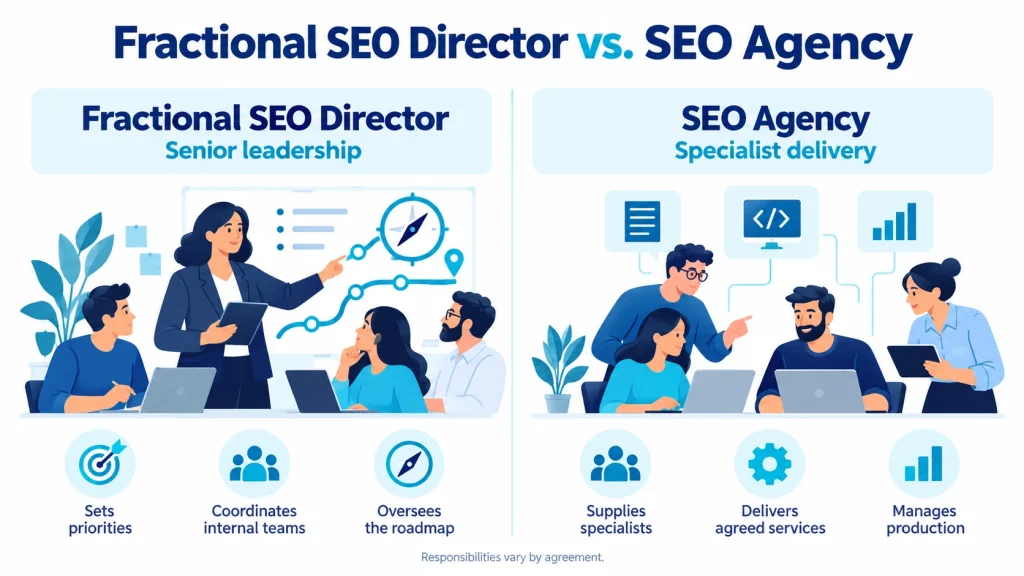
A fractional SEO director takes ongoing responsibility for directing your SEO programme without joining as a full-time employee. An SEO agency provides contracted expertise and delivery resources through an external team.
The distinction is not absolute. Some agencies provide substantial strategic leadership, while some fractional directors include hands-on implementation. Evaluate the actual agreement, access, and responsibilities behind each offer.
What Does a Fractional SEO Director Do?
A fractional SEO director connects organic search priorities with business objectives. They decide where the company will focus, help allocate resources, and oversee the people delivering the work. The responsibilities include:
- Developing an SEO roadmap tied to commercial goals.
- Prioritising technical improvements and content opportunities.
- Coordinating developers, writers, marketing teams, and external suppliers.
- Reviewing implementation quality and resolving competing priorities.
- Explaining performance, constraints, and investment needs to leadership.
For example, a company might already employ developers and content writers but lack someone who can decide whether fixing its site architecture should take priority over publishing new articles. A fractional director provides that judgement and coordinates delivery.
What Does an SEO Agency Handle?
An SEO agency brings together specialists to perform the services included in its contract. These cover technical audits, keyword research, content planning, on-page optimisation, local SEO, relevant link acquisition, and reporting. Implementation needs particular attention. An agency might identify technical problems but require your developer to fix them. Another might offer development support within its scope. Ask who will complete each type of work before comparing proposals.
| Area | Fractional SEO director | SEO agency |
| Main contribution | Embedded senior leadership | Specialist expertise and delivery capacity |
| Strategy | Usually owns or directs the roadmap | Often develops strategy within the engagement |
| Implementation | Uses internal teams or external suppliers; may contribute directly | Delivers contracted services |
| Decision authority | Delegated by business leadership | Usually operates through client approvals |
| Team integration | Works across internal departments | Collaborates through agreed contacts and workflows |
| Cost structure | Retainer, day rate, or defined time commitment | Retainer, project fee, or service package |
| Typical fit | Existing resources need direction | Business needs an external SEO team |
When Does a Business Need a Fractional SEO Director Instead of an Agency?
Fractional leadership is useful when a business has people capable of completing SEO work but lacks a senior owner who can guide their decisions. The strongest signal is persistent uncertainty about what deserves attention, who should act, and how SEO supports the wider business.
When Internal Teams Can Execute but Lack Strategic Direction
An internal team is busy without making coordinated progress.
- Writers publish articles independently of sales priorities.
- Developers complete isolated SEO tickets.
- Marketing managers track traffic but cannot explain which improvements will generate better enquiries.
A fractional SEO director can turn those separate activities into a workable programme. Consider a B2B software company with an active blog, available developers, and limited visibility for its core solutions. Its immediate need might be to strengthen commercial pages and conversion paths. Increasing article production would consume resources without resolving the underlying problem. Senior leadership helps the team select the right work and stop lower-value activity.
When SEO Requires Cross-Department Leadership
Some SEO decisions involve several departments and competing objectives. A website migration requires marketing, development, design, and product teams to agree on URL changes, redirects, navigation, and launch criteria. International expansion may introduce decisions about language targeting, regional content, and website structure. A fractional director coordinates these decisions, documents trade-offs, and escalates unresolved dependencies.
However, part-time leadership needs practical access to decision-makers. If the director cannot secure development time or obtain approvals, their recommendations may remain unfinished regardless of their expertise.
When Is an SEO Agency the Better Choice for Business Growth?
An SEO agency suits businesses that need consistent delivery but lack specialist resources or internal capacity.
| Business situation | How an SEO agency can help | What to confirm |
| Technical SEO problems remain unresolved | Investigates issues, prioritises fixes, and supports implementation. | Who makes website changes and checks the completed work? |
| Content and service pages need improvement | Provides keyword research, content planning, writing, and on-page optimisation. | Which production tasks and revisions are included? |
| Local SEO requires ongoing attention | Supports location pages, Google Business Profiles, and local business information. | Which locations and activities does the agreement cover? |
| Internal teams cannot absorb more work | Adds specialist capacity through a coordinated delivery schedule. | What can the agency deliver, and which internal resources will it need? |
| Building an in-house team is impractical | Provides access to multiple SEO skills through one engagement. | Who will handle the account, and how is service continuity maintained? |
Assign an internal contact to approve work, verify business information, and resolve blockers so the agency can keep delivery moving.
How Do Fractional SEO Director Costs Compare With SEO Agency Pricing?
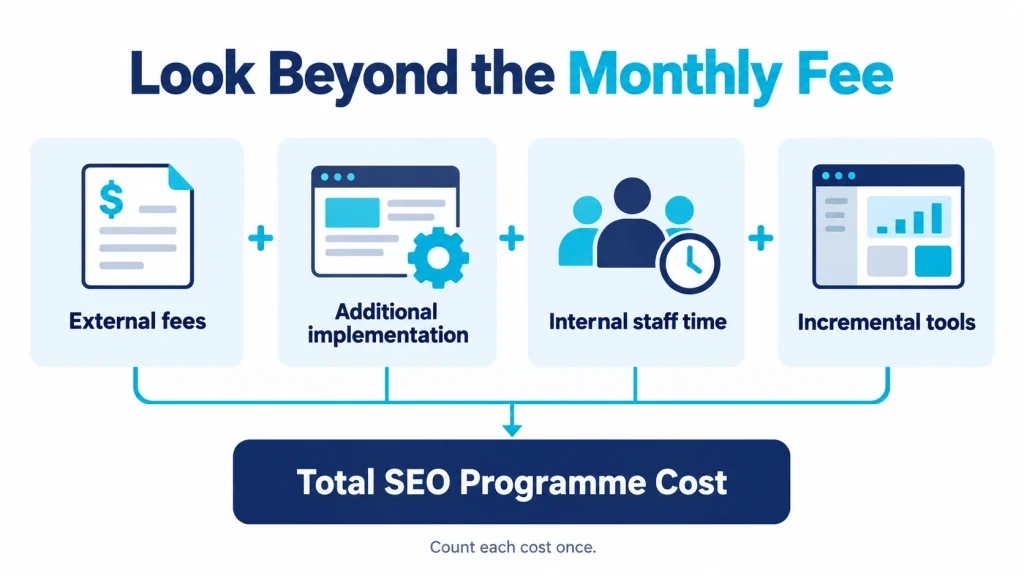
Compare the cost of a functioning SEO programme, including leadership and implementation. A fractional director’s fee may cover planning, coordination, and oversight while leaving production costs separate. An agency retainer may include production but exclude development, extensive content creation, or specialist projects.
Leadership Fees vs. Agency Retainers and Execution Costs
Request a clear breakdown of what each proposal includes.
- For fractional leadership, clarify the time commitment, meeting availability, hands-on contribution, supplier management, and support during urgent issues.
- For an agency, clarify the delivery capacity, senior involvement, implementation responsibilities, revision process, and charges for work outside the scope.
Both proposals should identify software costs and the internal resources required to keep work moving.
How to Calculate the Total Cost of Each SEO Model
Use this budgeting formula:
Total monthly SEO cost = external fees + additional implementation + internal labour allocation + incremental tools.
The following example uses hypothetical Canadian-dollar amounts. These are budgeting illustrations, not market averages or provider quotes.
| Monthly cost component | Fractional-led programme | Agency-led programme | Hybrid programme |
| Fractional leadership | CAD 3,000 | — | CAD 2,000 |
| Agency services | — | CAD 5,000 | CAD 4,000 |
| Additional content or development | CAD 2,500 | CAD 1,000 | CAD 1,000 |
| Allocated internal staff time | CAD 1,500 | CAD 750 | CAD 750 |
| Additional tools | CAD 200 | CAD 200 | CAD 200 |
| Illustrative monthly total | CAD 7,200 | CAD 6,950 | CAD 7,950 |
These programmes do not provide equivalent output. Compare the amount, complexity, and quality of work each budget supports. Internal labour is also an allocation of employee time, which may not represent additional cash spending. Include it to understand resource consumption, and avoid counting services or tools twice when they are already covered by a retainer.
Can a Fractional SEO Director and SEO Agency Work Together?
Yes. A hybrid model suits a business that needs embedded leadership alongside external production capacity. The fractional director connects the SEO programme with internal objectives. The agency supplies agreed specialist services. Internal teams contribute business knowledge, approvals, and implementation where required.
How Responsibilities Are Divided in a Hybrid SEO Model
A responsibility matrix makes the arrangement concrete. In the example below,
- A means accountable for the decision or acceptance,
- R means responsible for completing the work,
- C means consulted, and
- I means informed.
| Activity | Business sponsor | Fractional director | SEO agency | Internal team |
| Approve business goals and budget | A | R | C | C |
| Own SEO roadmap | C | A/R | C | C |
| Implement website code changes | I | C | C | A/R |
| Produce agency-contracted content | I | A | R | C |
| Maintain SEO reporting | I | A | R | C |
| Review performance and revise priorities | C | A/R | R | C |
Adjust this matrix to match the contract. If the agency provides development, for example, its responsibilities should reflect that arrangement. Clinical, legal, or other specialist content also needs a separate internal approval owner.
How to Prevent Overlapping Responsibilities and Accountability Gaps
Maintain one shared roadmap with a named owner, deadline, and acceptance requirement for each task. Agree who will approve changes to priorities and how unresolved issues will be escalated. Otherwise, the director and agency may produce separate plans, duplicate audits, or assume the other party is handling implementation.
The hybrid model earns its additional cost when each participant provides a distinct contribution. Review that division regularly as the internal team develops.
How Should Businesses Evaluate SEO Performance and Accountability?
Businesses should assess SEO by looking at both completed work and its contribution to business goals. Rankings, traffic, and activity reports are useful, but they do not show the full commercial impact.
Measure Business Outcomes Beyond Rankings and Traffic
Choose metrics that match how the business earns revenue.
- A local service business may track qualified calls, bookings, and enquiries.
- A B2B company may focus on demo requests, sales opportunities, and pipeline.
- An ecommerce business may measure organic purchases, revenue, and conversion rate.
Use these outcomes alongside diagnostic metrics such as search impressions, clicks, landing page performance, and conversions. Google Search Console, GA4, and CRM data help connect search visibility with customer actions. Attribution will not be perfect because customers may use multiple channels, devices, or offline touchpoints before converting.
For AEO or GEO work, define the visibility signals being tracked, such as brand mentions, cited pages, referral visits, or appearances in AI-generated answers. Treat these as additional visibility indicators rather than precise performance measures.
Establish Clear Deliverables, Reporting, and Ownership
SEO reporting should show:
- What was completed and validated
- What changed in performance
- What blocked or delayed progress
- What the data suggests doing next
- Which decisions require business approval
Set baselines, reporting responsibilities, and data sources at the start of the engagement.
SEO providers should be accountable for the quality, timeliness, and reasoning behind their work. Revenue also depends on factors such as pricing, market demand, website conversion, and sales follow-up, so reports should clearly separate SEO performance from wider business dependencies.
How to Choose the Right SEO Model for Your Business
Use your current operating constraints to make the decision. Company size alone is an unreliable guide because similarly sized businesses can have very different teams and technical requirements.
Identify Whether Your Biggest Gap Is Strategy, Execution, or Both
Review the previous quarter’s SEO work.
- If priorities changed repeatedly or nobody could explain why tasks mattered, investigate the leadership gap.
- If the plan was clear but important work remained unfinished, examine production capacity and access to resources.
- If both happened, assess whether a strategically capable agency can cover the requirements or whether embedded leadership would add necessary coordination.
Also check for broader constraints. A weak offer, broken enquiry process, or inability to serve additional customers deserve attention before expanding SEO investment.
Match Your SEO Model to Your Business Stage and Budget
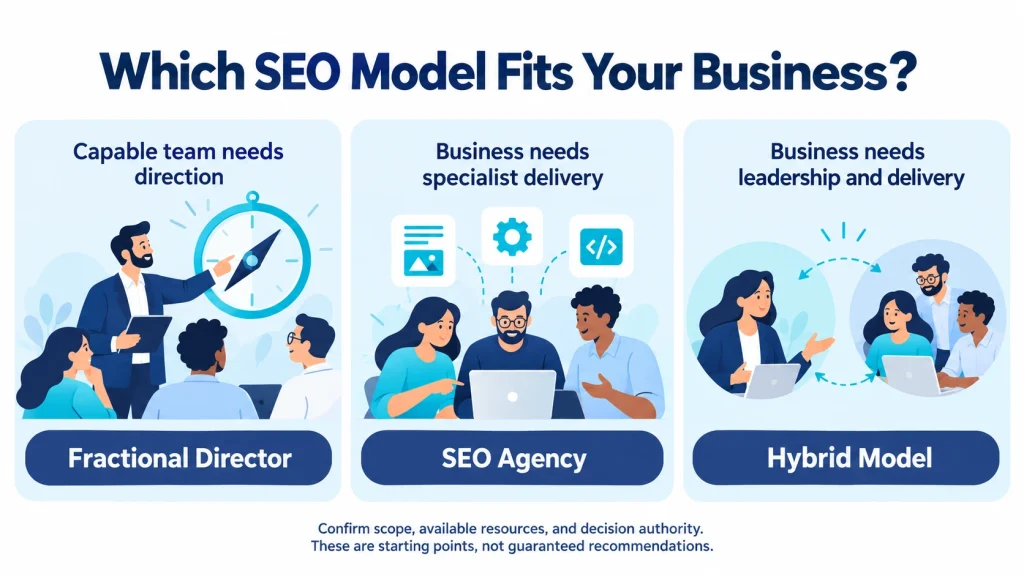
Use these scenarios as starting points:
| Business situation | Model to consider | What to verify |
| Small service business with little internal marketing capacity | Agency offering strategy and implementation | Scope, affordability, and approval requirements |
| Growing B2B company with writers and developers | Fractional SEO director | Actual staff availability and delegated authority |
| Multi-location business with recurring production needs | Agency with suitable operational capacity | Location management, quality control, and delivery volume |
| Established marketing team needing coordination and specialist production | Hybrid model | Distinct responsibilities and sufficient budget |
| Business with continuous, complex SEO leadership needs | Full-time internal leader with specialist support | Sustainable workload and management responsibilities |
| Business unable to implement work or fund a continuing programme | Focused diagnostic or foundational project first | Whether the main constraint can be resolved |
Before signing, ask each provider to explain how their proposed model addresses your specific bottleneck. A credible answer should identify required resources and dependencies as well as deliverables.
Know When to Move Toward a Hybrid or In-House SEO Team
Review the model when coordination demands, workload, or business complexity change. A fractional arrangement becomes insufficient if senior SEO decisions require daily involvement. An agency-led programme may need an internal leader as more departments become involved.
Plan any transition around continuity. Keep roadmaps, account access, reporting definitions, documentation, and completed work accessible to the business so a staffing change does not interrupt progress.
What Should You Expect During the First 90 Days?
The first 90 days should establish a working programme and show evidence of delivery. Ranking or revenue gains may take longer, depending on the starting position, competition, and implementation pace.
First 30 Days: Assessment, Priorities and Responsibilities
Early work should establish the commercial objectives, current performance, website constraints, and resources available. A fractional director should produce a prioritised roadmap, clarify ownership, and secure agreement on how work will be delivered. An agency should complete the agreed assessments and translate them into a practical delivery plan.
Missing analytics access, unavailable developers, or slow approvals should become visible planning issues. A substantial website may require assessment beyond the first month. The key is to explain what has been examined, what remains uncertain, and which actions can already proceed.
Days 31 to 90: Execution, Quality Assurance and Performance Reviews
During the following two months, review progress against the agreed scope. Look for implemented improvements, approved content, validated tracking, documented quality checks, and resolved blockers. The fractional director’s contribution should be visible in decisions and coordination. The agency’s contribution should be visible in accepted deliverables and implementation.
At the 90-day review, assess whether the team completed the right work, whether responsibilities functioned as intended, and what early evidence supports the next quarter’s priorities. Repeated delays without corrective action deserve attention even when the reporting looks polished.
Choose an SEO Partner That Supports Your Business Growth
A fractional SEO director can help an existing team make better decisions and coordinate complex work. An SEO agency can provide the specialist capacity needed to deliver a sustained programme. A hybrid arrangement can support businesses that require both. Choose the model around the work your company needs and the resources it can realistically provide.
If you are evaluating agency support for your Canadian business, discuss your objectives, existing team, and implementation requirements with RankSure. Use that conversation to establish a clear scope, ownership structure, and measurement plan.
Discuss Your SEO Growth Strategy With RankSure.
Frequently Asked Questions About Fractional SEO Directors and SEO Agencies
What Is a Fractional SEO Director?
A fractional SEO director is a senior SEO professional who provides ongoing leadership on a part-time basis. They typically direct strategy, coordinate resources, and oversee performance without holding a full-time position.
How Is a Fractional SEO Director Different From an SEO Consultant?
A consultant may provide a specific audit, recommendation, or specialist project. A fractional director usually holds continuing responsibility for the programme. Titles overlap, so check the agreed authority, availability, and deliverables.
Is Hiring a Fractional SEO Director Cheaper Than an SEO Agency?
It depends on scope and existing resources. A leadership fee may exclude content and development, while an agency retainer may include some execution. Compare complete programme costs and expected output.
Can a Fractional SEO Director Manage an Existing SEO Agency?
Yes, if vendor oversight is included in the role. They can align the agency’s work with business priorities, review quality, and resolve dependencies, provided decision rights are clear.
Should a Small Business Hire an SEO Agency or a Fractional SEO Director?
A small business with limited execution capacity may benefit from an agency providing strategy and delivery. Fractional leadership becomes more useful when capable internal resources need sustained direction.
When Should a Company Hire a Full-Time SEO Director?
Consider a full-time director when strategic decisions, team management, and cross-department coordination consistently require permanent senior attention. Base the decision on recurring workload and organisational needs.