
Search engines evaluate websites as connected systems, not isolated pages. They analyze how pages link, how entities relate, and how users and crawlers move between topics.
Internal linking architecture is the planned structure of links between pages on the same website. It controls crawl paths, internal PageRank distribution, and topic clarity.
AI overviews and large language models retrieve answers from specific passages. Internal links help search systems connect those passages with related pages, which makes the site easier to crawl, index, and understand.
This guide explains how internal linking architecture works, which site structures scale, and how entity-driven linking supports traditional search and AI-powered retrieval.
Foundations of Internal Linking & Site Structure
What Internal Linking Architecture Actually Means
Internal linking architecture is the systematic organization of hyperlinks across a website. Each internal link should support the larger page network, not work as a random recommendation.
Think of a website as a network rather than a collection of pages. Internal links connect related destinations, shaping how users and search engines move through your content.
A strong connected page network aligns with the site’s information architecture, taxonomy, business goals, and content strategy. Pages covering the same entity should link through anchors that explain the relationship.
How Search Engines Interpret Internal Links as a Graph System
Search engines model websites as graphs composed of nodes (pages) and edges (links). Every new internal link changes that graph by creating another pathway between documents.
Discovery follows these pathways. Pages with multiple crawlable links are easier to discover, revisit, and evaluate than isolated URLs. Pages sitting at the edge of the graph receive less crawling attention and weaker contextual association.
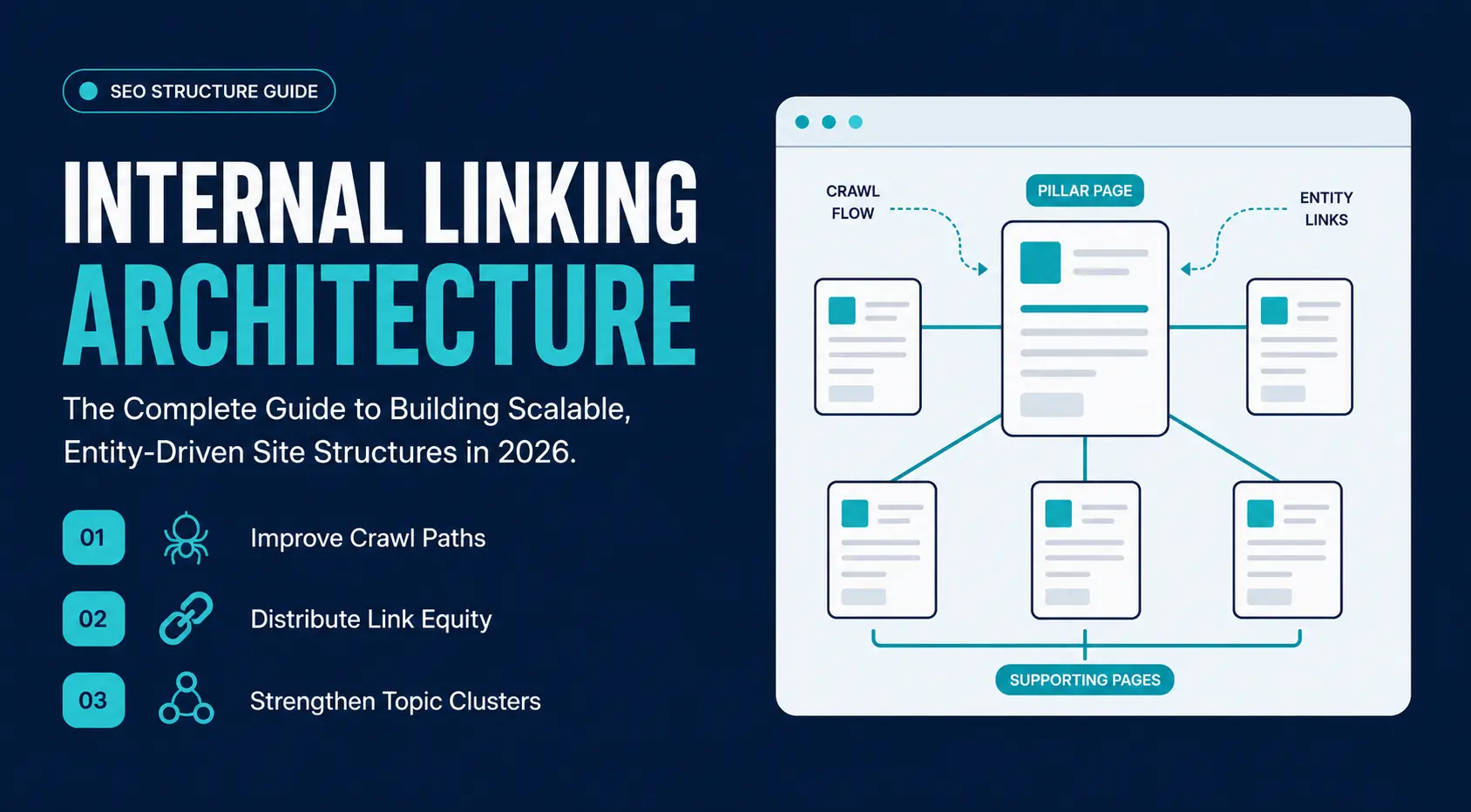
The link graph shows which pages act as hubs. A comprehensive pillar page linked by dozens of supporting resources naturally becomes a central node within the network, while thin pages with few incoming references contribute little to the site’s overall authority.
Internal Links vs Navigation vs Site Hierarchy
Internal links, navigation, and site hierarchy perform different roles.
| Element | Primary Function |
| Internal links | Create contextual relationships between pages. |
| Navigation | Help users access major website sections consistently. |
| Site hierarchy | Defines the parent-child structure of content and URL organization. |
Navigation establishes predictable access through menus, breadcrumbs, and footers. Site hierarchy organizes content into logical categories. Internal links operate across that hierarchy, connecting semantically related pages regardless of their directory location.
An effective architecture combines all three layers instead of relying exclusively on navigation menus.
How Internal Linking Impacts Search Performance
Crawl Efficiency & Discovery Control
Every website has finite crawling resources. Internal links determine how efficiently search engine bots spend that budget.
Pages buried six or seven clicks from the homepage receive less crawling than pages accessible within two or three clicks. Excessive page depth increases the likelihood that valuable content is discovered slowly or revisited infrequently.
Strategic internal linking shortens discovery paths by creating direct routes toward important resources. Contextual links expose deeper content earlier in the crawl process and reduce long category-chain dependency.
Link Equity Distribution Across a Site Graph
Internal links distribute authority throughout a website. Every linked page transfers a portion of its accumulated PageRank to connected pages, creating an internal authority network.
High-value pages need stronger internal support than low-priority URLs.
A hub page receiving links from dozens of related articles gradually accumulates more authority, which it can redistribute to supporting resources. Orphan pages and poorly connected content remain outside the main authority network.
Good site structures link hub pages from supporting articles and keep supporting pages within crawlable paths.
Semantic Understanding Through Anchors & Entities
Anchor text provides context far beyond simple keywords.
Search engines gain stronger confidence about the destination’s topical focus, when multiple pages consistently reference a destination using varied but semantically related phrases. Natural language models evaluate those contextual signals alongside surrounding content to understand entity relationships rather than exact keyword matches.
For example, an article about technical SEO might naturally link to a crawl budget guide using anchors like:
- optimizing crawl budget
- crawl efficiency strategies
- improving Googlebot discovery
Each phrase reinforces similar concepts without appearing repetitive or over-optimized.
Internal Linking in AI Search Systems
AI-powered search retrieves answers from specific passages, not only from full pages.
That makes internal linking architecture more significant. Strong contextual links help retrieval systems understand how one passage relates to another, allowing connected content to reinforce topical confidence across multiple documents.
Why Internal Linking Architecture Matters
Strengthening Site-Level Topical Authority
Authority is built through interconnected expertise, not isolated high-performing pages.
Supporting articles create stronger clusters by linking to comprehensive pillar pages and receiving contextual links back.
Over time, interconnected clusters reinforce coverage of one subject through pillar pages, supporting articles, and related FAQs and demonstrate subject expertise more effectively than isolated pages.
Improving Navigation Through Link-Driven User Paths
Contextual internal links help users move naturally between related topics.
Someone landing on a beginner’s guide may later need implementation advice, troubleshooting documentation, or a product comparison. Contextual links guide users to the next useful page without sending them back to Google.
Every important page should become part of a linked cluster, not a dead end.
Reducing Structural Inefficiencies
Website growth creates disconnected pages, category drift, and fragmented authority without ongoing maintenance.
These inefficiencies appear as:
- orphan URLs
- excessive click depth
- isolated topic clusters
- duplicate content pathways
- uneven authority distribution
Planned internal linking prevents these problems from growing as the site expands.
Core Components of Internal Linking Architecture
Structural Layer (Hierarchy + URL + Information Architecture)
The structural layer defines how information is organized before a single internal link is added.
Clear parent-child relationships, logical URL structures, and consistent categorization establish predictable content organization for both users and search engines. Ideally, related pages live within coherent topical sections instead of scattered across unrelated directories.
Navigation Layer (Menus, Breadcrumbs, Sitemaps)
Navigation creates the framework users rely on throughout the website.
Primary menus expose major sections, breadcrumbs reinforce hierarchical relationships, and XML sitemaps assist search engines in discovering important URLs. Together they provide stable access paths independent of contextual linking.
Contextual Linking Layer (In-Content + Related + CTA Links)
Contextual links carry the strongest semantic signals because they’re surrounded by relevant content.
Placed naturally within paragraphs, resource boxes, related article sections, or strategic calls-to-action, these links explain why two pages belong together.
Their value depends on relevance, surrounding context, and user intent.
Taxonomy Layer (Categories, Tags, Facets)
Taxonomy determines how content is grouped and classified.
Categories should represent broad thematic areas, while tags identify meaningful attributes that connect related resources. Poorly managed taxonomies create duplicate archives, fragmented clusters, and crawl inefficiencies.
For ecommerce websites, faceted navigation requires additional control to prevent index bloat from generating thousands of low-value parameter combinations.
Well-managed taxonomy strengthens both navigation and semantic organization.
Internal Linking Architecture Models
Flat vs Deep Hierarchies
Flat architectures minimize click depth by keeping important pages close to the homepage. They improve crawl efficiency, distribute authority more evenly, and simplify discovery across medium-sized websites.
Deep hierarchies introduce multiple directory levels and nested categories. Deep hierarchies organize large websites, but excessive depth reduces crawl frequency and delays indexation.
Hub-and-Spoke / Topic Clusters (Core Model)
The hub-and-spoke model has become the preferred architecture for modern SEO.
A central pillar page serves as the hub, providing comprehensive coverage of a broad topic. Supporting pages explore individual subtopics in greater depth while linking back to the hub and, where appropriate, to one another.
This structure creates a tightly connected knowledge cluster that strengthens topical coverage, simplifies navigation, and distributes link equity efficiently across related content.
Silo + Hybrid Systems (Merged)
Traditional silo architecture organizes content into tightly separated thematic sections with minimal cross-linking between silos. This preserves topical focus but can restrict internal PageRank distribution across the wider site.
Hybrid systems introduce selective cross-links where genuine semantic relationships exist. Hybrid systems avoid rigid isolation and connect related clusters where semantic relationships exist.
For most growing websites, hybrid architectures offer greater flexibility than strict silos.
Choosing the Right Model by Website Type
The best architecture reflects how users search for information and how content naturally relates.
Anatomy of a High-Performance Internal Link
Anchor Text as Semantic Context (Not Just Keywords)
Anchor text provides semantic context. Modern search engines evaluate the anchor, its surrounding copy, and the topical relationship between the source and target pages to understand why the connection exists.
That makes exact-match anchors far less important than contextual relevance. A page about technical SEO can naturally attract anchors such as crawl efficiency, site crawl optimization, improving indexation, or crawl budget management. Collectively, these variations reinforce the same entity without creating an over-optimized anchor profile.
Dynamic anchor text allows anchors to evolve naturally with the surrounding content. This provides richer contextual signals while keeping links useful for readers.
Contextual vs Structural Placement (Body vs Navigation)
Contextual links in the main body provide stronger semantic signals because surrounding text explains the relationship. They help search engines understand the relationship between topics while offering users logical next steps.
Structural links—including navigation menus, breadcrumbs, sidebars, and footers—serve a different purpose. They establish site-wide accessibility and reinforce hierarchy, but they rarely convey the same topical specificity as an in-content reference.
Google’s Reasonable Surfer model connects link value with click probability. Prominent contextual links therefore carry clearer value than repeated footer links. A prominently placed contextual recommendation often contributes more than another footer link repeated across every page.
Technical Accessibility (HTML vs JavaScript Rendering Impact)
An internal link only has value if search engines can reliably discover and process it.
Standard HTML anchor elements remain the safest implementation because crawlers can access them without relying on additional rendering. Complex client-side rendering, delayed hydration, and event-driven navigation create crawl inconsistencies.
Best practices include:
- Use standard <a href=””> links for important navigation and contextual links.
- Avoid links that require user interaction before becoming visible.
- Minimize redirect chains between internal pages.
- Ensure mobile and desktop versions expose the same crawlable link structure.
The quality of the pages’ content becomes irrelevant when crawlers struggle to reach a page.
Building an Internal Linking Strategy
Mapping Content into Topic & Entity Clusters
Every effective internal linking strategy begins with mapping the site’s knowledge landscape.
Instead of organizing pages around isolated keywords, group them by topics, entities, and search intent. Each cluster should revolve around a primary subject supported by related subtopics that answer complementary questions.
For example, a Technical SEO cluster might include:
- Crawl Budget
- XML Sitemaps
- Robots.txt
- Canonical Tags
Entity-first clustering creates a more resilient architecture that scales as new content is added.
Designing Pillar Pages and Supporting Structures
Pillar pages act as central knowledge hubs.
Pillar pages organize supporting articles instead of competing with them. A well-designed pillar introduces the broader topic before directing readers toward specialized resources covering individual concepts in greater depth.
Each supporting article should link to 1 pillar page and 2–3 related supporting pages.
This creates a closed feedback loop:
Pillar → Supporting Article → Related Supporting Article → Pillar
New articles should be assigned to an existing cluster during content expansion.
Entity-Based Internal Linking Strategy
Traditional internal linking often relied on keyword matching. Modern architecture should prioritize meaning instead.
Ask a simple question before adding any link:
Do these two pages help explain the same entity, process, product, or user journey?
A link is worth adding when both pages explain the same entity, process, product, or user journey.
Entity-driven linking also aligns better with AI retrieval systems, which interpret relationships through semantic similarity rather than exact lexical overlap.
Internal Link Prioritization Logic
Not every page deserves the same number of incoming links. Prioritize internal links using four practical signals:
| Priority | Why It Matters |
| Authority | Strengthen cornerstone pages capable of distributing equity. |
| Traffic | Reinforce pages already attracting qualified visitors. |
| Conversions | Support pages that directly contribute to leads or revenue. |
| Crawl Depth | Surface valuable pages buried too deep within the architecture. |
This prioritization prevents authority from being diluted across low-value URLs while ensuring strategic pages remain highly accessible.
Ongoing Optimization Loop
Internal linking is never a one-time project. As content grows, internal links should evolve with it.
A sustainable optimization cycle involves:
- updating older articles with links to newly published resources
- identifying weak clusters that lack supporting content
- reinforcing successful hubs with additional contextual links
- removing outdated or irrelevant connections
- reviewing anchor text diversity
Internal Linking Architecture by Website Type
Different websites require different internal linking strategies because their content, user journeys, and business goals vary.
Blogs & Publishers
Build topic clusters around pillar pages instead of publishing isolated articles. A Technical SEO pillar, for example, can connect to articles on crawl budget, XML sitemaps, structured data, JavaScript SEO, and log file analysis, while supporting pages also link to one another where relevant.
This creates a pillar-led cluster that improves crawl discovery, reduces cannibalization, and clarifies topic coverage.
SaaS Websites
SaaS sites typically contain feature pages, solution pages, documentation, integrations, pricing, case studies, blogs, and help centers. These sections should work as one connected ecosystem rather than separate silos.
A typical user journey might follow:
Feature → Use Case → Documentation → Case Study → Demo
Each page answers the next logical question, supporting both organic visibility and conversions.
Ecommerce Websites
Ecommerce architecture should connect category pages, subcategories, collections, buying guides, comparison articles, and product pages. Products should also link to complementary items and educational content that helps customers make purchasing decisions.
Multiple linking paths keep products discoverable even as inventory changes and prevent important pages from becoming isolated.
Enterprise Documentation
Large documentation sites should organize links by user tasks, such as installation, configuration, troubleshooting, and release updates. API references, installation guides, configuration documentation, troubleshooting articles, and release notes should guide users through logical workflows.
This improves navigation, reduces friction, and helps search engines understand relationships across thousands of pages. At enterprise scale, automated internal linking often becomes necessary.
Local Business Websites
Local websites contain fewer pages, but they still need structured internal linking. Connect location pages with relevant service pages, FAQs, customer success stories, industry resources, and contact pages to improve both user navigation and local search visibility.
Advanced Internal Linking Strategies
Entity-Driven Architecture Design
Entity-first architecture organizes websites around real-world concepts rather than keyword lists.
A cybersecurity website, for example, might build clusters around ransomware, endpoint security, zero-trust architecture, compliance frameworks, and threat intelligence. Each cluster contains multiple resources connected through their conceptual relationships.
Internal Link Graph Optimization
Viewing a website as a graph reveals structural patterns that traditional audits often miss.
Effective site structures contain hub pages, short crawl paths, connected clusters, and few isolated sections. :
- strong central hub nodes
- balanced authority distribution
- multiple discovery paths
- minimal disconnected sections
- limited structural bottlenecks
Graph analysis also exposes fragmentation. Related clusters with few cross-connections trap authority inside isolated sections.
Programmatic & Rule-Based Internal Linking
Manual linking eventually becomes unsustainable.
Large publishers and enterprise websites increasingly automate portions of their architecture through CMS rules.
Examples include:
- automatically linking glossary terms
- connecting articles sharing primary entities
- inserting related resources based on taxonomy
Automation should enhance editorial decisions.
Large-Scale Architecture Management
Managing tens of thousands of pages requires governance.
Establish linking standards covering:
- maximum crawl depth
- pillar page ownership
- taxonomy consistency
- anchor text variation
- orphan page monitoring
- redirect maintenance
Large websites accumulate structural debt without governance.
Faceted Navigation, Pagination & Multilingual Systems
Complex websites introduce additional architectural challenges.
Faceted navigation can generate thousands of parameterized URLs that consume crawl budget without providing unique value. Pagination requires clear relationships between sequential pages, while multilingual websites must maintain equivalent internal structures across language versions.
Manage these systems by controlling crawl paths, blocking low-value indexation, and keeping topic relationships consistent.
Internal Linking in the AI Search Era
How AI Overviews Select and Interpret Content
AI-powered search systems retrieve information differently from traditional ranking algorithms. These systems extract specific passages that answer a query and combine information from multiple sources.
Internal linking influences this process by providing context. When a page is consistently referenced by closely related content, those connections reinforce its expertise within a broader topic. A well-linked article isn’t simply easier to crawl—it becomes easier to interpret.
Entity-First Site Architecture
Search engines increasingly organize information around entities—people, places, products, organizations, concepts, and their relationships—instead of individual keywords.
An entity-first architecture mirrors this model.
Build comprehensive clusters around a central entity instead of creating separate pages for slight keyword variations. Supporting pages should explore related attributes, processes, comparisons, use cases, and frequently asked questions while linking naturally throughout the cluster.
This creates a strong entity-based internal linking system that remains resilient as search behavior evolves beyond exact keyword matching.
Passage-Level Retrieval & Semantic Chunking
Modern retrieval systems frequently evaluate passages instead of complete documents.
That makes page structure just as important as page content.
Clear headings, focused sections, concise explanations, and contextual internal links help search engines understand where one concept ends and another begins. Sections that address one distinct intent become easier to retrieve independently.
Preparing Internal Link Structures for LLM Systems
Large language models perform best when information is logically organized and contextually connected.
Preparing a website for LLM retrieval involves more than adding internal links. The surrounding structure should make relationships obvious.
A crawlable, structured, AI-readable site architecture includes:
- clearly defined topic clusters
- descriptive contextual anchors
- strong pillar pages
- shallow crawl depth for important resources
- consistent taxonomy
- minimal orphan content
The objective isn’t to optimize specifically for AI. It’s to create a website whose knowledge structure is easy for both humans and machines to understand.
Common Internal Linking Failures
Structural Failures (Orphans, Depth, Weak Clusters)
Most internal linking problems are structural rather than technical.
Website expansion causes new pages to lose internal links over time. Important resources drift deeper into the hierarchy, while some content becomes orphaned entirely, existing only in XML sitemaps or internal databases.
Regular structural reviews help identify these weaknesses before they affect crawl efficiency or visibility.
Link Graph Breakdowns
A website can appear well linked while still containing a fragmented graph.
Common warning signs include:
- disconnected content sections
- isolated topic clusters
- hub pages receiving little internal support
- excessive dependence on navigation links
Graph fragmentation interrupts authority flow and makes topical relationships less obvious to search engines.
A clean link graph contains crawlable pages, low click depth, no orphan URLs, and multiple pathways between related resources.
Technical Failures (Broken Links, Redirects, Canonicals)
Technical issues erode internal linking performance.
Broken links create dead ends for users and crawlers. Long redirect chains waste crawl resources, while incorrect canonical tags can send conflicting signals about which page should receive authority.
Routine technical audits should verify that:
- internal links resolve directly to their destination
- redirects remain minimal
- canonical URLs are consistent
- deleted pages are removed from internal navigation
- important pages return valid status codes
Technical maintenance preserves the integrity of the entire architecture.
Optimization Failures (Over-Linking, Irrelevant Linking)
Excessive contextual links dilute user attention and weaken the value of genuinely important recommendations. Forced links between unrelated topics create a confusing information network.
Auditing Internal Linking Architecture
Crawl Structure Analysis
A crawl audit should begin with structure rather than individual pages.
Measure click depth, identify long discovery paths, and review whether high-value pages are accessible within a reasonable number of clicks. Important commercial pages buried deep within the architecture often indicate poor internal prioritization.
Visualizing crawl paths also reveals unnecessary complexity introduced through outdated categories or redundant navigation.
Orphan Page & Cluster Strength Detection
Finding orphan pages requires comparing multiple data sources rather than relying on a single crawler.
Cross-reference:
- XML sitemaps
- crawl data
- Google Search Console
- CMS exports
- analytics landing pages
URLs appearing in one dataset but missing from crawl paths often indicate orphan content.
Cluster analysis should follow. Evaluate whether each major topic has a clear hub, sufficient supporting content, and strong internal connectivity.
Link Equity & Anchor Text Distribution
An audit should also examine how authority is distributed throughout the site.
Look for:
- pages receiving unusually few internal links
- excessive links pointing toward low-value URLs
- overused exact-match anchors
- inconsistent anchor patterns
- important pages lacking contextual references
Balanced distribution generally outperforms concentrating hundreds of links on a handful of pages while neglecting the rest of the site.
Internal Link Graph Visualization
Graph visualization tools transform thousands of URLs into an interactive network, making structural issues easier to identify.
Visual analysis complements traditional metrics by revealing patterns that spreadsheets frequently hide.
Tools
No single tool provides a complete picture. A practical audit stack includes:
| Tool | Primary Purpose |
| Google Search Console | Indexation, internal link reports, crawl insights |
| Screaming Frog | Crawl analysis, click depth, orphan detection, redirects |
| Ahrefs | Internal link opportunities and authority analysis |
| Semrush | Site audits, architecture reviews, and cluster evaluation |
Using these tools together provides a more accurate view of structural health than relying on any individual platform.
Measuring Internal Linking Success
| Area | What to Measure | Why It Matters |
| Crawl & Index Efficiency | Crawl frequency for important pages, orphan URLs, average click depth, indexation speed, crawl errors | Shows how efficiently search engines discover, crawl, and index your content. |
| Rankings & Organic Visibility | Topic cluster rankings, visibility of supporting pages, performance of new content, long-tail keyword growth | Measures how internal linking strengthens topical authority and improves search visibility across related pages. |
| User Engagement & Navigation | Pages per session, internal click-through rate, average engagement time, bounce rate, navigation paths | Indicates whether users follow intended journeys and easily discover related content. |
| Conversions & Business Impact | Qualified leads, demo requests, product inquiries, purchases, assisted conversions | Evaluates whether internal links successfully move users from informational content to commercial actions. |
Internal Linking Checklist
Before publishing new content, confirm that it:
- belongs to an existing topic cluster
- links to an appropriate pillar page
- includes relevant contextual anchors
- follows the site’s taxonomy and hierarchy
After publication:
- verify crawlable HTML links
- check for broken or redirected URLs
- confirm reciprocal links where appropriate
- validate breadcrumb placement
Every month:
- review orphan pages
- strengthen weak topic clusters
- update older articles with links to new content
- diversify repetitive anchor text
Every quarter:
- Audit click depth every quarter and flag pages deeper than 4 clicks.
- evaluate link equity distribution
- review taxonomy growth
- visualize the internal link graph
- remove obsolete or low-value internal links
Conclusion
Internal linking architecture is not a collection of isolated hyperlinks. It is the structural framework that determines how authority, information, and users move across a website.
Treat internal linking as an evolving graph rather than publishing checklist. Continuously strengthen high-value hubs, eliminate structural weaknesses, reinforce meaningful topic clusters, and keep important content accessible. A healthy architecture doesn’t just improve rankings,but creates a scalable, AI-readable website that continues to perform as both your content library and search technology evolve.
FAQ
What is the difference between an internal link and a backlink?
An internal link connects two pages on the same website, while a backlink connects pages across different websites. Internal links influence crawlability, site structure, and internal authority distribution.
How many internal links should a page have?
There is no fixed limit. Add as many links as genuinely improve navigation and contextual understanding without overwhelming readers or diluting important pathways.
Should internal links use nofollow?
Generally, no. Internal links should remain crawlable so search engines can discover content and understand relationships. No-follow is rarely necessary for standard site architecture.
How often should I audit internal links?
Large websites benefit from quarterly architecture audits and monthly reviews of new content, orphan pages, broken links, and expanding topic clusters.
Will changing my internal link structure affect rankings?
Yes, although not always immediately. Significant architectural changes alter crawl paths, authority flow, and contextual relationships. Implement changes gradually, monitor indexation, and avoid restructuring without a clear objective.