


B2B SaaS SEO generates qualified demo requests by connecting commercial search demand with pages that address real buyer problems and product requirements. A SaaS company needs not just traffic, but visitors who match its ideal customer profile, have a relevant business need, and can progress from search to product evaluation, demo, sales opportunity, and customer.
An effective B2B SaaS SEO strategy combines search intent, product positioning, technical SEO, conversion optimization, lead qualification, and CRM measurement. The key question is not simply how much organic traffic SEO generates. It is which searches, pages, and conversion paths produce qualified demos and measurable sales pipeline.
What Is B2B SaaS SEO and How Does It Generate Qualified Demo Requests?
B2B SaaS SEO is the process of improving a software company’s organic search visibility for queries used by relevant business buyers and turning that visibility into customer acquisition opportunities.
The process connects four elements:
- Search demand from the ideal customer profile
- Content and landing pages that match buyer intent
- Conversion paths that move suitable buyers toward product evaluation
- Analytics and CRM data that show whether leads become opportunities and customers
A visitor searching for a broad definition might be useful for awareness. A prospect searching for a specific integration, software category, use case, competitor comparison, or product capability has stronger commercial intent. SEO therefore supports different levels of buyer readiness rather than pushing every visitor directly toward a demo.
How B2B SaaS SEO Differs From Traditional SEO
B2B SaaS SEO uses the core disciplines similar to traditional SEO, including keyword research, content creation, technical optimization, internal linking, and conversion tracking. The difference is how those activities connect with the buyer journey and commercial outcomes.
| Factor | Traditional SEO | B2B SaaS SEO |
| Primary objective | Visibility, traffic, or conversions | Qualified demos, sales opportunities, customers, and revenue contribution |
| Audience | Often individuals or broad consumer groups | Organizations and multiple purchasing stakeholders |
| Buying process | Can involve short or immediate decisions | Often involves research, evaluation, approval, and sales conversations |
| Keyword priorities | Relevance, search demand, and intent | ICP relevance, product fit, commercial intent, and conversion potential |
| Content focus | Informational and transactional pages | Product, solution, industry, use case, integration, comparison, and educational pages |
| Measurement | Traffic, rankings, and conversions | Qualified demos, opportunities, customers, and financial contribution |
B2B SaaS purchases can involve several decision makers with different information needs. Operational users may evaluate workflows and usability. IT teams may investigate integrations, APIs, security, and data handling. Finance may assess costs and financial impact. Department leaders may compare products against business requirements. A strong B2B SaaS content strategy addresses these stakeholder needs while maintaining consistent product positioning across the buying journey.
Why Organic Traffic Alone Does Not Guarantee Qualified Demos
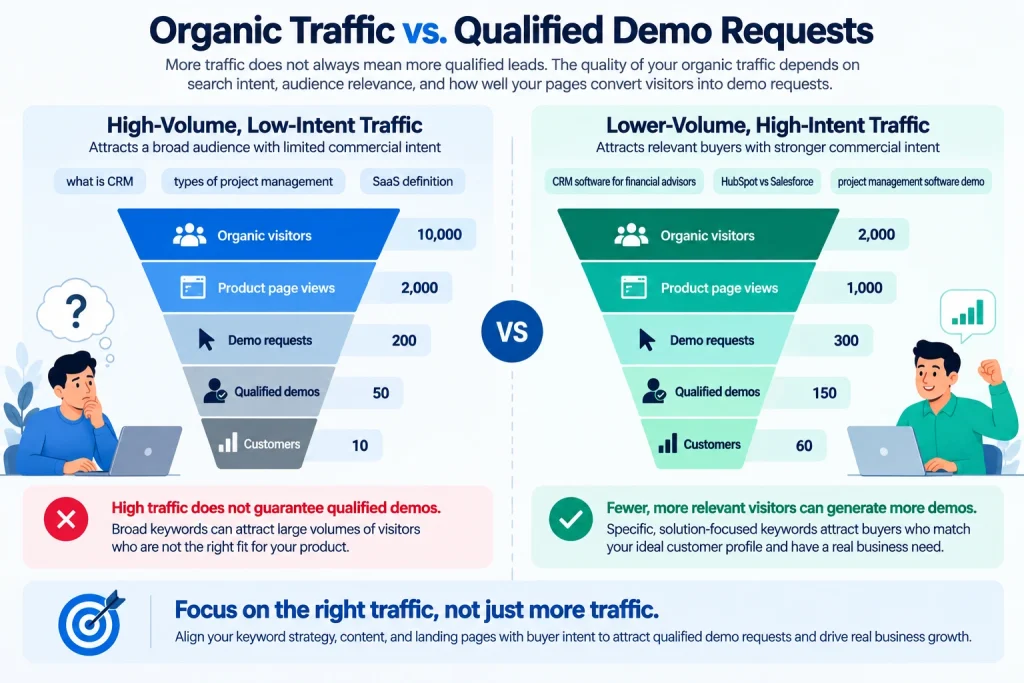
Organic traffic measures visits, not buyer quality. A visitor has commercial value when the person fits the ideal customer profile, has relevant search intent, and reaches a page that supports the next buying step.
Three factors matter most.
- Audience relevance: Does the visitor match the target industry, company profile, role, or use case?
- Search intent: Is the visitor learning about a problem, comparing solutions, or actively evaluating software?
- Conversion experience: Does the page explain the product clearly, address the searched need, and provide an appropriate next step?
A broad article might attract thousands of visitors with little sales potential. A focused integration, comparison, or solution page, however, may attract fewer visitors but generate more qualified conversations. SEO performance should therefore be measured across the full acquisition funnel:
Organic visitors → Demo requests → Qualified demos → Sales accepted leads → Sales opportunities → Customers → Revenue contribution
Each drop in the funnel points to a different problem.
- High traffic with few demos indicates weak intent alignment or poor conversion.
- Many demos with low qualification indicate broad targeting or unclear positioning.
- Qualified demos that rarely become opportunities point to product fit, pricing, qualification criteria, or sales execution rather than SEO itself.
Why B2B SaaS Companies Struggle to Generate Qualified Demo Requests From SEO
B2B SaaS SEO underperforms when keyword targeting, product messaging, conversion paths, and sales measurement are disconnected.
Targeting High-Volume Keywords Instead of High-Intent Buyers
Search volume measures demand, not commercial value. A CRM platform serving financial advisory firms can attract substantial traffic from “what is CRM,” while “CRM software for financial advisory firms” might have lower demand but stronger ICP relevance, product fit, and purchase intent.
Keyword priorities therefore consider:
- ICP relevance
- Commercial intent
- Product fit
- Ranking opportunity
- Conversion potential
Educational keywords support awareness and category education, but they should complement higher intent opportunities rather than replace them.
Weak Product Messaging and Demo Conversion Paths
Relevant traffic fails to convert when the page does not explain why the software fits the searched need. Generic messaging such as “Transform Your Business” communicates little product value. A headline such as “Automate Invoice Approvals Across Finance Teams” identifies the function and business problem.
Commercial SaaS pages should clarify who the product serves, what problem it solves, how the capability works, why it is relevant, what proof supports the claim, and what the visitor should do next. Demo forms also need balance. Too many fields create friction, while too few will limit qualification. Every required field should support a genuine sales or lead qualification need.
Measuring SEO Success Without Tracking Sales Pipeline Quality
A demo submission is not a qualified lead. Marketing and sales teams need shared lifecycle definitions.
- Demo request: A prospect submits a demo form.
- Marketing qualified lead: The lead meets agreed marketing criteria.
- Sales qualified lead: The lead has sufficient fit and buying potential for sales involvement.
- Opportunity: The account has entered the company’s defined sales process.
- Customer: The opportunity has converted commercially.
Google Analytics 4 supports recommended lead events such as generate_lead, qualify_lead, disqualify_lead, working_lead, and close_convert_lead. CRM platforms such as HubSpot and Salesforce add qualification, opportunity, deal, and customer data that web analytics cannot provide alone. Together, these systems help show whether SEO is generating traffic, leads, qualified pipeline, or actual customers.
How to Build a B2B SaaS SEO Strategy That Attracts Demo-Ready Buyers
A B2B SaaS SEO strategy begins with the customer, buying problem, and product fit before keyword research starts.
Define Your Ideal Customer Profile and SaaS Buying Committee
An ideal customer profile describes the organizations likely to benefit from and purchase the software. Relevant attributes include industry, company size, geography, technology environment, operational complexity, business problem, budget, compliance requirements, and software needs. The buying committee identifies the stakeholders involved in evaluation and approval.
For an enterprise workflow platform, operations focus on efficiency, IT on integrations and architecture, security on controls, finance on cost, and executives on business outcomes. These needs should influence keyword selection, content topics, page structure, and internal linking.
Map Keywords to Awareness, Consideration, and Decision Stages
Keyword mapping connects search intent with the page type most useful at each buying stage.
| Buyer stage | Example query | Recommended content |
| Awareness | How to automate employee onboarding | Educational guide |
| Consideration | Best employee onboarding software | Evaluation guide |
| Consideration | HR software with payroll integration | Integration or solution page |
| Decision | Product A vs Product B | Comparison page |
| Decision | Enterprise HR software demo | Product or demo page |
Awareness content explains the problem. Consideration content helps buyers evaluate solution types and requirements. Decision content supports vendor and product selection. B2B buying journeys are not always linear, but this framework helps align search intent, content format, and conversion path.
Prioritize Keywords Based on Product Fit and Demo Conversion Potential
Keyword prioritization reflects commercial value, and not search volume alone.
| Factor | Key question |
| ICP relevance | Does the search attract the target customer? |
| Commercial intent | Does the query suggest active solution evaluation? |
| Product fit | Can the software genuinely satisfy the requirement? |
| Conversion potential | Can the query naturally lead toward product evaluation? |
A team can score each factor from one to five. A broad educational term might score 8 overall, while a specific integration query with strong ICP relevance, product fit, and buying intent might score 19. The score is a prioritization tool, not a conversion forecast. Lead quality, opportunity creation, and customer data refine the keyword priorities over time.
Build Topic Clusters Around Products, Problems, and Use Cases
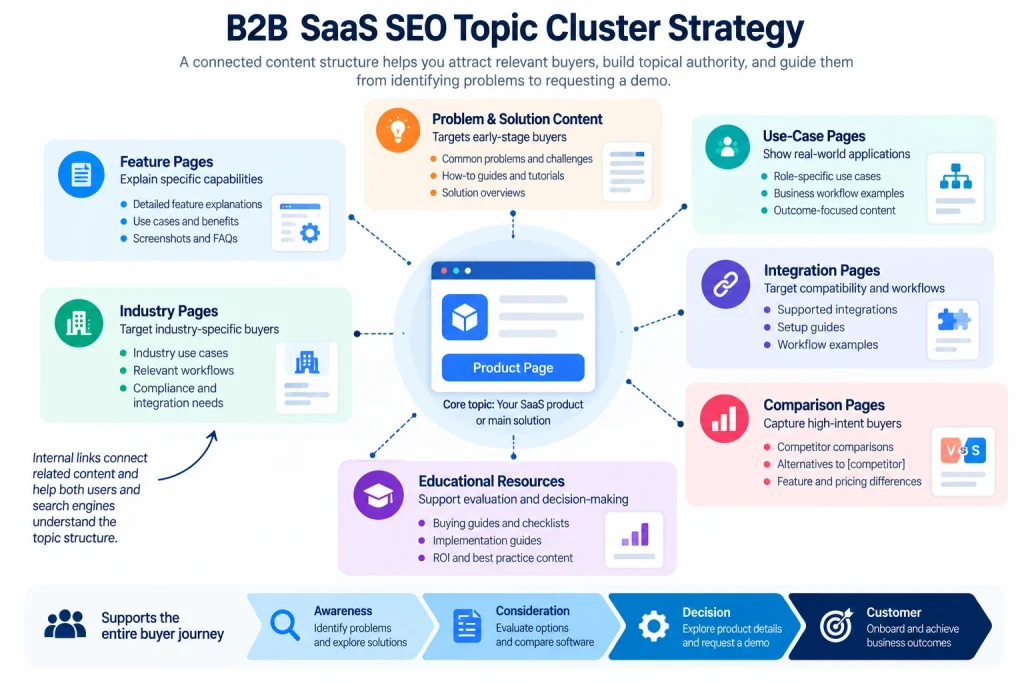
Topic clusters should reflect how product capabilities connect with buyer problems and requirements. A cloud security software cluster includes:
- Core product page
- Threat detection page
- Compliance reporting page
- Integration pages
- Industry pages
- Comparison pages
- Implementation guides
- Educational content
Internal links connect these pages according to genuine topical relationships. This structure strengthens topical depth, supports user navigation, and helps avoid creating several pages that compete for the same search intent.
Which SEO Pages Generate the Most Qualified B2B SaaS Demo Requests?
Pages addressing specific product requirements and purchase decisions have stronger demo potential than broad informational content. Actual performance depends on product fit, search demand, rankings, competition, and page quality.
| Page type | Search intent | What the page should cover | Demo value |
| Product feature and solution pages | Product evaluation | Product capabilities, business problems, workflows, integrations, requirements, outcomes, and next steps | Helps buyers determine whether the software solves a specific need |
| Industry-specific and use case pages | Segment or problem evaluation | Industry workflows, use cases, integrations, security requirements, regulatory context, and customer evidence | Connects product capabilities with a defined ICP or business situation |
| Competitor comparison and alternative pages | Vendor evaluation | Capabilities, target customers, integrations, implementation requirements, verifiable pricing considerations, limitations, and use cases | Reaches buyers actively comparing software options |
| Integration and workflow pages | Technical and operational evaluation | Supported connections, data flows, setup requirements, permissions, limitations, and practical workflows | Captures buyers with specific compatibility requirements |
| High-intent educational content | Purchase preparation | Evaluation criteria, implementation guidance, migration planning, security considerations, purchasing checklists, and ROI frameworks | Supports buyers who are researching requirements before vendor selection |
These page types should connect naturally through internal links. Product and solution pages can link to relevant industry, integration, comparison, and educational content, while supporting pages guide qualified visitors toward the appropriate product or demo page.
How to Optimize B2B SaaS Landing Pages for More Qualified Demo Requests
Landing page optimization improves both conversion volume and lead quality.
Match Messaging to Search Intent and Buyer Pain Points
The page should immediately confirm that it addresses the searched need. Someone searching for contract approval software should see contract approval workflows. An integration search should lead to integration information. A comparison query should lead to useful evaluation criteria. Strong opening content establishes the audience, problem, product capability, outcome, and next step quickly.
Use Relevant Demo CTAs and Reduce Form Friction
The CTA should describe what happens after the click. “Book a Product Demo” is clearer than “Get Started” when the visitor will speak with sales. Qualification fields include business email, company, role, organization size, use case, or required integration. More fields improve qualification but also reduce completion. The best form captures information that sales actually uses.
Build Trust With Product and Customer Evidence
B2B buyers need evidence before engaging with a vendor. Useful proof includes case studies, product screenshots, workflow examples, testimonials, relevant certifications, technical documentation, implementation examples, and verified customer outcomes. Evidence needs to match the claim. Security claims require relevant security proof. Efficiency claims are stronger when supported by documented customer results.
Test Conversion Elements Without Sacrificing Lead Quality
Conversion testing should measure downstream quality. Teams can test headlines, CTAs, form length, product screenshots, proof placement, and page structure. A variation that increases forms but reduces qualification may not be an improvement. Useful metrics include demo conversion rate, qualified demo rate, meeting attendance, sales acceptance, and opportunity creation.
Technical SEO Requirements for B2B SaaS Websites
Technical SEO ensures that search engines can access, render, understand, and index important SaaS content.
| Technical area | What to review | Why it matters |
| Crawlability and indexation | XML sitemaps, robots directives, canonical tags, redirects, duplicate URLs, broken links, internal linking, URL hierarchy, and indexing status | Helps search engines discover and index important product, solution, integration, comparison, and educational pages |
| JavaScript rendering | Rendered content, internal links, navigation, dynamic elements, and search engine accessibility | Prevents important SaaS content from becoming difficult for search engines to process |
| Core Web Vitals | Largest Contentful Paint, Interaction to Next Paint, and Cumulative Layout Shift | Measures loading performance, responsiveness, and visual stability that affect user experience |
| Structured data | Organization, BreadcrumbList, SoftwareApplication, and other applicable Schema.org types | Helps search engines interpret company, software, and site information more accurately |
| Content accuracy | Product details, integrations, pricing, security claims, and technical specifications | Reduces outdated or misleading information on commercially important pages |
Not every URL requires indexing. Login pages, internal search results, utility pages, and duplicate resources may require different handling based on their purpose. Google Search Central identifies Largest Contentful Paint, Interaction to Next Paint, and Cumulative Layout Shift as the current Core Web Vitals. Strong scores support user experience, but they do not guarantee higher rankings.
Structured data should match visible page content and follow current eligibility requirements. Valid SoftwareApplication markup helps search engines understand software information, but it does not guarantee a rich search result.
How to Measure B2B SaaS SEO From Organic Traffic to Revenue
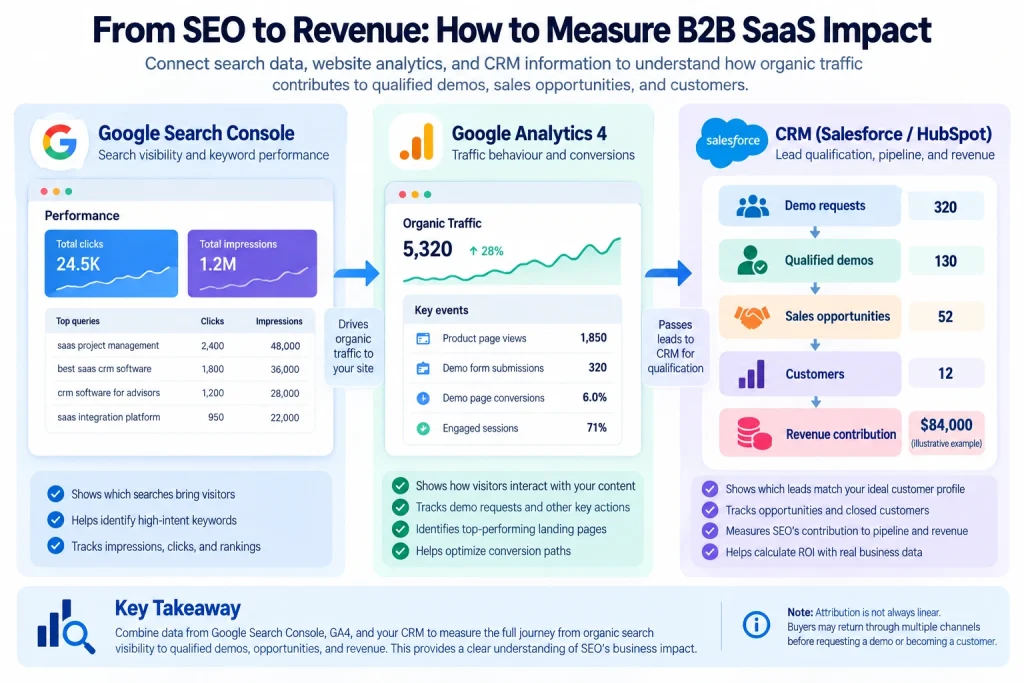
B2B SaaS SEO measurement should connect organic search performance with qualified leads, sales pipeline, customers, and financial contribution.
Track Demo Requests, Qualified Leads, and Opportunities
Demo volume alone does not show commercial performance. Measure how organic visitors progress through the acquisition funnel.
| Funnel stage | Illustrative result | Conversion |
| Organic visitors | 5,000 | Starting point |
| Demo requests | 100 | 2 percent |
| Qualified demos | 40 | 40 percent of demos |
| Sales opportunities | 16 | 40 percent of qualified demos |
| New customers | 4 | 25 percent of opportunities |
These figures are illustrative and should not be treated as SaaS benchmarks. The funnel shows why lead quality matters. A campaign generating fewer demo requests might create more commercial value when a larger share becomes qualified leads, sales opportunities, and customers.
Connect GA4 and CRM Data for Pipeline Attribution
GA4 tracks acquisition sources and lead interactions. Google Search Console provides search query, impression, click, and indexing data. CRM platforms such as HubSpot and Salesforce can record qualification status, sales opportunities, deal values, and customer outcomes. Connecting these systems helps answer important commercial questions:
- Which organic landing pages generate demo requests?
- Which pages attract leads that match the ideal customer profile?
- Which content topics contribute to sales opportunities?
- Which organic leads become customers?
- How much pipeline is associated with organic acquisition?
Attribution requires context. A buyer may first discover the company through organic search, return directly, engage with email, and request a demo later. First touch, last touch, and multi-touch attribution models therefore assign different values to the same customer journey. Teams should document the attribution model used and define what each reported figure represents.
Calculate B2B SaaS SEO ROI Using Customer Data
SEO ROI should use defined financial outcomes rather than treating traffic or pipeline value as revenue. Suppose organic search contributes four new customers paying 500 US dollars per month. Monthly recurring revenue equals 2,000 US dollars. Annualized recurring revenue equals 24,000 US dollars. The 24,000 US dollar figure represents annualized recurring revenue. It does not automatically equal cash received or profit earned.
A stronger ROI assessment should consider:
- SEO investment
- Gross margin
- Implementation costs
- Sales costs
- Customer retention
- Attribution
- Incrementality
A simplified calculation is:
SEO ROI percentage = (attributed gross profit minus SEO investment) divided by SEO investment, multiplied by 100
Pipeline value should remain separate from realized revenue. A sales opportunity represents potential commercial value, not earned revenue.
How Long Does B2B SaaS SEO Take to Generate Qualified Demo Requests?
Results depend on website maturity, existing rankings, technical health, competition, content quality, implementation speed, conversion performance, and sales cycle length.
What to Prioritize During the First 90 Days
| Period | Priorities |
| Days 1 to 30 | Audit technical SEO, define ICPs, review search intent, establish conversion tracking, document CRM stages, and identify priority pages |
| Days 31 to 60 | Improve commercial pages, resolve critical technical issues, strengthen internal links, publish high-intent content, and improve demo paths |
| Days 61 to 90 | Review early performance, refine keyword priorities, validate CRM reporting, test conversion elements, and plan the next content cycle |
This is an implementation framework, not a promise that rankings, demos, or revenue will improve within 90 days.
How to Evaluate Progress Before Revenue Appears
Early indicators include improved indexing, stronger visibility for relevant queries, better commercial keyword positions, more clicks to product pages, higher demo conversion, stronger lead qualification, and early opportunity creation. These signals matter because SaaS sales cycles delay revenue well beyond the first organic visit.
When Should a B2B SaaS Company Invest in Professional SEO Services?
Professional B2B SaaS SEO services make sense when organic search has clear acquisition potential, but the company lacks the expertise or capacity to manage strategy, technical SEO, content, conversion optimization, and measurement consistently.
In-House SEO vs. B2B SaaS SEO Agency
| Consideration | In-house SEO | B2B SaaS SEO agency |
| Product knowledge | Direct access to internal expertise | Requires structured onboarding |
| Specialist expertise | Depends on team composition | Can provide multiple specialist disciplines |
| Execution | Managed internally | Delivered through an agreed scope |
| Scalability | Requires hiring or additional capacity | Can add specialist resources more easily |
| Cost structure | Salaries, tools, and overhead | Retainers, consulting fees, or project fees |
An in-house team suits organizations with established SEO capability and ongoing execution needs. An agency provides strategy, technical expertise, content resources, and implementation support. A consultant provides senior guidance where the internal team already handles execution. A hybrid model can combine internal product knowledge with external specialization.
What to Look for in a B2B SaaS SEO Service Provider
A strong provider should understand both organic search and SaaS revenue mechanics. Evaluate whether the provider can:
- Connect keyword opportunities with the ICP
- Map content to buying stages
- Prioritize technical issues by business impact
- Develop product-focused and commercially relevant pages
- Improve conversion paths
- Report qualified leads and sales opportunities
- Connect SEO performance with CRM outcomes
Reporting should extend beyond rankings and traffic. A credible provider should explain how SEO activity supports relevant visibility, qualified demand, sales opportunities, and customer acquisition without guaranteeing rankings or revenue.
Looking to turn organic search into more qualified SaaS demo requests?
Explore our B2B SaaS SEO services to build a strategy around relevant buyers, commercial search intent, product-focused content, stronger conversion paths, and measurable pipeline performance.
Turn Organic Search Into a Qualified SaaS Acquisition Channel
B2B SaaS SEO creates value when search visibility, product positioning, conversion optimization, lead qualification, and revenue measurement operate as one acquisition system. Start with the ideal customer. Identify searches that represent real buyer problems and product requirements.
Build product, solution, industry, use case, integration, comparison, and educational pages around those needs. Create clear conversion paths and connect analytics with CRM data. The objective is not simply more traffic. It is to attract the right business buyers, help them evaluate the software, and convert relevant organic demand into qualified demos, opportunities, customers, and measurable commercial value.
Frequently Asked Questions About B2B SaaS SEO
What Is the Difference Between B2B SaaS SEO and Traditional SEO?
B2B SaaS SEO targets business buyers, longer buying journeys, multiple stakeholders, and qualified pipeline. Traditional SEO may focus more broadly on traffic, visibility, or simpler conversion goals.
Can SEO Generate Qualified Demo Requests for SaaS Companies?
Yes. SEO can generate qualified demos when keywords match the ideal customer profile, landing pages support product evaluation, and conversion paths capture relevant prospects.
Which Keywords Are Best for B2B SaaS Lead Generation?
Strong opportunities include software category terms, industry solutions, use cases, integrations, product features, comparisons, alternatives, and implementation searches.
How Much Do B2B SaaS SEO Services Cost?
Pricing depends on competition, website complexity, technical needs, content scope, and service depth. Common models include retainers, project fees, consulting, and defined service packages.
How Do You Measure ROI From B2B SaaS SEO?
Measure SEO ROI by connecting organic acquisition with qualified leads, opportunities, customers, and financial contribution, while accounting for costs, attribution, retention, and sales cycle length.