
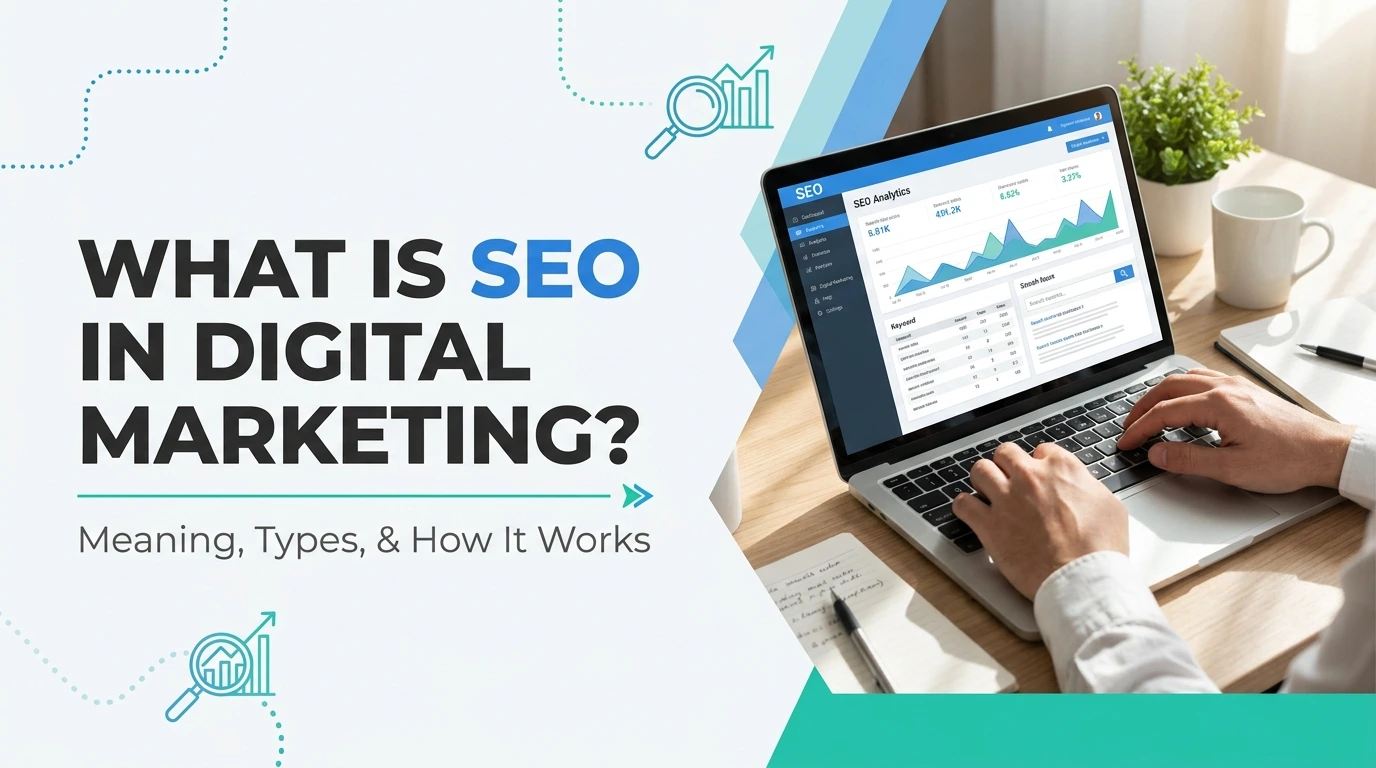
SEO in digital marketing is the process of improving a website so search engines can discover, understand, and show its pages for relevant searches.
SEO stands for Search Engine Optimization. Its purpose is to increase organic search visibility and attract people looking for relevant information, products, services, or solutions.
SEO fits within a broader marketing system. Marketing defines the audience, value proposition, and business goals. Digital marketing uses online channels to reach that audience. SEO focuses on organic search discovery.
Consider a dental clinic that wants more local patients. Marketing identifies the patients it wants to attract. Digital marketing selects the online channels. SEO helps the clinic appear when people search for dental implants, teeth whitening, emergency dental care, or a nearby dentist.
What Is SEO in Digital Marketing?
SEO improves website content, technical accessibility, structure, and credibility to increase visibility in organic search results. Organic results are unpaid search listings. Businesses do not pay Google for higher organic rankings.
SEO helps search engines understand a page and match it with relevant queries. For a dental clinic, this can involve:
- Creating useful service pages
- Improving website performance
- Strengthening internal links
- Maintaining an accurate Google Business Profile
- Publishing patient-focused content
- Earning relevant external mentions
The objective is not simply to rank for more keywords. SEO should attract relevant visitors who can become leads, customers, patients, or buyers.
What Does SEO Stand for in Marketing?
SEO stands for Search Engine Optimization. It combines three ideas:
- Search engines: Platforms such as Google that organize and return information for user queries
- Optimization: Improvements to content, structure, accessibility, and usability
- Organic visibility: Unpaid exposure in search results
A dental clinic optimizing its implant page is not buying an organic position. It is making the page clearer, more useful, and more relevant to people searching for that service.
How Does SEO Help Businesses Attract Customers?
Search queries reveal what people want.
- A person searching for the causes of tooth sensitivity has informational intent.
- A person searching for the best dental implant clinic has commercial intent.
- A person searching for an emergency dentist near them may be ready to act.
SEO connects these needs with suitable content.
- Informational content supports research.
- Comparison content supports evaluation.
- Service pages support inquiries.
- Local pages connect nearby customers with businesses.
Relevant traffic matters more than raw traffic volume.
Where Does SEO Fit Within Marketing and Digital Marketing?
SEO is a specialized part of digital marketing.
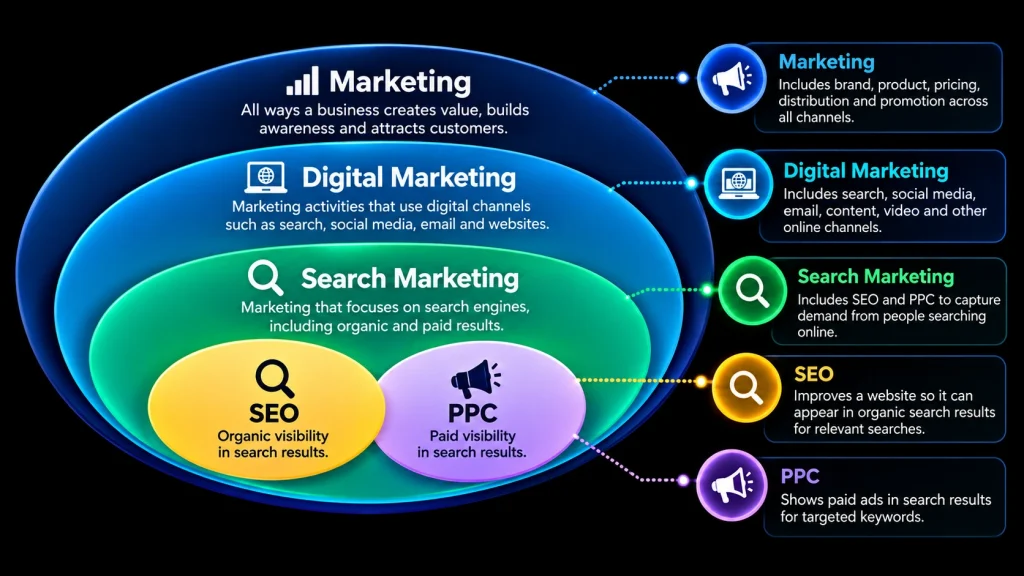
Paid search advertising also sits within search marketing.
This hierarchy matters because SEO cannot replace the broader marketing strategy. A website may attract search traffic but still perform poorly if the offer, positioning, audience, or conversion process is weak.
What Is Marketing?
Marketing identifies customer needs, creates relevant value, communicates that value, and supports acquisition and retention.
For a dental clinic, marketing may determine:
- Which patients to target
- Which treatments to prioritize
- How services should be positioned
- What differentiates the clinic
SEO supports these decisions by connecting relevant search demand with suitable website content.
What Are the Core Principles of Marketing?
Two common frameworks are the 4Ps and STP. The 4Ps are:
- Product
- Price
- Place
- Promotion
STP represents:
- Segmentation
- Targeting
- Positioning
A dental clinic might segment families, cosmetic dentistry patients, orthodontic patients, and emergency patients. It then chooses priority groups and positions its services for those audiences.
SEO should reflect those marketing decisions.
What Is Digital Marketing?
Digital marketing uses online channels to reach audiences, communicate value, generate demand, capture demand, and measure results. Common channels include:
- Websites
- Search engines
- Social media
- Online advertising
- Marketplaces
SEO is one digital marketing discipline among several.
Digital Marketing vs Traditional Marketing
| Area | Traditional marketing | Digital marketing |
| Channels | Print, television, radio, outdoor media | Websites, search, email, social media, digital ads |
| Targeting | Often broad | Can be more precise |
| Interaction | Usually limited | Can support immediate clicks, forms, messages, and purchases |
| Measurement | Often less detailed | Can track traffic, leads, conversions, and revenue |
The right channel depends on the audience, business goal, budget, and buying journey.
What Are the Main Types of Digital Marketing?
Major digital marketing disciplines include:
- SEO: Organic search visibility
- Paid search: Paid visibility in search results
- Content marketing: Articles, guides, videos, landing pages, and other resources
- Social media marketing: Brand discovery, engagement, and distribution
- Email marketing: Communication with leads and customers
- Affiliate marketing: Partner driven referrals and sales
- Conversion optimization: Improving the percentage of visitors who take desired actions
These channels often work together.
How Does SEO Work?
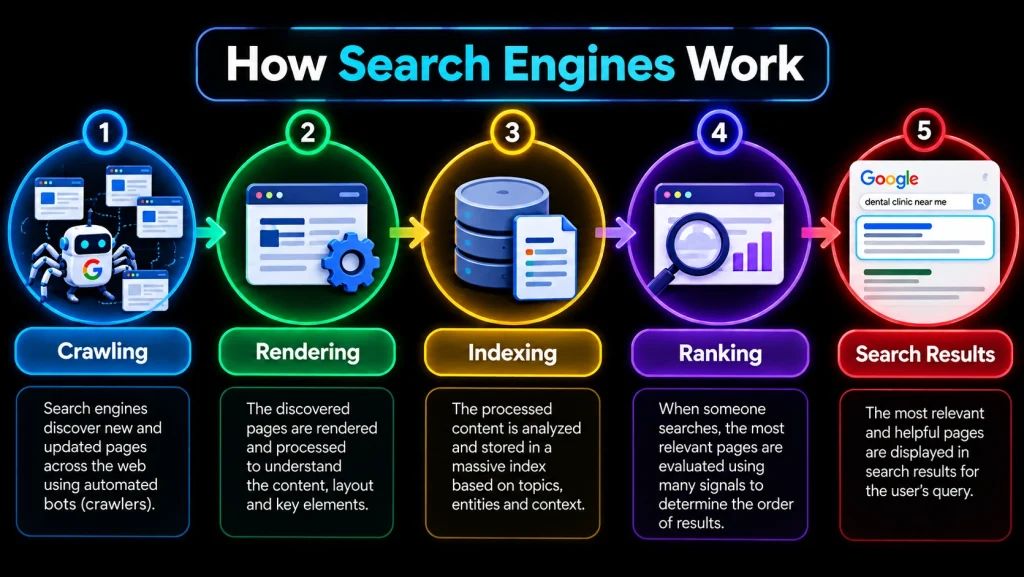
SEO helps search engines discover, process, understand, and evaluate website pages.
The core process involves crawling, indexing, and ranking.
What Appears on a Search Results Page?
Search results can include:
- Organic listings
- Paid advertisements
- Local business results
- Featured answers
- Images
- Videos
- Shopping features
- AI Overviews
Visibility therefore extends beyond traditional organic listings.
What Are the Main Types of SEO?
The three core SEO disciplines are On-Page SEO, Technical SEO, and Off-Page SEO. Specialized forms include Local SEO, Ecommerce SEO, International SEO, and Enterprise SEO.
On-Page SEO
On-page SEO improves elements within a page. Important elements include:
- Page titles
- Headings
- Body content
- Images
- Internal links
- Anchor text
- Topical coverage
- Search intent alignment
Keywords help clarify topics and customer language, but repetition does not make content useful. A strong dental implant page should explain the treatment, suitability, procedure, recovery, cost, risks, and next steps.
Technical SEO
Technical SEO helps search engines access and process website content. Important areas include:
- Crawl access
- Indexing controls
- XML sitemaps
- Canonical URLs
- Mobile usability
- Website performance
- Structured data
- JavaScript rendering
Technical SEO supports content by removing barriers to discovery and indexing.
Off-Page SEO
Off-page SEO covers recognition outside the website. Common signals include:
- Backlinks
- Brand mentions
- Media coverage
- Expert citations
- Digital PR
Link quality matters more than raw quantity. Relevant editorial references are more useful than large numbers of unrelated links created only to influence rankings.
Local SEO
Local SEO improves visibility for searches connected with a geographic area. Important elements include:
- Google Business Profile
- Accurate contact information
- Business categories
- Reviews
- Local service pages
- Geographic relevance
Local SEO is important for clinics, restaurants, legal practices, salons, trades, and repair companies.
Ecommerce, International, and Enterprise SEO
- Ecommerce SEO focuses on product pages, category pages, product discovery, and store architecture.
- International SEO supports websites serving multiple languages or countries.
- Enterprise SEO manages search visibility across very large websites with complex templates, internal linking, publishing workflows, and large numbers of URLs.
Why Is SEO Important in Digital Marketing?
SEO matters because search connects businesses with people who are already expressing needs. It supports:
- Organic visibility
- Qualified traffic
- Brand awareness
- Lead generation
- Customer acquisition
- Sales
- Long-term growth
The main value of SEO comes from business outcomes, not rankings alone.
Attracting Qualified Traffic
Relevant visitors are more valuable than large volumes of unrelated traffic. One thousand visitors researching an unrelated topic may create little value for a dental clinic.
Fifty users actively looking for dental implant treatment in the clinic’s area may have greater commercial potential. Search intent should therefore influence keyword selection, page creation, and measurement.
Building Credibility and Trust
Search visibility can increase brand recognition, but trust depends on content quality, accuracy, transparency, and expertise. Google uses the concept of E E A T to describe experience, expertise, authoritativeness, and trustworthiness.
A dental clinic can strengthen credibility by:
- Publishing accurate health information
- Identifying qualified contributors
- Showing professional credentials
- Explaining treatments clearly
- Reviewing important content regularly
Supporting Leads and Revenue
SEO creates business value when visitors complete meaningful actions. For a dental clinic, this means:
- Calling the practice
- Booking an appointment
- Submitting a consultation form
For an online store, the goal may be a purchase. For a software company, it may be a trial or demo request.
Leads, customers, and revenue show business impact directly.
What Are the Core Elements of an Effective SEO Strategy?
An effective SEO strategy combines research, useful content, site structure, technical accessibility, credibility, and measurement.
| SEO element | What it covers | Practical use |
| Keyword Research and Search Intent | Relevance, intent, search demand, competition, result types, and business value | Group related searches into logical topics and map them to the right page. For example, implant price, implant cost, and treatment pricing can be covered within one focused topic. |
| Helpful Content and Semantic SEO | Clear answers, related entities, topical relationships, and natural language | Build content around the subject rather than repeating exact keywords. A dental implant page may cover missing teeth, implant posts, crowns, jawbone health, healing, suitability, and aftercare. |
| Website Architecture and Internal Linking | Site hierarchy, service groups, navigation, and contextual links | Organize pages into clear sections and connect related articles, service pages, and supporting resources. |
| Technical Accessibility | Crawling, indexing, canonicalization, performance, mobile usability, and structured data | Remove technical barriers that prevent important pages from being discovered, processed, or indexed. |
| External Credibility | Legitimate links, professional references, press mentions, expert citations, and partnerships | Strengthen reputation and authority through genuine third-party recognition. |
| Measurement | Search visibility, traffic, conversions, and business outcomes | Track performance and refine the SEO strategy based on results rather than rankings alone. |
How Does SEO Support the Customer Journey?
Search behavior changes as people move from learning to evaluating and acting.
| Journey stage | Search behavior | Useful content |
| Awareness | Learning about a problem | Articles, guides, explanations |
| Consideration | Comparing solutions | Comparisons, reviews, service pages |
| Conversion | Looking for a provider or product | Service, product, location, and booking pages |
| Retention | Seeking support | Help content and aftercare resources |
SEO can therefore support more than initial discovery.
How Does SEO Work With Other Digital Marketing Channels?
SEO works best as part of an integrated strategy.
SEO vs PPC vs SEM
| Channel | Purpose | Payment model | Best use |
| SEO | Organic search visibility | No payment per organic click | Long-term demand capture |
| PPC | Paid advertising visibility | Paid advertising model | Fast visibility and controlled targeting |
| SEM | Search marketing | Depends on usage | Coordinating search acquisition |
SEO and PPC can work together. One does not automatically replace the other.
SEO and Content Marketing
- Content marketing creates useful resources.
- SEO helps suitable content become discoverable through search.
The two overlap, but they are not identical. A newsletter may be useful content without an SEO purpose, while a service page may be heavily optimized for search.
SEO and Social Media
- Social media can create awareness and distribute content.
- SEO often captures explicit search demand.
A person may discover a dental clinic through social media and later search for the clinic or its services through Google.
SEO and Email Marketing
- SEO can attract visitors who later become subscribers, leads, or customers.
- Email can continue communication after that initial discovery.
SEO supports acquisition. Email supports nurturing and retention.
Demand Creation vs Demand Capture
| Situation | SEO | Paid search | Social and brand marketing |
| Existing demand | Strong | Strong | Supporting |
| Immediate visibility | Limited in the short term | Strong | Moderate to strong |
| New category with little search demand | Limited initially | Limited by demand | Strong |
| Long-term search discovery | Strong | Depends on continued spend | Supporting |
SEO is useful for capturing demand that already exists.
How to Build an SEO Strategy for a Small Business
A practical SEO strategy should connect every action with a business objective.
Step 1: Define Business Goals and Audience
Identify:
- Priority customers
- Customer problems
- Service area
- Priority products or services
- Desired conversions
- Competitive position
Step 2: Audit the Website
Review:
- Technical health
- Existing content
- Organic visibility
- Important pages
- Indexing status
- Internal links
- Conversion paths
Competitor analysis reveals content gaps and search opportunities.
Step 3: Research Keywords and Map Intent
Group related queries by topic and intent. Assign each important topic to the most suitable page type, such as:
- Service page
- Article
- Product page
- Category page
- Location page
- Comparison page
Step 4: Improve Priority Pages
Optimize important pages for:
- Accuracy
- Structure
- Titles
- Headings
- Internal links
- Topical coverage
- Conversion paths
Improve existing high-value pages before creating unnecessary new content.
Step 5: Fix Technical Issues and Build Credibility
Resolve problems that affect crawling, rendering, indexing, performance, and website structure. Strengthen credibility through genuine expertise, partnerships, useful resources, legitimate links, and media recognition.
Step 6: Measure and Refine
Monitor search performance and business outcomes.
- A page with impressions but few clicks may need stronger relevance or search presentation.
- A page with traffic but few inquiries may have a conversion issue.
- A page with modest traffic but profitable leads may deserve more investment.
First 30 Days of SEO
| Week | Main action | Deliverable |
| Week 1 | Define goals, audiences, services, locations, and conversions | SEO goals and measurement setup |
| Week 2 | Audit content, indexing, architecture, and technical issues | Prioritized issue list |
| Week 3 | Research demand and map keywords to pages | Keyword and intent map |
| Week 4 | Improve priority pages and fix major issues | Updated pages and reporting baseline |
The first month should establish a measurable foundation rather than chase immediate ranking promises.
Real World Example: How Marketing, Digital Marketing, and SEO Work Together
Consider a dental clinic that wants more implant consultations.
- Marketing identifies adults with missing teeth as a priority audience and defines the clinic’s positioning.
- Digital marketing uses the website, paid search, social media, educational content, and email to reach potential patients.
- SEO improves implant-related service pages, supporting articles, Google Business Profile information, internal links, and technical accessibility.
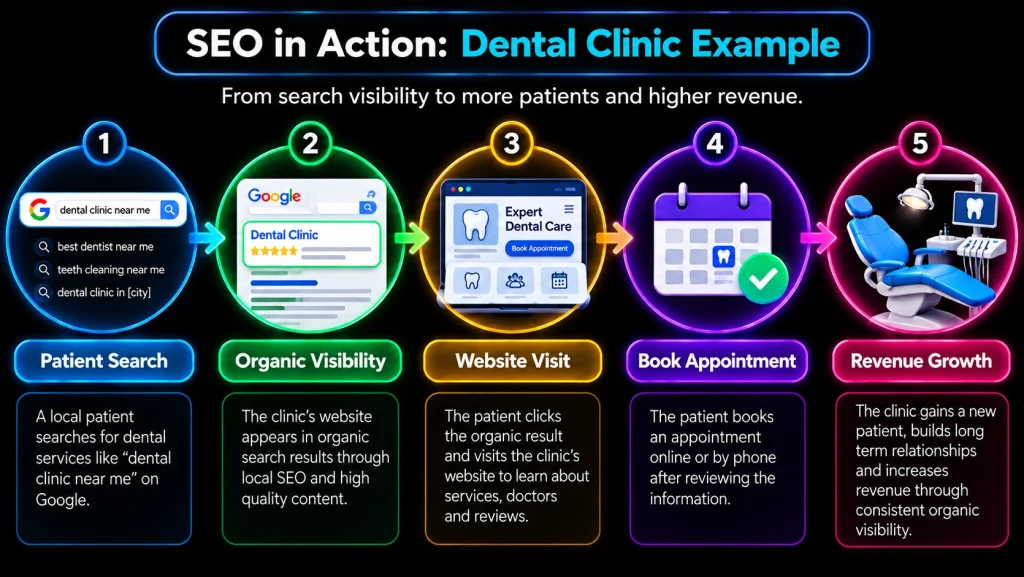
A hypothetical monthly result might look like this:
| Stage | Example result |
| Organic search impressions | 1,000 |
| Website visits | 80 |
| Appointment inquiries | 12 |
| Consultations | 6 |
| Treatment customers | 2 |
| Treatment value per customer | CAD 3,000 |
| Hypothetical revenue | CAD 6,000 |
These numbers are illustrative only. The example shows the commercial path from search visibility to clicks, inquiries, customers, and revenue.
How to Measure SEO Performance
SEO performance should be measured across three levels: search visibility, website behavior, and business results.
| Measurement area | Key metrics | What it shows | Primary tool |
| Search visibility | Impressions, clicks, click-through rate, average position | How often the website appears in search and attracts clicks | Google Search Console |
| Website behavior | Organic sessions, landing page activity, engagement, lead submissions, purchases | What organic visitors do after reaching the website | Google Analytics 4 |
| Business results | Qualified leads, appointments, purchases, revenue, conversion rate, acquisition cost, customer value | Whether SEO contributes to commercial outcomes | Analytics, CRM, and sales data |
SEO KPIs and Business Outcomes
| Metric | What it shows | Business meaning |
| Impressions | Search visibility | Potential exposure to relevant searchers |
| Clicks | Search traffic | Visits generated from search |
| Organic sessions | Website traffic from organic search | Size of the acquired organic audience |
| Leads | Potential customers generated | Commercial opportunities created |
| Conversion rate | Percentage completing a desired action | Traffic quality and page effectiveness |
| Revenue | Financial value generated | Direct business contribution |
| Acquisition cost | Cost of acquiring a customer | Efficiency of SEO investment |
| Customer value | Revenue generated by a customer | Longer-term commercial impact |
A basic SEO return calculation is:
SEO return percentage equals SEO attributed profit minus SEO cost, divided by SEO cost, multiplied by 100.
Attribution should be interpreted carefully because customers may interact with several channels before converting.
Best SEO Tools for Beginners
| Tool | Best use |
| Google Search Console | Search performance, indexing, queries, clicks, and impressions |
| Google Analytics 4 | Website behavior, traffic, engagement, and conversions |
| Google Keyword Planner | Keyword ideas and search demand research |
| Screaming Frog | Technical crawling and website issue detection |
| Ahrefs | Keyword, competitor, backlink, and site research |
| Semrush | Keyword research, competitor analysis, audits, and marketing insights |
Beginners do not need every SEO tool. Google Search Console and Google Analytics 4 provide a strong starting point for measuring visibility, traffic, and conversions.
How Long Does SEO Take and What Does It Cost?
SEO has no universal timeline or fixed cost. Results depend on the website, market, competition, resources, and quality of execution.
| Factor | How it affects SEO |
| Competition | More competitive markets usually require more time and resources |
| Website history | Established websites may start with stronger visibility than new websites |
| Technical condition | Crawl, indexing, performance, or architecture issues can slow progress |
| Content quality | Accurate, useful, relevant content improves the foundation for organic visibility |
| Available resources | More capable teams can research, publish, optimize, and fix issues faster |
| Search demand | Results depend partly on whether customers actively search for the topic or service |
| Execution quality | Consistent research, content, technical work, and measurement affect performance |
No responsible SEO provider can guarantee a specific organic ranking by a specific date.
Is SEO Free?
Organic clicks do not require payment to Google, but SEO still requires time, expertise, tools, and other resources.
| Potential SEO cost | What it may cover |
| Staff time | Research, optimization, reporting, and coordination |
| Content production | Articles, service pages, product content, images, and updates |
| Development | Technical fixes, performance improvements, and website changes |
| SEO specialists | Strategy, audits, technical SEO, and ongoing optimization |
| Software | Keyword research, crawling, analytics, and competitor research |
| Public relations | Media outreach, brand mentions, and legitimate editorial coverage |
| Agency services | Strategy, implementation, content, reporting, or full SEO management |
Small businesses handle many basic SEO activities internally. More complex websites require developers, SEO specialists, content experts, or agency support.
How Is SEO Changing With AI Search and Semantic Search?
Search increasingly uses AI to help users explore complex questions and discover information. Google Search includes AI Overviews and AI Mode alongside traditional search experiences.
SEO therefore needs to support both conventional organic results and newer AI-assisted discovery.
What Is Semantic SEO?
Semantic SEO focuses on meaning, entities, context, and relationships rather than exact keyword repetition. A page about dental implants can naturally connect the main topic with:
- Missing teeth
- Crowns
- Jawbone health
- Healing
- Consultation
- Suitability
- Aftercare
These relationships create stronger topical context.
What Are AEO and GEO?
- AEO commonly means Answer Engine Optimization.
- GEO commonly means Generative Engine Optimization.
Both terms describe efforts to improve visibility within answer-based and generative search experiences. Their definitions are less standardized than traditional SEO terminology.
The practical foundations remain familiar:
- Accurate information
- Clear structure
- Useful content
- Technical accessibility
- Strong entities
- Credible expertise
Does Traditional SEO Still Matter in AI Search?
Yes.
AI-based search changes how information may be presented, but websites still need to be accessible, understandable, relevant, and useful. Strong SEO foundations continue to support discovery across traditional and AI-assisted search experiences.
Common SEO Mistakes and Misconceptions
| Misconception | Problem | Better approach |
| SEO guarantees rankings | Creates unrealistic expectations | Measure visibility, traffic, leads, and revenue |
| SEO is free | Ignores operational costs | Budget for tools, people, and implementation |
| More keywords improve results | Creates repetitive content | Cover search intent and related concepts naturally |
| Backlinks determine everything | Creates an unbalanced strategy | Combine content, technical health, relevance, and credibility |
| Technical SEO can be ignored | Can limit discovery and indexing | Maintain technical accessibility |
| SEO is a one-time task | Allows content and strategy to become outdated | Review and improve performance continuously |
Frequently Asked Questions About SEO in Digital Marketing
Do I Need a Website for SEO?
Most traditional SEO strategies depend on having website pages that search engines can discover and index. Local businesses can also gain visibility through Google Business Profile, but a website provides greater control over services, content, conversions, and brand presentation.
Does SEO Require Coding?
Basic SEO does not always require coding.
Content, headings, internal links, local business information, and search intent can often be improved without programming. Technical SEO may require knowledge of HTML, JavaScript, redirects, structured data, and website infrastructure.
Can SEO Work Without Paid Advertising?
Yes.
SEO does not require paid search campaigns. Paid advertising can complement SEO, but organic rankings do not depend on running ads.
Is SEO Better Than Social Media Marketing?
Neither is universally better.
SEO is strong when customers actively search for solutions. Social media is useful for awareness, engagement, community building, and demand creation.
Can Beginners Learn SEO?
Yes.
Beginners can learn keyword research, search intent, on-page SEO, internal linking, Local SEO, Search Console, and basic technical concepts. Complex websites may eventually require specialist support.
Which Type of SEO Should a Small Business Start With?
A local service business should prioritize:
- Accessible service pages
- Local SEO
- Google Business Profile
- Internal links
- Reviews
- Basic technical health
An online retailer may prioritize product pages, category pages, site architecture, and technical SEO.
Conclusion
SEO is the part of digital marketing that improves organic search discoverability.
Marketing defines the customer and business objective. Digital marketing selects the online channels. SEO connects relevant search demand with useful, accessible website content.
That visibility can contribute to qualified traffic, leads, customers, and revenue.
Start with one business goal, identify what the target customer searches for, and evaluate whether the relevant page clearly satisfies that need. That connection between customer intent, useful content, and business value is the foundation of SEO in digital marketing.