


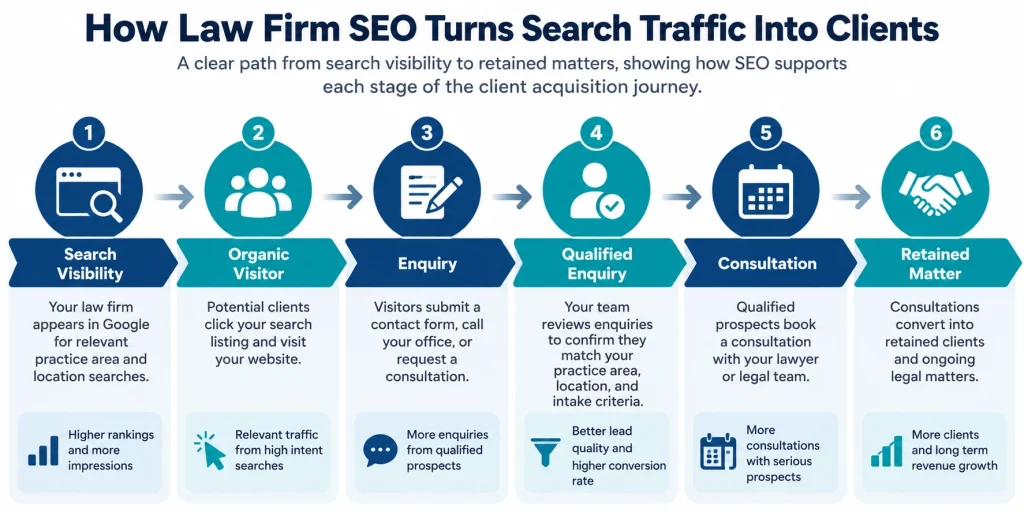
Choosing SEO services for law firms requires more than comparing retainers or ranking promises. A legal SEO specialist should understand practice-area competition, local search, professional advertising requirements, and how organic visibility contributes to qualified enquiries, consultations, and retained matters.
Canadian law firms also need to consider provincial and territorial rules. The Canadian Bar Association notes that advertising requirements vary by jurisdiction, so firms should assess providers against the rules that apply to their practice. This guide explains how to compare legal SEO providers before signing a contract.
Before Hiring an SEO Specialist, Identify What Your Law Firm Actually Needs
Define the business problem before evaluating agencies. Your firm may need more qualified consultations, stronger visibility for an important practice area, better local search performance, expansion into another market, or improved lead quality. These goals require different SEO priorities.
Are You Trying to Attract More Consultations or Expand Into New Practice Areas?
Start with the commercial outcome. Ask each provider how its proposed work connects to the specific outcome your firm wants.
- A law firm may be looking for more qualified consultation requests, stronger visibility for a profitable practice area, expansion into another city, reduced dependence on paid search, or better performance from existing service pages.
- An immigration firm expanding into another Canadian city may need new location and service content.
- A family law firm receiving strong traffic but few consultation requests may need better intent targeting, landing pages, and conversion measurement.
Is Your Biggest Challenge Local Visibility, Website Traffic, or Lead Quality?
Different symptoms require different solutions. A capable agency should diagnose the underlying problem before recommending more content, links, or traffic. For example;
- Low visibility and low enquiries may indicate technical problems, weak practice area coverage, poor local optimisation, or insufficient authority.
- High traffic and low enquiries may indicate weak commercial intent, ineffective landing pages, unclear calls to action, or traffic from users seeking general information.
- High enquiry volume with weak lead quality suggests a targeting problem.
An Ottawa criminal defence firm gains little from enquiries about British Columbia family law. A higher lead count can still represent poor SEO performance if prospects fall outside the firm’s practice area, location, or intake criteria.
Seven Things to Verify Before Hiring a Legal SEO Specialist
Use these seven criteria to compare legal SEO providers consistently.
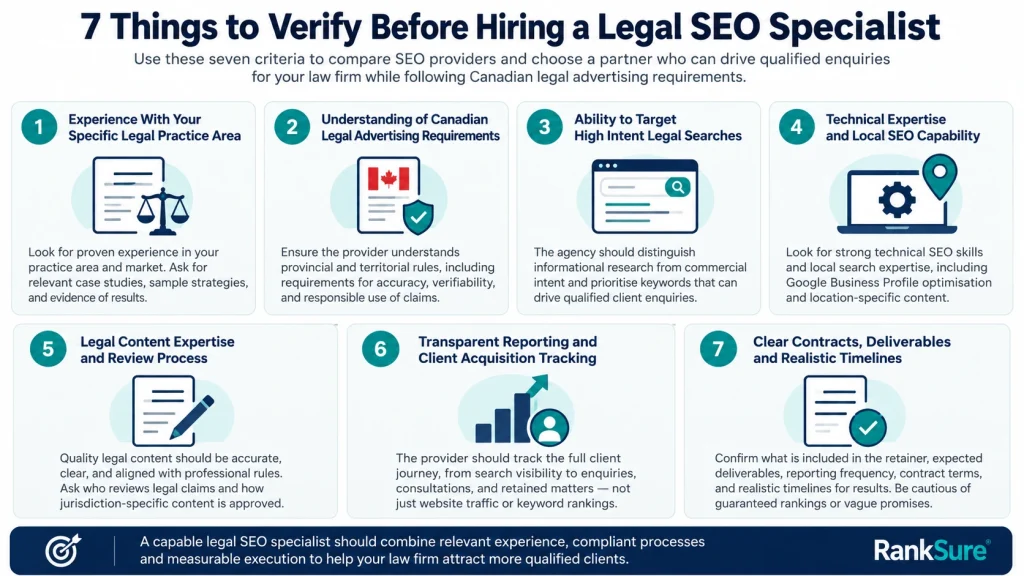
1. Experience With Your Specific Legal Practice Area
Look for relevant experience in your practice area and market. Ask for case studies, comparable client work, or a clear explanation of how the agency researches legal search intent.
2. Understanding of Canadian Legal Advertising Requirements
The provider should understand that professional advertising rules vary by jurisdiction and should have a process for reviewing legal claims, credentials, outcomes, and jurisdiction-specific content.
3. Ability to Target High-Intent Legal Searches
The agency should distinguish general research queries from searches that indicate stronger client intent and prioritise keywords that can lead to qualified enquiries.
4. Proven Technical and Local SEO Capabilities
Verify that the provider can handle technical SEO, Google Business Profile optimisation, local landing pages, internal linking, indexing issues, and location-based search visibility.
5. Processes for Reviewing Legal Content Accuracy
Ask how legal content is researched, reviewed, approved, and updated. The law firm should retain appropriate control over substantive legal accuracy.
6. Transparent Reporting and Client Acquisition Tracking
Reporting should connect search visibility to enquiries, consultations, and retained matters, not just traffic and rankings.
7. Clear Deliverables, Responsibilities, Account Ownership, and Conflict Policies
The proposal should define scope, implementation responsibilities, reporting, account access, content ownership, timelines, and how the agency handles direct competitor relationships.
How to Verify an SEO Agency’s Claims Before Signing a Contract
Do not evaluate a provider through its sales presentation alone. Verify important claims through case studies, client references, reporting examples, team information, and clear explanations of the proposed work.
What to Look for in Legal SEO Case Studies
A useful case study provides context. A traffic graph alone doesn’t explain whether the additional visitors were relevant or whether the agency produced the improvement. Look for the practice area, geographic market, starting condition, problem being solved, work completed, measurement period, visibility changes, and conversion results where available.
A provider may need to protect client confidentiality. It should still be able to explain its methodology and the type of result produced without disclosing sensitive information.
How to Evaluate Client References and Previous Results
Client references are useful to verify execution quality. References are especially useful for assessing reliability, transparency, and accountability. Ask whether the agency completed promised work, explained recommendations clearly, communicated consistently, provided understandable reporting, maintained proper account access, and responded constructively when performance changed.
How to Identify Misleading Ranking and Traffic Promises
Treat guaranteed ranking claims as a major warning sign. Evaluate claims carefully.
We guarantee a number one ranking
Ask how the provider can guarantee an outcome controlled by Google’s ranking systems.
We guarantee a specific traffic increase
Ask which search terms, pages, assumptions, and prospective client segments support that projection.
We have a special relationship with Google
Ask the agency to explain exactly what that statement means.
Our strategy is proprietary, so we cannot explain it
The provider may protect internal processes, but it should still explain what work will be performed on your website and accounts. Require a clear explanation whenever a claim affects your contract decision.
What Should Be Included in a Law Firm SEO Proposal?
A law firm SEO proposal should clearly define strategy, deliverables, implementation responsibilities, measurement, ownership, pricing, and contract terms. The goal is to make the scope easy to verify before work begins.
Essential Deliverables and Implementation Responsibilities
| Deliverable | What the Proposal Should Define | How the Firm Can Verify It |
| Technical audit | Pages reviewed, issue categories, priorities, and recommended fixes | Review the documented findings and priority list |
| Technical implementation | Which fixes the agency will complete and which require another developer | Confirm implemented changes on the live website |
| Practice area optimisation | Target pages, search intent research, content recommendations, and internal linking work | Compare approved recommendations with published pages |
| Content creation | Number and type of pages, research process, review responsibilities, and publication workflow | Review briefs, drafts, approvals, and published content |
| Local SEO | Google Business Profile work, location optimisation, citations, and local visibility reporting | Inspect profiles, listings, and location information directly |
| Authority development | Planned mentions, citations, outreach, or links | Review actual placements and their relevance |
| Conversion tracking | Calls, forms, bookings, and other conversion events to be measured | Test tracked actions and reporting |
| Reporting | Metrics, commentary, completed work, unresolved issues, and future priorities | Compare reports with source platforms where appropriate |
Reporting Expectations and Performance Indicators
The proposal should explain how progress will be measured. Useful indicators can include organic visibility, Google Search Console clicks, landing page performance, local visibility, qualified enquiries, consultation requests, technical improvements, completed deliverables, and retained matters where suitable attribution data is available.
More metrics do not automatically mean better reporting. A useful report explains what changed, why it matters, and what action should follow.
Contract Terms, Content Ownership, and Cancellation Policies
Review operational terms before signing. Confirm the contract length, cancellation requirements, notice period, included services, additional charges, content ownership, website and account access, reporting access, competitor conflict policies, and responsibilities after termination. Ownership and access should be clear before the relationship begins, not after it ends.
Comparing Two Legal SEO Agencies: A Practical Evaluation Example
A consistent scorecard makes agency comparison more objective. Consider a fictional Canadian family law firm comparing Agency A with Agency B.
- Agency A emphasizes traffic growth, faster rankings, a lower retainer, and high content volume.
- Agency B reviews intake data, priority practice areas, technical issues, local competitors, legal review processes, and conversion measurement before proposing work.
Comparing Expertise, Strategy, and Deliverables
| Evaluation Criterion | Weight | Agency A | Agency B | Key Difference |
| Legal industry and practice area expertise | 20 percent | 3 out of 5 | 5 out of 5 | Agency B provides relevant family law examples from comparable markets and demonstrates a stronger understanding of practice area search intent. |
| Client acquisition and intake strategy | 20 percent | 2 out of 5 | 5 out of 5 | Agency A focuses mainly on traffic. Agency B connects SEO with enquiries, qualification, consultations, and intake capacity. |
| Technical and local SEO capabilities | 20 percent | 3 out of 5 | 4 out of 5 | Both offer technical SEO, but Agency B defines implementation responsibilities and local competitor analysis more clearly. |
| Legal content accuracy and compliance awareness | 20 percent | 2 out of 5 | 5 out of 5 | Agency B includes lawyer approval and jurisdiction-specific review in its content process. |
| Reporting and transparency | 10 percent | 2 out of 5 | 4 out of 5 | Agency A reports mainly on traffic and rankings. Agency B also reports enquiries, completed work, and next actions. |
| Pricing and contract clarity | 10 percent | 3 out of 5 | 4 out of 5 | Agency B costs more but defines scope, ownership, responsibilities, and exclusions more clearly. |
The stronger provider is not the cheaper one. Compare the evidence behind each score, including case studies, reporting examples, implementation responsibilities, legal review processes, and contract terms.
Using a Weighted Scorecard to Make Your Decision
Use the following editorial weighting model:
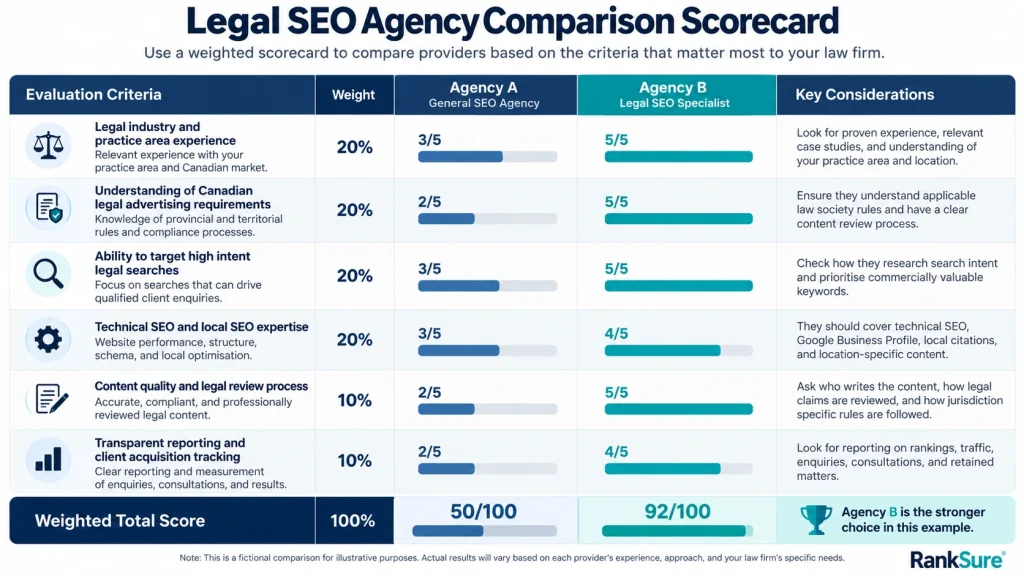
This is a decision framework, not an industry standard. Require supporting evidence for every score above three. Evidence may include case studies, reporting examples, implementation records, documented workflows, account access policies, or client references. This keeps a persuasive sales presentation from receiving the same weight as demonstrated execution capability.
Five Warning Signs That an SEO Agency May Be the Wrong Choice for Your Firm
Some warning signs should trigger further due diligence.
1. Guaranteed Google Rankings
Google Search Central states that no SEO provider can guarantee a number one ranking. Treat guaranteed positions as a vendor risk signal.
2. The Agency Cannot Explain Its Work
Your provider should be able to explain what it plans to change and why. Technical complexity does not justify complete secrecy.
3. Case Studies Show Traffic Without Relevant Business Context
Traffic growth does not prove client acquisition value. Ask which pages improved, which searches generated visits, and whether relevant enquiries or consultations changed.
4. Legal Content Is Published Without a Defined Approval Process
Your firm should know who verifies substantive legal claims before publication. This is particularly important for jurisdiction-specific information, credentials, outcomes, rankings, awards, testimonials, and specialist claims.
5. Ownership or Competitor Relationships Are Unclear
Your firm should understand who controls important accounts and whether the agency also serves direct competitors. Clarify account access, content ownership, confidentiality, strategy separation, and competitor policies before signing.
What Should Happen During the First 90 Days After Hiring an SEO Agency?
The first 90 days should establish strategy, measurement, technical priorities, content requirements, and implementation responsibilities. The period should produce observable work rather than guaranteed ranking outcomes.
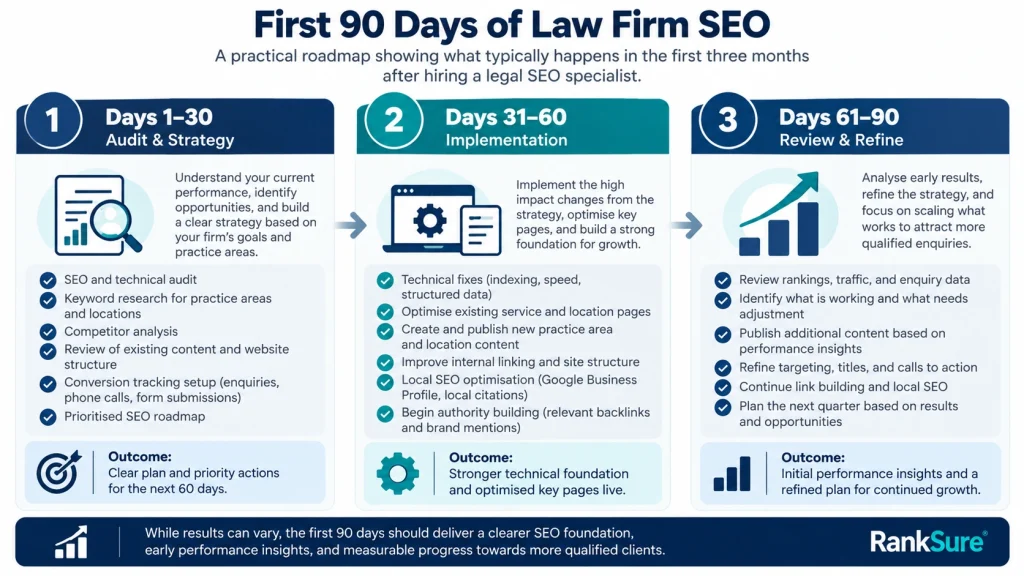
The First 30 Days
The provider establishes a baseline. The firm understands which issues were found, which matter most, and what work comes first.
Days 31 Through 60
The engagement moves into implementation. The agency documents completed work, dependencies, and outstanding actions.
Days 61 Through 90
Execution continues while early performance signals are reviewed. At the 90-day review, the firm should be able to identify completed deliverables, unresolved dependencies, approved content, measurement coverage, early performance signals, and the next quarter’s priorities.
The first 90 days primarily reveal whether the agency is executing the agreed strategy, communicating clearly, and building a measurable foundation. Search performance may need more time because crawling, indexing, competition, website history, and implementation speed affect results.
When Is Hiring a Legal SEO Specialist Worth the Investment?
Hiring a legal SEO specialist is worth considering when organic search can support the firm’s client acquisition goals and the firm has the resources to act on the resulting opportunities. SEO is relevant when prospective clients actively search for your practice areas, competitors consistently appear for important local searches, your website generates few suitable enquiries, important services have weak visibility, your firm plans to enter another market, or paid advertising accounts for most search-based client acquisition.
SEO may be a weak immediate priority when the firm cannot respond to additional enquiries or lacks the internal resources required for approvals and implementation. More visibility cannot fix every operational problem. A law firm that regularly misses calls or delays consultation follow-up may need to improve intake capacity before increasing lead volume.
Make an Informed Decision About Your Law Firm’s SEO Partner
The best SEO services for law firms are not defined by the largest keyword list, lowest monthly retainer, or strongest ranking promise. Choose a provider based on evidence. Verify experience with your practice area. Assess whether the agency understands high-intent legal searches and local competition. Confirm how legal content will be reviewed. Require clear deliverables.
Clarify competitor conflicts. Retain appropriate access to important accounts. Connect reporting with qualified enquiries and consultations. Use the same evaluation criteria for every provider. A disciplined selection process makes it easier to distinguish an agency selling general search visibility from one that understands how organic search fits into long-term law firm client acquisition.
RankSure can help your firm assess search visibility, technical priorities, conversion measurement, and reporting requirements before deciding what level of SEO investment makes sense. Discuss your law firm’s SEO goals with RankSure to identify which organic search priorities deserve attention first.
Frequently Asked Questions About Hiring a Legal SEO Specialist
What Is a Legal SEO Specialist?
A legal SEO specialist is an SEO professional or agency experienced in improving search visibility for law firms through technical SEO, local SEO, legal content, and conversion tracking.
Should a Law Firm Hire a Legal SEO Specialist or a General SEO Agency?
Choose the provider with relevant legal industry knowledge, strong processes, and verifiable results. A general agency can still be suitable if it demonstrates the required expertise.
What Should I Ask a Law Firm SEO Agency Before Hiring It?
Ask about practice area experience, case studies, technical implementation, local SEO, legal content review, reporting, account ownership, competitor conflicts, and contract terms.
How Can a Law Firm Verify an SEO Agency’s Results?
Review case studies, client references, reporting examples, and the specific work completed. Focus on relevant enquiries and consultations, not traffic growth alone.
Can a Legal SEO Specialist Guarantee Google Rankings?
No. Google Search Central states that nobody can guarantee a number one ranking. SEO agencies can influence performance through strategy and execution, but they cannot control Google’s rankings.
How Long Should a Law Firm Give an SEO Agency Before Evaluating Results?
Evaluate execution from the beginning. Review audits, implementation, reporting, and deliverables during the first 90 days, while allowing more time for meaningful organic search results to develop.