
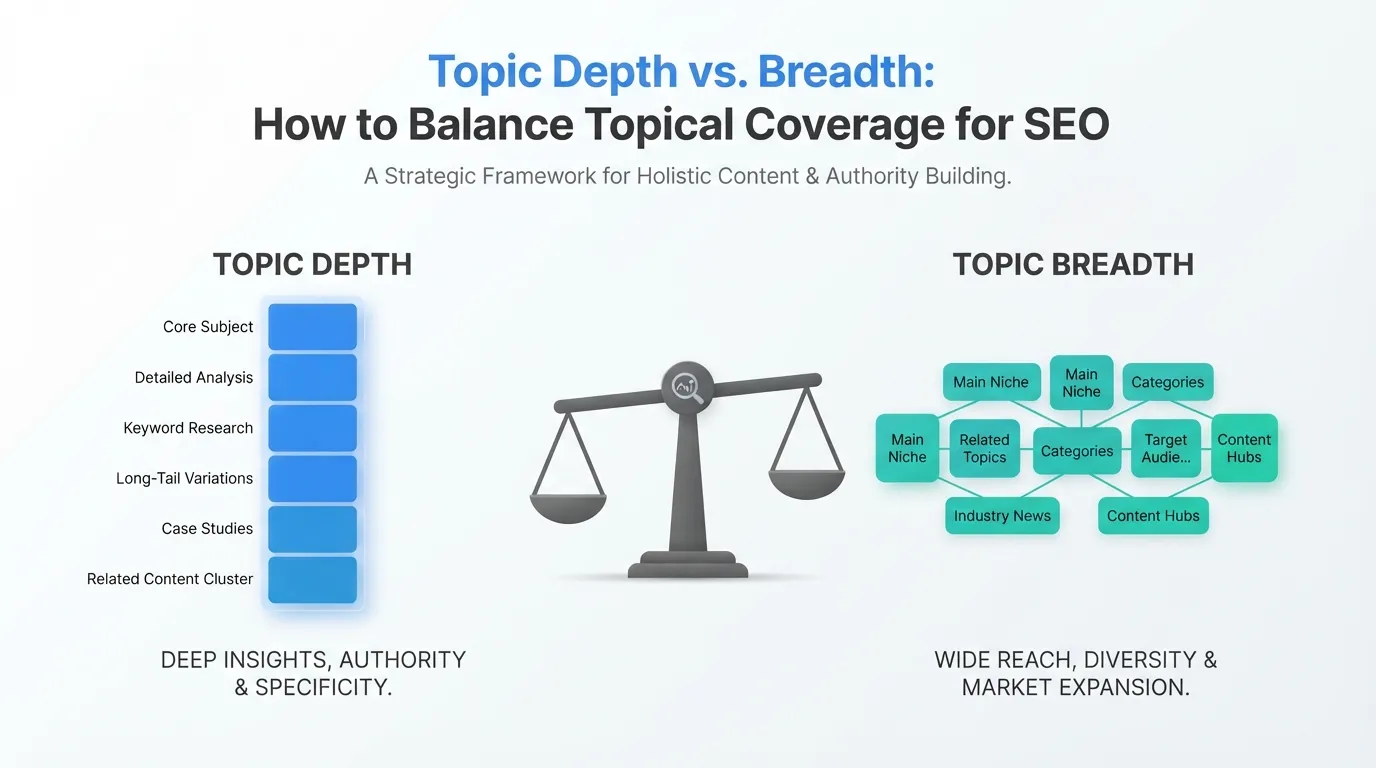
Topic depth and topic breadth describe two dimensions of topical coverage in SEO. Topic depth measures how completely a website covers one subject. Topic breadth measures how many relevant topics the website covers within the same semantic and business context.
A strong content strategy needs both. Depth helps a site answer detailed questions about important subjects. Breadth helps it cover more relevant user needs and search topics.
The objective is not to publish the largest number of pages. The objective is to cover important topics thoroughly, expand into relevant adjacent areas, and connect those areas through clear relationships. Topic depth, topic breadth, and topical authority are useful content strategy concepts. They are not documented Google ranking metrics.
What Are Topic Depth and Topic Breadth?
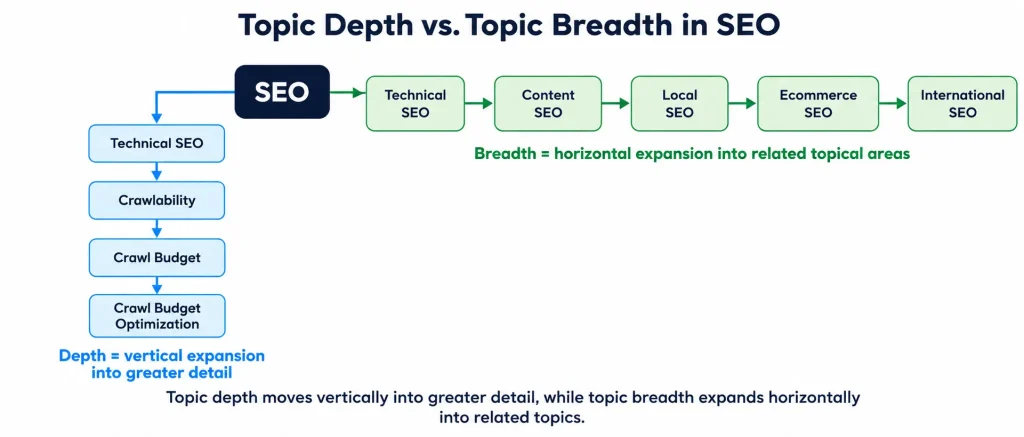
Topic depth represents vertical coverage within a subject. Topic breadth represents horizontal coverage across related subjects. A website increases depth by covering more detail within the same topic. It increases breadth by covering additional topics that remain relevant to the same audience, category, or business.
What Is Topic Depth?
Topic depth is the level of useful detail and completeness within a defined topical area.
Consider technical SEO. Basic coverage might explain what technical SEO is. Deeper coverage could include crawlability, indexing, rendering, site architecture, structured data, canonicalization, XML sitemaps, robots directives, and page performance.
Depth can continue inside each subtopic. A crawlability cluster might cover crawl budget, robots.txt, orphan pages, crawl traps, server responses, internal links, and log file analysis.
Useful dimensions of topic depth include:
- Subtopics: Major components contained within the main topic.
- Entity attributes: Properties, functions, problems, benefits, limitations, and relationships associated with the main entity.
- Supporting questions: Questions users need answered to understand, evaluate, troubleshoot, or act on the topic.
- Search needs: Definitions, comparisons, evaluation, troubleshooting, implementation, and purchase-related needs where relevant.
- Information completeness: Coverage of the facts and explanations needed to satisfy the query.
- Granularity: The level of detail provided as the topic moves from broad concepts toward specific applications.
Topic depth does not mean producing longer pages. A concise page can provide strong depth when it answers the relevant search need completely.
What Is Topic Breadth?
Topic breadth is the range of distinct but contextually relevant topics a website covers.
Breadth moves horizontally across a subject area. A website focused on SEO could expand from technical SEO into content SEO, local SEO, international SEO, ecommerce SEO, keyword research, digital PR, and search analytics.
Relevant breadth involves:
- Parent and child topics: SEO can contain technical SEO, local SEO, and content SEO.
- Adjacent entities: Google Search Console, crawling, indexing, XML sitemaps, and robots directives are different concepts but closely related within technical SEO.
- Query space: The range of searches a site can appropriately answer.
- Audience needs: Whether the topic serves the same intended users.
- Semantic proximity: How closely a new topic relates to existing coverage.
Breadth needs boundaries. New topics should connect meaningfully to the site’s subject, audience, products, services, or customer journey.
Topic Depth vs. Breadth: Key Differences
Topic depth and topic breadth solve different coverage problems.
Scope versus granularity
Breadth increases scope. Depth increases granularity. Moving from technical SEO into local SEO increases breadth. Moving from crawlability into crawl budget increases depth.
Horizontal versus vertical coverage
Breadth moves across related categories. Depth moves from broad topics toward specific subtopics, attributes, questions, and applications.
Primary benefit
Depth improves information completeness within an existing topical area. Breadth increases the amount of relevant topical territory the site can cover.
Primary limitation
Excessive depth can create overlapping pages and unnecessary granularity. Excessive breadth can create semantic drift and weak audience alignment.
Depth is most useful when an important topic remains incomplete. Breadth is most useful when established clusters are mature and adjacent topics serve the same audience or business objective.
How Depth and Breadth Build Topical Authority
Topical authority can be approached as the ability of a website to demonstrate substantial, useful, and connected coverage of a defined subject area.
Depth contributes detail. Breadth contributes relevant scope. Relationships connect both. A practical planning model is:
Topical Authority → Topical Coverage → Depth + Breadth + Relationships
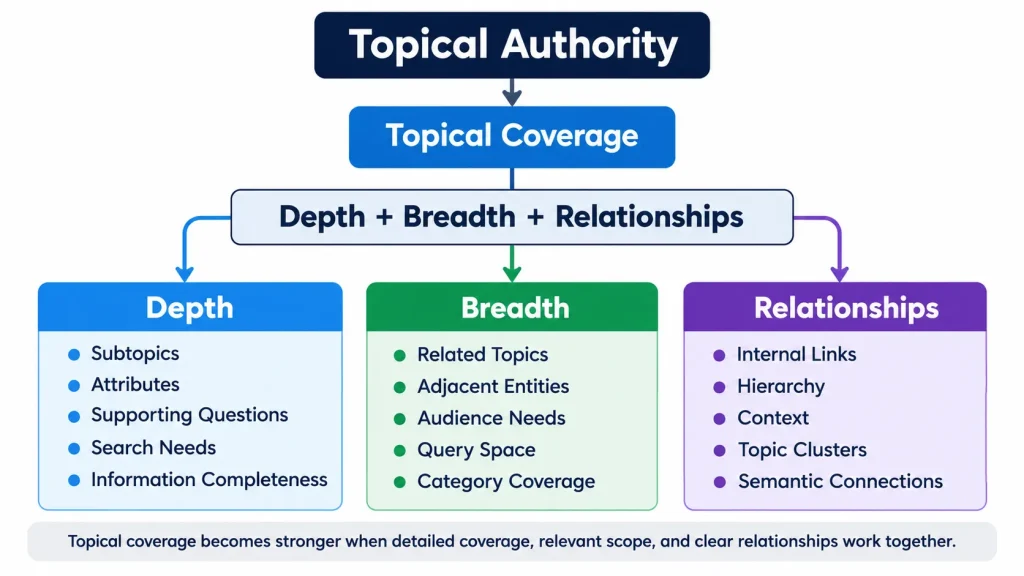
This is a content strategy framework rather than a documented Google metric.
Depth Strengthens Topical Relevance
Depth strengthens topical relevance by improving coverage of important entities, attributes, questions, and search needs. A page about crawl budget, for example, can explain what crawl budget means, which websites need to consider it, what wastes crawling resources, how robots directives affect access, how server responses matter, and how log files reveal crawler activity.
This gives the site fuller coverage of the topic’s important properties, problems, and relationships. Useful depth can also add information competing pages do not explain clearly, such as original examples, practical processes, distinctions, evidence, or expert analysis.
Depth becomes valuable when each additional section or page contributes meaningful information rather than more words.
Breadth Expands Topical Coverage
Breadth expands topical coverage by adding relevant categories, entities, problems, and user needs beyond the original cluster.
A technical SEO website might first establish strong coverage of crawling and indexing. It could later add site architecture, JavaScript SEO, structured data, migrations, page performance, and international site configuration.
Each new cluster allows the site to answer searches about additional related topics. Breadth is useful only when new clusters remain relevant to the site’s established audience and purpose.
Why Topical Authority Requires Both
Depth without breadth can make a website detailed but narrow. Breadth without depth can make it wide-ranging but superficial.
Balanced topical coverage combines both.
Internal links help connect those areas. A crawlability page can link to crawl budget, robots.txt, XML sitemap, orphan page, and indexing resources where those pages help the reader continue the task. Google Search Central recommends crawlable internal links and descriptive anchor text because links help Google discover pages and understand linked content.
When Should You Prioritize Depth vs. Breadth?
Prioritize depth while important existing topics remain incomplete. Prioritize breadth after core clusters reach meaningful saturation and adjacent topics offer greater incremental value.
Prioritize Depth When Core Topic Coverage Is Incomplete
Depth deserves priority when the site has gaps inside topics it already covers. Common signals include:
- A new or unfocused site
- Missing entity attributes or subtopics
- Missing search needs
- Incomplete topic clusters
- Relevant competitor coverage gaps
- Underperforming core pages
Depth should continue only while new coverage adds meaningful value. Creating separate pages for minor keyword variations does not create useful depth.
Prioritize Breadth When Core Topics Reach Meaningful Saturation
Breadth becomes more valuable when the current topical area has few meaningful information gaps remaining. Useful signals include:
- Mature clusters: Important entities, attributes, subtopics, and search needs already have suitable coverage.
- Stable performance: Established content consistently earns visibility for relevant searches.
- Few meaningful depth gaps: Additional pages would mostly duplicate existing information.
- Diminishing returns: New ideas target increasingly narrow queries with limited audience or business value.
- Adjacent search demand: Related topics serve the same audience and have worthwhile search potential.
A cluster can be treated as meaningfully saturated when further subdivision produces little new value.
Evaluate Semantic and Business Relevance Before Expanding
Breadth should expand through meaningful semantic and commercial relationships. Evaluate five factors before entering a new topic:
- Semantic proximity: How closely the topic relates to existing entities, categories, problems, or tasks.
- Audience relevance: Whether the topic serves the same intended customer.
- Customer journey fit: Whether it supports discovery, education, evaluation, purchase, implementation, retention, or troubleshooting.
- Business relevance: Whether it contributes to qualified visibility, leads, sales, product discovery, or customer education.
- Contextual boundaries: Whether the topic still fits the site’s central purpose.
An SEO consultancy logically covers keyword research, site architecture, Google Search Console, content optimization, and analytics. Unrelated lifestyle content would not strengthen the same topical context.
Choose Depth First, Breadth First, or Hybrid
A depth-first strategy concentrates resources on completing a limited number of important clusters. It suits new sites, narrow niches, limited teams, or specialized services.
A breadth-first strategy establishes coverage across several important categories before developing individual areas further. It can suit large publishers, marketplaces, established brands, or broad product categories.
A hybrid strategy develops core clusters while selectively expanding into strong adjacent opportunities.
Choose the approach based on:
- Site maturity
- Niche size
- Search competition
- Existing topical strength
- Available expertise and resources
- Business objectives
A useful strategy directs resources toward the important relevant coverage gap rather than the greatest number of new URLs.
How Topic Clusters Balance Depth and Breadth
Topic clusters organize related pages around a central subject. They can build depth inside a topic while creating paths into adjacent clusters.
Pillar and Cluster Pages Build Topical Depth
A pillar page establishes broad coverage of a core topic. Supporting pages develop important subtopics, attributes, questions, processes, and search needs in greater detail. For technical SEO, a pillar page might introduce:
- Crawling
- Indexing
- Site architecture
- Structured data
- JavaScript rendering
- XML sitemaps
- Robots directives
- Canonicalization
The pillar page should explain the broad subject and direct readers toward deeper resources where useful. Supporting pages should have a distinct purpose. A separate page is justified when the subtopic has enough unique intent, information, or practical value to support independent treatment.
The structure can look like:
Core Entity → Pillar Page → Subtopic → Attribute → Supporting Question
Adjacent Clusters Expand Topical Breadth
Adjacent clusters extend coverage into subjects that remain closely connected to the established topical area. After developing technical SEO, an SEO publication might expand into content optimization.
That cluster could include search intent, content briefs, content audits, keyword mapping, content updates, and on-page optimization.
The site has moved horizontally without leaving its central SEO context. A useful sequence is:
Established Cluster → Related User Need → Adjacent Entity → New Cluster
Internal Linking Establishes Relationships Across the Topical Map
Internal links connect related pages and provide navigation paths for users and crawlers. A crawl budget page might naturally link to crawlability, robots directives, server logs, status codes, and orphan pages.
Useful relationships include contextual links, parent and child relationships, descriptive anchor text, and crawl paths. The broader structure can follow:
Core Topic → Pillar → Cluster → Supporting Content → Adjacent Cluster
Internal links should reinforce genuine relationships rather than compensate for weak content.
How to Build a Topic Depth and Breadth Strategy
A practical strategy starts by defining the subject boundary, auditing existing coverage, separating depth gaps from breadth gaps, and prioritizing the next useful action.
Define the Core Topic and Map Its Semantic Scope
Start with the core subject the website needs to cover. Map it through:
- Entities: Products, platforms, technologies, concepts, organizations, and objects connected to the subject.
- Attributes: Properties, features, problems, benefits, limitations, processes, and use cases.
- Subtopics: Distinct areas contained within the main subject.
- Search needs: Different goals users bring to the topic.
- Audience: People the content is designed to help.
- Topical boundary: Subjects relevant enough to include and subjects that fall outside the site’s useful scope.
A clear boundary prevents topic research from becoming unlimited keyword collection.
Audit Existing Coverage and Competitors
Review existing pages by topic, intent, entity, performance, and relationship to other content. Look for:
- Entity gaps: Important entities are missing.
- Attribute gaps: Important properties, processes, or questions are absent.
- Intent gaps: Users need an answer type the site does not provide.
- Thin coverage: A page exists but does not sufficiently answer its intended query.
- Overlap: Multiple pages serve substantially the same purpose.
Competitor analysis can reveal additional gaps. Compare strong competing pages by entities, questions, examples, formats, and search needs. Competitor coverage identifies opportunities, not dictate what you publish.
Separate Depth Gaps From Breadth Gaps
This distinction is central to the strategy.
Depth gap = missing information within an existing topical area.
A site with technical SEO content about crawling and indexing but no useful crawl budget coverage has a depth gap.
Breadth gap = missing relevant topical territory.
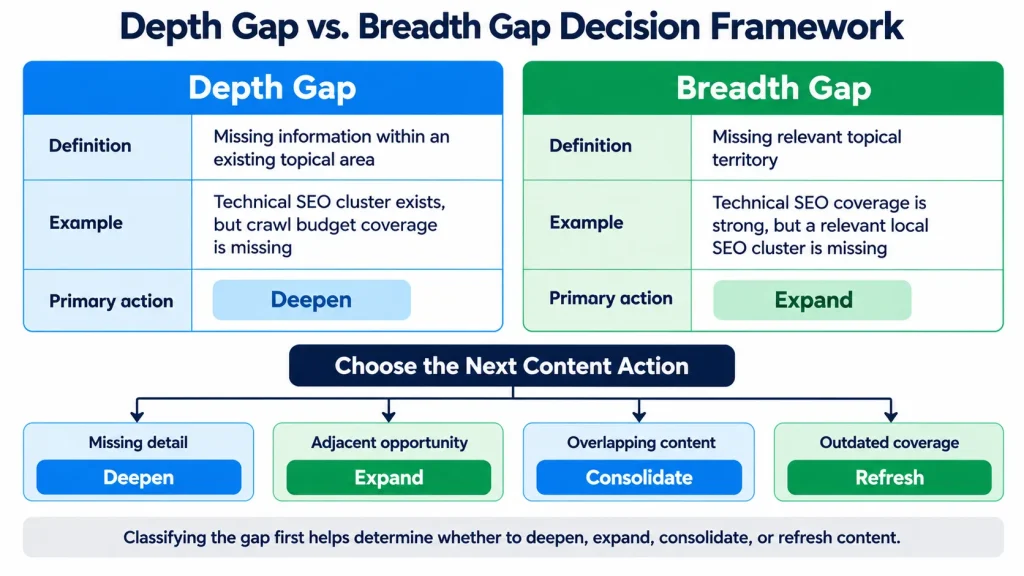
technical SEO coverage but no local SEO content, despite serving businesses with physical locations, may have a breadth gap.
The distinction prevents two planning errors. The first is expanding into new categories while core topics remain incomplete. The second is endlessly deepening mature clusters while ignoring valuable adjacent opportunities.
Prioritize the Next Content Opportunity
Evaluate opportunities through:
Business Relevance + Audience Relevance + Semantic Proximity + Search Opportunity + Information Gain
- Business relevance asks whether the topic supports a commercial or customer objective.
- Audience relevance asks whether it serves the intended reader.
- Semantic proximity asks how closely it connects to existing coverage.
- Search opportunity considers demand, ranking feasibility, visibility, and competition.
- Information gain asks whether the content can contribute useful information that existing pages do not already provide clearly.
The evaluation should lead to one of four actions:
- Deepen: Add missing information inside an existing topic.
- Expand: Build a relevant adjacent cluster.
- Consolidate: Merge pages with overlapping purpose.
- Update: Improve an existing page because its information, examples, evidence, or coverage need improvement.
How to Measure and Optimize Topic Depth and Breadth
Topic depth and breadth should be evaluated through both coverage and performance signals. No single metric proves that a website has sufficient topical coverage.
Measure Depth and Breadth Coverage
Useful depth indicators include:
- Coverage of important entities and attributes
- Search need coverage
- Supporting question coverage
- Relevant query coverage
- Information completeness
Useful breadth indicators include:
- Cluster completeness
- Related topic coverage
- Adjacent entity coverage
- Relevant query coverage
- Competitor coverage gaps
These indicators should guide investigation rather than become arbitrary publishing quotas.
Measure Topic Cluster Performance
Use different tools for different signals.
Google Search Console
Track impressions, clicks, average position, visible queries, and page performance. Query diversity can indicate whether a cluster is gaining visibility across more relevant searches, but it is a directional signal because Search Console does not expose every individual query.
Web analytics
Track organic sessions, engagement, landing page behavior, and conversions where configured.
Site crawling and audit tools
Review orphan pages, crawl depth, internal links, broken links, and structural relationships.
Customer and revenue systems
Measure qualified leads, sales, subscriptions, or other business outcomes where relevant. Evaluate performance at cluster level as well as page level.
Identify Saturation and Diminishing Returns
A cluster can be treated as meaningfully saturated when further expansion produces limited incremental value. Useful signals include:
- Few meaningful content gaps remain.
- Existing pages cover the main entities, attributes, and search needs.
- Search performance is stable or improving.
- New topic ideas increasingly overlap with existing page intent.
- Proposed pages offer little new information.
- The expected audience or commercial value of further subdivision declines.
The next decision should remain:
Deepen → Expand → Consolidate → Refresh
Common Depth vs. Breadth Mistakes
Most problems come from confusing content quantity with topical coverage, expanding outside meaningful relevance, or publishing new content when existing pages should be improved.
| Mistake | Problem | Better Approach |
| Mistaking More Content for Greater Depth | More pages or words do not guarantee deeper coverage. Similar keyword variations may satisfy the same intent. | Cover meaningful subtopics and separate pages by distinct meaning or intent, not minor keyword variations. |
| Expanding Beyond Topical Relevance | Chasing search volume can introduce topics unrelated to the audience or business. | Expand only into topics with clear semantic, audience, or business relevance. |
| Publishing Instead of Improving Existing Content | New pages can create overlap when existing pages could satisfy the opportunity. | Review existing content first. Consolidate, update, prune, improve internal links, or correct intent before creating a new page. |
Publishing should be one possible outcome, not the automatic outcome.
Topic Depth vs. Breadth Example
SEO provides a clear example of both dimensions.
From Topic Depth to Topic Breadth
Depth can move like this:
SEO
↓
Technical SEO
↓
Crawlability
↓
Crawl Budget
↓
Crawl Budget Optimization
Each step narrows the subject and increases granularity. Breadth moves horizontally:
SEO
→ Technical SEO
→ Content SEO
→ Local SEO
→ Ecommerce SEO
→ International SEO
Each branch represents another relevant part of the broader SEO category. A balanced architecture combines both:
Core Topic → Pillar → Subtopics → Supporting Questions → Adjacent Cluster
For example:
SEO → Technical SEO → Crawlability → Crawl Budget → Crawl Budget Questions
The site can later move horizontally from technical SEO into content SEO. Depth provides detailed coverage. Breadth expands relevant scope. Internal links connect both.
Conclusion
A balanced topical SEO strategy develops depth inside important subjects and breadth across relevant adjacent subjects.
Depth covers subtopics, entities, attributes, questions, and search needs in greater detail. Breadth expands coverage into additional categories, entities, and audience needs that remain connected to the site’s central purpose.
The practical model is:
Topical Authority → Topical Coverage → Depth + Breadth + Relationships
Start by defining the core topic and its boundary. Audit existing coverage. Separate depth gaps from breadth gaps. Evaluate opportunities through business relevance, audience relevance, semantic proximity, search opportunity, and information gain.
The next action should be deliberate:
Deepen → Expand → Consolidate → Refresh
This approach turns content production into structured topical coverage rather than a race to publish more pages.
Frequently Asked Questions
How Does Internal Linking Support Topic Depth?
Internal links connect related pages and help users and search engines understand how subtopics relate to the broader subject. Use descriptive, contextually relevant links rather than linking every related page indiscriminately.
How Can You Identify Gaps in a Topic Cluster?
Compare your existing coverage with related entities, subtopics, user questions, competitor coverage, and search results. A useful gap is one that addresses a relevant need your current content does not adequately cover.
Should Every Topic Cluster Have a Pillar Page?
Not necessarily. A pillar page is useful when a broad topic contains multiple closely related subtopics that benefit from a central overview. Smaller or narrowly defined topics may need only a focused page structure.
How Often Should a Topic Cluster Be Updated?
Update a cluster when important information changes, new subtopics become relevant, existing pages develop gaps, or search intent shifts. Prioritize updates based on relevance and information value rather than using a fixed publishing schedule.