


A content audit is a systematic review of website content used to evaluate its performance, accuracy, relevance, search intent, quality, and business value. The process helps determine whether each page should be kept, updated, consolidated, redirected, or removed.
A complete audit combines quantitative data such as traffic, clicks, rankings, backlinks, and conversions with qualitative analysis of usefulness, freshness, topical coverage, originality, and user experience.
The goal is not simply to clean up old pages. It is to improve the overall value of the content library and make better decisions about future content investment.
What Is a Content Audit?
A content audit is the structured process of inventorying, evaluating, and improving existing website content according to defined search, user, and business goals. A content audit evaluates two main areas: performance and quality.
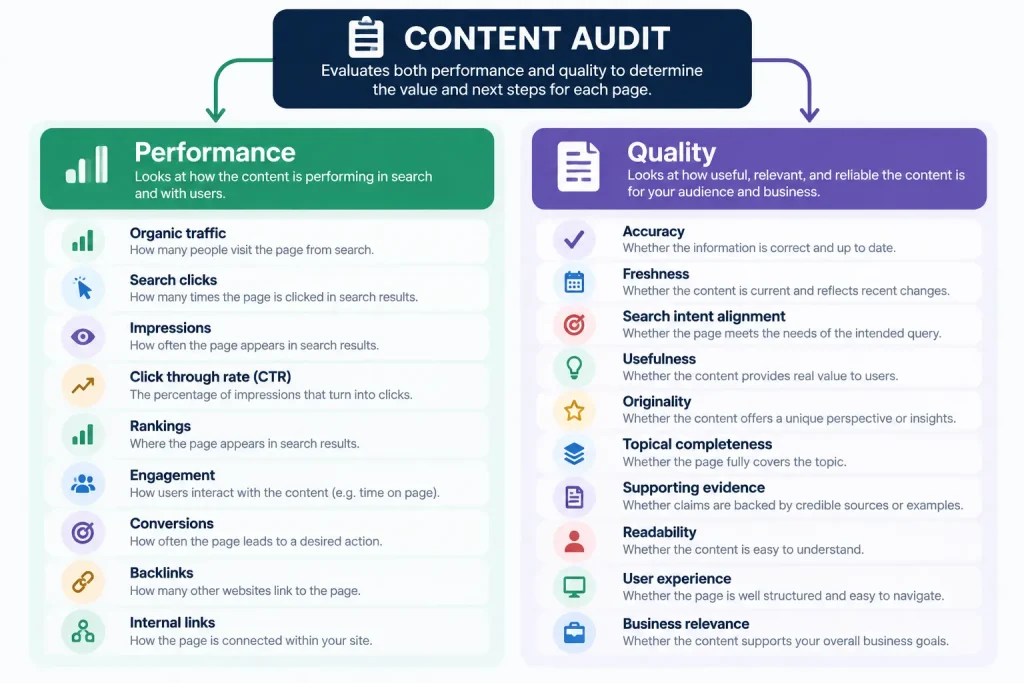
You can audit the strategically important content of a website. This includes blog posts, guides, product pages, category pages, service pages, landing pages, location pages, resource pages, case studies, and help content.
A content audit is different from reviewing old content.
Reviewing old content usually means checking individual pages for outdated information or opportunities to edit. A content audit examines the entire content system, including how pages perform, how topics connect, where coverage is missing, and whether multiple URLs compete for the same purpose.
For example, a website may have three articles addressing almost identical search intent. Editing each article separately would preserve the overlap. A content audit reveals that consolidating those pages into one stronger resource is the better action.
Content Audit vs. SEO Audit
A content audit evaluates the relevance, quality, performance, purpose, and value of website content.
An SEO audit has a broader scope. It can examine crawling, indexing, site architecture, canonicalization, structured data, redirects, sitemaps, internal linking, and other technical factors that affect organic search performance.
The two processes overlap because content performance depends partly on technical accessibility.
The main distinction is scope. A content audit asks whether the right content exists and whether it serves users effectively. An SEO audit evaluates the wider search health of the website.
Why Is a Content Audit Important?
A content audit shows which existing pages deserve investment and which content problems may be limiting search visibility, user satisfaction, or business results.
It can reveal declining content, missing topics, weak internal links, overlapping pages, outdated information, and opportunities that are difficult to identify while reviewing URLs individually.
Find Underperforming and Outdated Content
Content performance can decline as search behavior, competitors, products, information, and user expectations change.
A page that once generated strong organic traffic may gradually lose clicks, impressions, rankings, or conversions. Historical comparisons help identify this decline more accurately than current traffic alone.
For example, a page receiving 300 organic visits per month might appear acceptable until the audit shows that it previously received 5,000.
Content can also become outdated without losing all of its traffic.
Common problems include:
- Old statistics
- Discontinued products
- Changed pricing
- Outdated screenshots
- Expired regulations
- Obsolete software instructions
- Broken references
- Changed company information
Meaningful content updates should improve the information itself.
Changing the publication date alone does not make a page fresh. A useful update may involve correcting facts, replacing obsolete examples, improving topic coverage, strengthening evidence, updating instructions, or aligning the page with current user expectations.
Identify Content Gaps and Cannibalization
A content gap exists when a website does not adequately cover a topic, subtopic, question, entity, comparison, or stage of the customer journey that matters to its audience.
The gap may involve a completely missing page.
It can also exist inside an existing article.
For example, a guide about home insurance may discuss policy types but fail to explain deductibles, exclusions, coverage limits, claims, premiums, and common comparison factors.
The page exists, but its topical coverage remains incomplete.
A content audit can reveal:
- Missing topics
- Missing subtopics
- Weak entity coverage
- Thin explanations
- Unanswered questions
- Missing examples
- Unsupported claims
- Missing informational content
- Missing commercial content
An audit can also reveal the opposite problem: too many pages covering substantially the same purpose.
Keyword cannibalization occurs when multiple pages compete for similar search demand or intent in a way that weakens the site’s ability to establish a clear primary page.
Two pages mentioning the same keyword do not automatically create cannibalization.
The problem becomes more important when several URLs have similar search intent, titles, content, target queries, and purposes.
These pages may need differentiation, consolidation, redirecting, or another action based on their value and role.
Improve SEO and Business Performance
A content audit connects content quality with measurable outcomes.
Strong content can improve organic visibility by satisfying search intent clearly, covering important concepts adequately, providing credible evidence, and offering useful information that distinguishes the page from competing results.
Content improvements can also support:
- Search visibility
- User satisfaction
- Engagement
- Lead generation
- Sales
- Internal navigation
- Content authority
- Publishing efficiency
- Better content investment
A service page may attract traffic but produce few enquiries because its messaging, proof, offer, or calls to action do not match visitor intent.
An informational guide may attract qualified users but fail to support conversions because it does not link naturally to relevant products, services, or comparison pages.
The goal of a content audit is not to maximize the number of published URLs. It is to maximize the usefulness and strategic value of the content library.
When Should You Conduct a Content Audit?
Conduct a content audit when the existing content library is large enough for systematic evaluation to improve decision making.
Several situations make an audit particularly useful.
A sustained decline in organic traffic or rankings is one common trigger. Historical page and query data can help identify which sections or URLs lost visibility.
Large content libraries also benefit from regular audits. Websites that have published for several years often accumulate outdated articles, overlapping topics, inconsistent quality, forgotten landing pages, and internal linking gaps.
Website redesigns and migrations are another important use case. An audit can identify which URLs should remain, which should be consolidated, which require redirects, and which content should not move to the new structure.
Changes to products, services, pricing, features, or company positioning can make existing pages inaccurate or commercially irrelevant.
Major changes in search behavior or search result formats can also affect content performance.
A content audit is especially useful before creating a new content strategy. Understanding what already exists helps prevent teams from publishing pages that duplicate current content or ignore valuable assets.
Audits can therefore be either periodic or event driven.
Periodic audits maintain content quality over time. Event driven audits respond to a specific issue such as a migration, traffic decline, rebrand, product change, or strategic shift.
How Often Should You Audit Your Content?
There is no universal content audit frequency.
The right schedule depends on:
- Website size
- Publishing frequency
- Rate of industry change
- Content lifecycle
- Available resources
- Importance of organic search
- Commercial importance of the content
A small website with twenty stable service pages does not require the same review schedule as a publisher producing hundreds of articles each month.
Fast changing industries generally need more frequent review because products, regulations, software, prices, and market conditions can change quickly.
High value pages also deserve closer monitoring.
Pages responsible for significant traffic, leads, sales, or customer acquisition should usually be reviewed more frequently than low priority archive content.
The practical goal is to audit often enough to detect meaningful deterioration before inaccurate, outdated, overlapping, or poorly performing content becomes a larger problem.
How to Conduct a Content Audit
A content audit works best as a repeatable process.
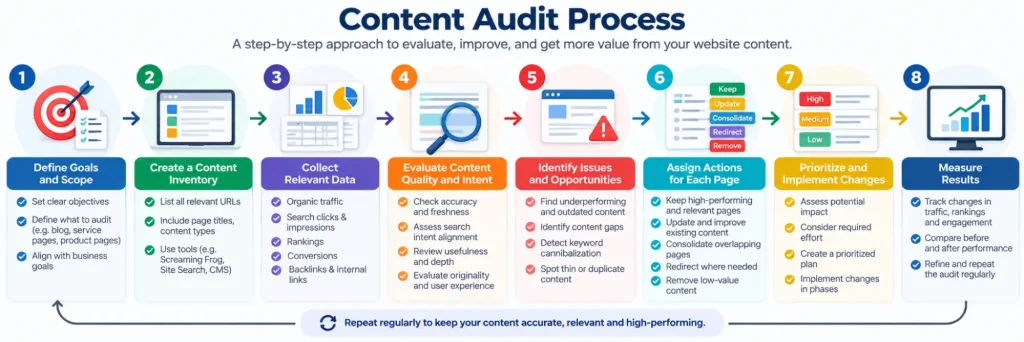
1. Define Your Goals and Scope
Define what the audit needs to accomplish before collecting data. The goals include:
- Recovering lost organic traffic
- Improving content quality
- Consolidating competing pages
- Increasing conversions
- Preparing for a website migration
- Improving topical coverage
- Removing obsolete content
- Strengthening internal linking
- Identifying new content opportunities
The goal determines which metrics matter.
- A traffic recovery audit should emphasize historical search performance.
- A migration audit should focus more heavily on URL value, backlinks, indexability, redirects, and content importance.
Define the scope as well.
The audit may include the entire website or a specific section such as the blog, product catalog, service pages, help center, or resource library. Clear scope prevents time from being spent on pages that have little connection to the audit objective.
2. Create a Content Inventory
A content inventory is a structured list of the URLs included in the audit. Record essential information such as:
URL | Title | Content Type | Topic | Publish or Update Date | Indexability
Useful additional fields may include canonical URL, status code, author, category, conversion purpose, crawl depth, and content owner.
Website crawling software can collect much of this information automatically.
The inventory becomes the central dataset where performance metrics, findings, actions, owners, priorities, and implementation status can be recorded.
3. Collect Performance Data
Connect relevant performance data to each URL. Useful metrics include:
Traffic | Clicks | Impressions | CTR | Rankings | Conversions | Backlinks | Internal Links
- Google Search Console is useful for evaluating organic search performance through metrics such as clicks, impressions, average position, click through rate, queries, and pages.
- GA4 can help evaluate traffic, user activity, engagement, acquisition, and configured conversion events.
- Backlink tools can show which pages have earned external links.
- Crawling tools can identify internal links and reveal how pages are connected across the website.
Historical comparison is essential.
A page receiving little traffic today may once have been a major organic asset. Another page with modest traffic may be growing consistently. Current performance alone does not show direction. Compare relevant periods and account for seasonality, tracking changes, website updates, campaigns, and unusual changes in search demand.
4. Evaluate Content Quality and Search Intent
Performance data explains what is happening. Content evaluation helps explain why. Review important pages for:
- Accuracy and freshness
- Search intent alignment
- Usefulness
- Originality
- Topical completeness
- Experience and expertise
- Authority and trust
- Supporting evidence
- Readability
- User experience
Search intent describes what the user wants to accomplish. Intent may be informational, commercial, transactional, navigational, local, or mixed.
The page format and information should satisfy that purpose. A basic definition article may struggle to satisfy a query where searchers clearly expect detailed product comparisons.
Important pages should also be compared with current search results. SERP analysis helps identify what users appear to expect, which formats dominate the results, which concepts receive consistent coverage, and where your page could provide greater clarity or original value.
Content quality should also consider information gain. Information gain refers to useful information that adds something meaningful beyond common summaries already available elsewhere.
Examples include:
- First party data
- Original research
- Expert observations
- Unique comparisons
- Proprietary processes
- Practical examples
- Case evidence
- Original demonstrations
- Specific experience based insights
These elements make content more useful to both readers and search systems.
5. Identify Content Problems and Opportunities
Turn the collected data into specific findings. Look for:
- Content decay
- Missing topics
- Missing subtopics
- Missing entities
- Thin content
- Weak search intent alignment
- Keyword cannibalization
- Duplicate information
- Overlapping page purpose
- Internal link gaps
- Ranking opportunities
- Conversion opportunities
Content decay should be identified through historical performance rather than current traffic alone. Thin content should be judged by usefulness rather than word count.
A short page can fully satisfy a simple query. A long article can still be thin if it repeats basic information without answering important questions.
Review URLs with similar titles, search queries, and purposes for possible cannibalization. Look for internal link opportunities where authoritative or relevant pages can support important URLs contextually.
Pages already receiving significant impressions or ranking near prominent positions can also represent strong improvement opportunities. These pages often have proven demand but incomplete execution.
6. Decide What to Do With Each Page
Every important audited page should receive a clear action.
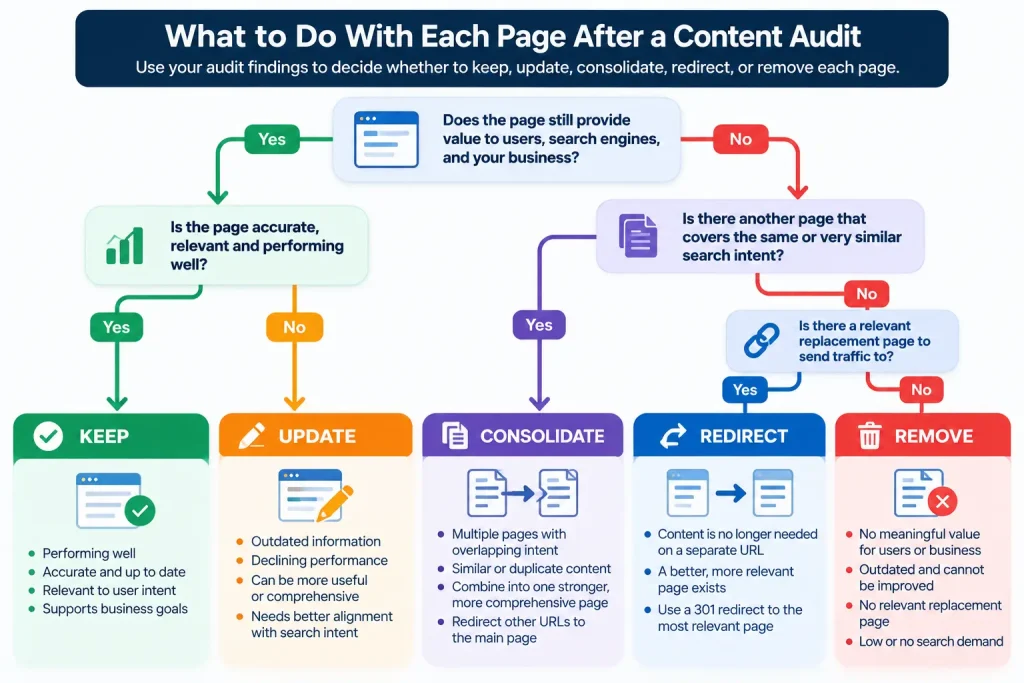
KEEP
Keep content that remains accurate, relevant, useful, and strategically valuable.
UPDATE OR EXPAND
Improve pages with outdated information, incomplete coverage, weak evidence, or poor search intent alignment. Expansion should be based on user needs rather than arbitrary word count.
CONSOLIDATE
Combine pages that serve substantially overlapping purposes when one stronger resource would provide a clearer experience. Preserve the strongest information from each page.
REDIRECT
Redirect an obsolete URL when another page is a relevant replacement. Check existing traffic, backlinks, external references, and page purpose before implementing the redirect.
REMOVE
Remove pages that provide no meaningful user, search, link, historical, legal, or business value and have no appropriate destination for consolidation or redirection. Low traffic does not justify removal.
This process is sometimes called content pruning. Content pruning is the selective improvement, consolidation, redirection, or removal of weak or obsolete content to improve the overall quality and usefulness of a website. Pruning should be based on page value and purpose rather than traffic alone.
7. Prioritize and Implement the Changes
An audit creates value only when its recommendations are implemented. Prioritize pages using:
Business Value + SEO Opportunity + Potential Impact + Required Effort
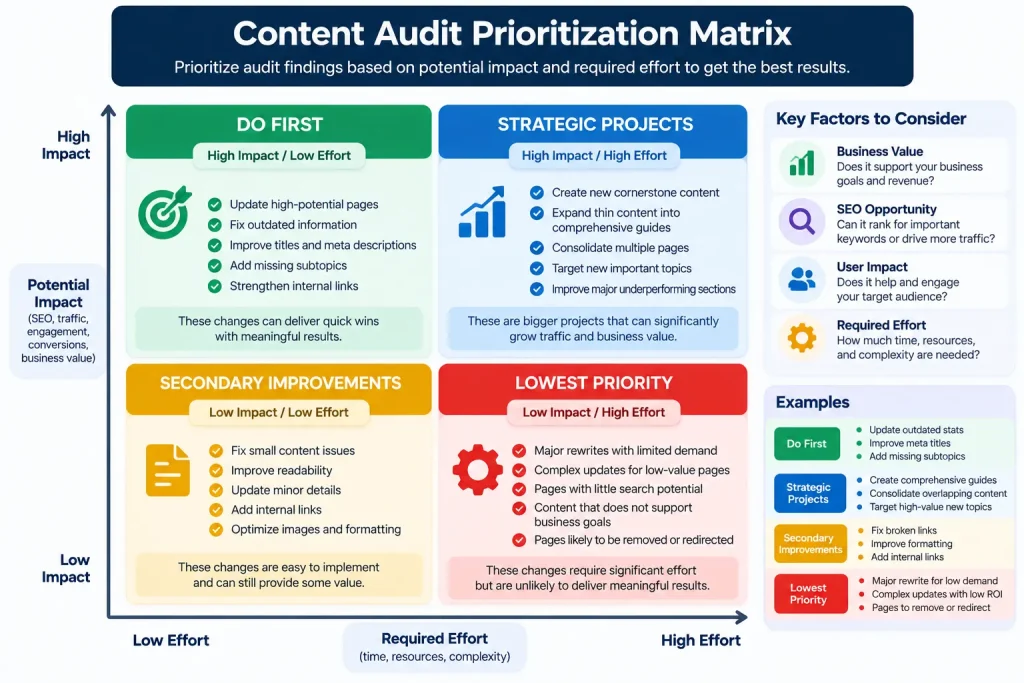
Record implementation information such as:
- Recommended action
- Priority
- Owner
- Deadline
- Status
- Notes
- Completion date
Grouping similar actions can also improve execution.
For example, teams may address factual updates first, consolidate competing pages in a separate workstream, improve internal linking across a related topic cluster, and review obsolete URLs for removal or redirection.
Prioritization should direct resources toward meaningful impact rather than simply starting with the easiest pages.
8. Measure the Results
Measure performance after audit recommendations are implemented. Relevant outcomes include:
- Organic visibility
- Organic traffic
- Search rankings
- Engagement
- Conversions
Use baseline data from before implementation so results can be compared accurately. Measurement should match the action.
A consolidated article can be evaluated using combined search visibility, rankings, clicks, and backlinks. A service page should be evaluated partly through enquiries, leads, or sales. An updated article targeting traffic decay should be measured against its previous performance trend. Avoid assuming every change resulted from the audit alone.
Seasonality, competitor activity, changing search demand, website updates, marketing campaigns, and search system changes influence the results at the same time.
Best Tools for a Content Audit
No single tool provides every piece of information needed for a complete content audit. A practical workflow combines search performance data, analytics, crawling, backlink research, and a central audit document.
| Tool | Main Role | What to Use It For |
| Google Search Console | Search performance | Review clicks, impressions, CTR, average position, search queries, and landing page performance. |
| GA4 | Traffic, engagement, and conversions | Evaluate website traffic, user behavior, acquisition, engagement, and configured conversion events. |
| Screaming Frog | Crawling and content inventory | Collect URLs and inspect page titles, status codes, canonical elements, indexability, and internal links. |
| Ahrefs or Semrush | Rankings, backlinks, and competitor research | Analyze keyword visibility, backlinks, competing pages, content gaps, and search opportunities. |
| Google Sheets or Excel | Audit organization and action tracking | Combine datasets, record recommendations, assign priorities and owners, and track implementation. |
How AI Is Changing Content Audits
AI can make large content audits more efficient by helping classify, compare, summarize, and analyze large numbers of pages. AI assisted workflows can help:
- Group URLs by topic
- Identify similar search intent
- Detect repeated content
- Extract important entities
- Compare topical coverage
- Find potential content gaps
- Identify overlapping pages
- Categorize recommended actions
AI also supports information gain analysis by identifying pages that repeat common explanations without adding distinct evidence, experience, examples, or insights.
AI-based search experiences increase the importance of content that contains clear facts, strong evidence, precise entity relationships, original information, and useful explanations.
Human review remains necessary. Automated systems can misunderstand business value, specialist accuracy, customer intent, regulatory requirements, brand positioning, and the purpose behind individual pages.
Important decisions such as removing, consolidating, redirecting, or substantially rewriting content should therefore be validated by a qualified reviewer.
Common Content Audit Mistakes
Content audits often fail because decisions are based on incomplete data or because findings are never implemented.
| Common Mistake | Why It’s a Problem | Better Approach |
| Judging pages only by traffic | Low-traffic pages may still earn backlinks, assist conversions, answer important questions, or support high-value products. | Evaluate traffic alongside backlinks, conversions, business value, and topical importance. |
| Ignoring search intent | A comprehensive page can still perform poorly if it answers a different question from what users are searching for. | Compare the page’s purpose and content with the dominant search intent. |
| Updating only the publication date | Changing the date alone does not make outdated or weak content more useful. | Improve accuracy, evidence, examples, structure, usefulness, and topical coverage. |
| Ignoring cannibalization | Multiple pages targeting the same intent can compete with each other and weaken performance. | Identify overlapping URLs and consolidate, differentiate, or redirect where appropriate. |
| Overlooking internal linking | Important pages may receive insufficient internal authority and be harder for users and search engines to discover. | Add relevant contextual links from authoritative and related pages. |
| Collecting data without taking action | A large audit spreadsheet creates little value if recommendations are never implemented. | Connect each meaningful finding to an action, priority, owner, and measurable objective. |
Content Audit Checklist
Use this workflow to keep the audit focused:
Define Goal → Inventory URLs → Collect Data → Evaluate Quality and Intent → Find Gaps, Decay, and Overlap → Assign Actions → Prioritize → Implement → Measure
A complete audit should answer four questions for every important page:
- Does this content still serve a useful purpose?
- Is it performing as well as it reasonably could?
- What specific problem or opportunity exists?
- What action should be taken?
Conclusion
A content audit helps you understand what is working, what needs improvement, and where your content deserves further investment. The goal is not simply to remove underperforming pages, but to make informed decisions based on content quality, performance, user needs, and business value.
By regularly auditing, improving, and measuring important content, you can maintain a more useful, relevant, and effective content library.
Frequently Asked Questions
How long does a content audit take?
A content audit can take a few hours to several weeks, depending on website size, audit scope, available data, and the level of manual review required.
How often should you conduct a content audit?
Most websites benefit from a full audit periodically, while high-value or frequently updated pages should be reviewed more often.
Should low-traffic content be deleted?
Not automatically. Check backlinks, conversions, impressions, historical performance, and business value before deciding to keep, update, consolidate, redirect, or remove it.
Can a content audit improve SEO rankings?
Yes, indirectly. Fixing outdated content, search intent mismatches, content gaps, cannibalization, and internal linking issues can improve organic visibility, but rankings are not guaranteed.
Can AI perform a content audit?
AI can assist with classification, clustering, gap detection, similarity analysis, and pattern identification, but important content decisions still require human judgment.