
Search engines no longer rank pages based solely on keyword matching. Google Search evaluates meaning, relevance, page quality, usability, context, and user intent to return results that match the query. A page can contain the exact phrase a user searches for and still fail to rank if it does not satisfy the user’s intent.
This shift has fundamentally changed how keyword research should be approached. Traditional SEO often focused on finding high-volume keywords and creating pages around them. Search volume indicates demand but does not reveal user motivation, conversion potential, or content format. Two users may search for similar terms while having completely different objectives. One may be researching a topic, another comparing solutions, and a third preparing to make a purchase.
Keyword research and intent mapping bridge this gap. Keyword research identifies search demand. Intent mapping connects that demand to the right page type, funnel stage, and user goal.
Together, they help align content with user needs and business goals.
What Is Keyword Intent Mapping?
Keyword Intent Mapping Defined
Keyword intent mapping is the process of organizing keywords based on the objective behind a search query and matching those keywords to the most appropriate content type, page, or stage of the customer journey.
Rather than treating keywords as isolated phrases, intent mapping treats them as signals of user needs.
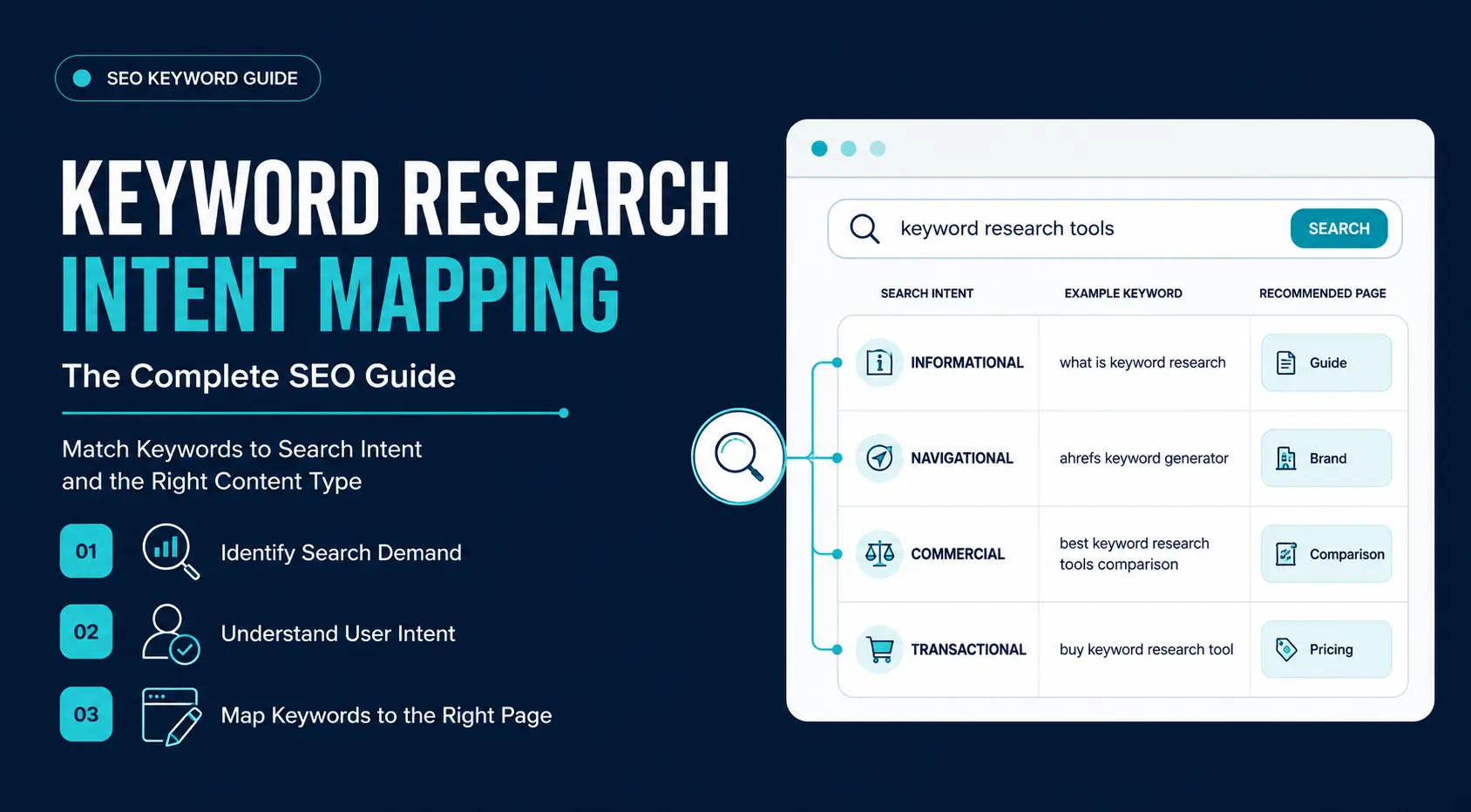
| Keyword | Intent | User Goal |
| What is keyword research | Informational | Learn a concept |
| keyword research process | Informational | Understand a methodology |
| best keyword research tools | Commercial Investigation | Compare solutions |
| ahrefs pricing | Transactional | Evaluate a purchase |
| semrush login | Navigational | Access a destination |
Each keyword reflects a different expectation and requires a different content experience. Intent mapping ensures content aligns with the user’s objective rather than simply targeting the keyword itself.
Keyword Intent Mapping vs Keyword Mapping
Traditional keyword mapping focuses on assigning keywords to URLs.
| URL | Target Keyword |
| /keyword-research-guide | keyword research |
| /search-intent-guide | search intent |
| /seo-tools | SEO tools |
While this helps organize content and prevent keyword overlap, it does not explain why users are searching.
Intent mapping expands the process by incorporating:
- Search intent
- User expectations
- Funnel stage
- Content format
- Conversion opportunities
- SERP behavior
The difference is simple:
- Keyword mapping: Which page should target this keyword?
- Intent mapping: What is the user trying to accomplish, and how should the page help achieve that goal?
Why Intent Mapping Matters for Modern SEO
Search engines increasingly prioritize content that satisfies user intent.
If a user searches for “best SEO tools” and lands on a page that only defines SEO software, the content may be relevant to the topic but fails to satisfy the query.
Intent mapping improves alignment between:
- Search queries
- Content formats
- User expectations
- Conversion opportunities
It also helps build coverage across the entire customer journey.
| Stage | Example Query |
| Problem Recognition | Why did organic traffic drop |
| Learning | What causes traffic loss |
| Evaluation | best SEO audit tools |
| Decision | ahrefs pricing |
| Action | ahrefs sign up |
The Relationship Between Intent Mapping and Topical Authority
Topical authority develops when a website addresses the full range of user needs within a subject area.
For example, a keyword research topic may include:
- Definitions
- Tutorials
- Tool comparisons
- Templates
- Case studies
- Pricing comparisons
- Implementation guides
Covering multiple intent stages helps strengthen topical relevance, improve content coverage, and create a more complete content ecosystem.
Understanding Search Intent in Modern Search
What Is Search Intent?
Search intent is the objective a user hopes to accomplish when entering a query into a search engine.
For example, a search for “keyword research” could indicate a desire to:
- Learn the concept
- Find a tutorial
- Download a template
- Compare tools
- Hire a service provider
The query remains the same, but the underlying motivations differ.
Understanding intent helps determine the content format, information depth, and user experience required to satisfy searchers.
Search Intent vs Keyword Intent
The terms are often used interchangeably, but there is a useful distinction:
- Search intent refers to the underlying objective.
- Keyword intent refers to how a specific query expresses that objective.
For example:
- how to do keyword research
- keyword research guide
- beginner keyword research tutorial
- keyword research explained
All represent different keyword variations but share the same informational intent.
This distinction is important because modern SEO groups keywords by shared intent rather than treating every variation as a separate opportunity.
Why Search Engines Prioritize Intent
Modern search engines focus on matching meaning rather than matching words.
For example, a query such as “best CRM for small business” typically returns:
- Product comparisons
- Reviews
- Pricing information
- Feature evaluations
A dictionary-style definition of CRM software may contain relevant keywords but fails to satisfy the dominant intent.
Search engines prioritize content that best aligns with user expectations and desired outcomes.
Semantic Search, Entities, and Query Understanding
Modern search systems interpret queries using:
- Semantic relationships
- Entity associations
- Contextual signals
- User behavior patterns
- Historical search interactions
Rather than analyzing keywords in isolation, search engines evaluate how concepts relate to one another.
For example, a topic such as keyword research naturally connects to:
- Search intent
- Search volume
- Keyword difficulty
- SERPs
- Topic clusters
- Topical authority
- SEO tools
These relationships help search engines understand context and topical relevance.
What Is an Entity?
An entity is a uniquely identifiable concept, person, organization, place, or thing.
Examples include:
- Google Search Console
- Ahrefs
- Semrush
- Search Intent
- Topical Authority
Entity coverage helps demonstrate topical completeness and semantic relevance.
The Impact of AI Search on Intent Mapping
AI-powered search systems increasingly retrieve passages, sections, and entities rather than evaluating pages solely as complete documents.
The optimization model is shifting from:
Keyword → Page
to:
Question → Relevant Passage → Answer
As a result, intent should be addressed at both the page level and section level.
Effective content increasingly relies on:
- Clear heading structures
- Direct answers
- Strong entity relationships
- Well-defined topic boundaries
- Content organized around user questions
A single section may be retrieved independently within AI-powered search experiences, making comprehensive intent coverage more important than keyword targeting alone.
From Keywords to Audience Demand
Modern keyword research is no longer limited to keyword discovery.
It combines:
- Search intent analysis
- Audience demand research
- Entity mapping
- Semantic content strategy
- Topic modeling
The objective is not simply to target keywords, but to understand user goals and create content that satisfies them across both traditional and AI-driven search environments.
The 4 Types of Search Intent
Search intent describes the objective behind a search query. Most keywords fall into one of four primary intent categories.
| Intent Type | User Goal | Example Keywords |
| Informational | Learn or understand a topic | what is keyword research, search intent explained |
| Navigational | Reach a specific website or page | Ahrefs login, Semrush pricing |
| Commercial Investigation | Evaluate potential solutions | Best keyword research tools, Ahrefs vs Semrush |
| Transactional | Complete an action | Buy keyword research software, SEO agency pricing |
Informational Intent
Informational intent occurs when users want to learn, solve a problem, or answer a question.
Common formats:
- Guides
- Tutorials
- Educational articles
- Research resources
- Glossaries
Informational content builds topical authority by answering early-stage questions such as definitions, causes, processes, and examples.
Navigational Intent
Navigational intent occurs when users want to reach a specific brand, website, or destination.
Examples:
- Google Search Console login
- Ahrefs dashboard
- HubSpot blog
These searches generally offer limited opportunities for non-brand websites but remain important for brand visibility and user experience.
Commercial Investigation Intent
Commercial investigation occurs when users are evaluating solutions before making a decision.
Common formats:
- Product comparisons
- Reviews
- Buyer’s guides
- Alternative lists
- Case studies
Commercial content often serves as the bridge between educational content and transactional pages.
Transactional Intent
Transactional intent indicates that users are ready to take action.
Examples include:
- Purchasing a product
- Requesting a quote
- Booking a service
- Starting a free trial
- Creating an account
Common formats:
- Product pages
- Service pages
- Pricing pages
- Landing pages
- Signup pages
The primary objective is to help users complete their intended action.
Search Intent Across the Customer Journey
Users often move through multiple intent stages before converting.
| Stage | Example Query | Intent |
| Awareness | Why did organic traffic drop | Informational |
| Learning | SEO audit process | Informational |
| Evaluation | best SEO audit tools | Commercial |
| Comparison | Ahrefs vs Semrush | Commercial |
| Decision | Ahrefs pricing | Transactional |
| Action | Ahrefs free trial | Transactional |
While transactional keywords typically generate the highest direct conversion rates, informational and commercial content frequently influence purchasing decisions earlier in the journey.
The strongest SEO strategies maintain coverage across all four intent categories rather than focusing exclusively on bottom-funnel keywords.
Advanced Intent Analysis
The traditional informational, navigational, commercial, and transactional framework provides a useful foundation. However, many keywords contain multiple user objectives, requiring deeper intent analysis.
Mixed-Intent Keywords
Some keywords generate SERPs containing multiple content formats because users have different goals. These are known as mixed-intent keywords.
Example:
Keyword: keyword research tools
Potential user objectives:
- Learn what keyword research tools are
- Compare available options
- Read reviews
- Find free tools
- Evaluate product features
As a result, search results may contain blog posts, comparison articles, product pages, videos, and listicles.
Mixed-Intent Analysis Framework
| SERP Composition | Recommended Strategy |
| Mostly educational articles | Create informational content |
| Mostly product pages | Create transactional content |
| Mix of guides and product pages | Create hybrid content |
| Heavy video presence | Incorporate video assets |
| Strong local results | Optimize for local intent |
Rather than forcing a keyword into a single category, use SERP composition to determine how search engines interpret demand.
Micro-Intent and Contextual Intent
Micro-intents are specific objectives that exist within a broader intent category.
Example:
Keyword: best keyword research tools
Primary Intent: Commercial Investigation
Potential Micro-Intents:
- Find affordable tools
- Compare features
- Identify beginner-friendly options
- Discover free alternatives
- Evaluate enterprise solutions
Addressing multiple micro-intents within a page often improves relevance, engagement, and conversion potential.
Intent is also influenced by context, including:
- Experience level
- Industry
- Budget
- Location
- Device
- Stage in the buying journey
Effective intent mapping considers these variables rather than treating all searchers identically.
AI Search and Fractional Intent Mapping
AI-powered search increasingly retrieves individual passages, sections, definitions, and comparisons rather than evaluating pages only as complete documents.
This has led to a growing strategy known as fractional intent mapping.
Instead of assigning a single intent to an entire page, content is structured so different sections satisfy different sub-intents.
Example:
Keyword: best keyword research tools
Potential sections:
- Tool definitions
- Feature comparisons
- Pricing information
- Use-case recommendations
- Beginner guidance
Each section addresses a distinct user need while supporting the page’s primary intent.
Building Content for Comprehensive Intent Coverage
Modern content should:
- Satisfy primary intent
- Address secondary intent
- Cover relevant micro-intents
- Anticipate follow-up questions
- Provide extractable answers for AI retrieval systems
The objective is no longer keyword targeting alone. It is understanding user goals and creating content that satisfies them across multiple search experiences.
Keyword Research for Intent Mapping
Intent mapping is only as effective as the keyword research that supports it. The objective is not simply to collect keywords, but to identify the topics, entities, questions, modifiers, and behaviors that reveal user intent.
Effective keyword research should answer three questions:
- What topics matter to the audience?
- What intent exists behind those topics?
- How should content be structured to satisfy that intent?
Start With Topics and Entities
Begin with broad subject areas rather than individual keywords.
Example SEO topics:
- Keyword Research
- Search Intent
- Technical SEO
- Link Building
- Semantic SEO
- Content Strategy
- Topical Authority
Expand each topic into related subtopics, entities, and content opportunities.
| Entity | Role |
| Search Intent | Defines user objectives |
| SERP | Reveals intent signals |
| Topic Cluster | Organizes content |
| Topical Authority | Measures subject coverage |
| Search Volume | Indicates demand |
| Keyword Difficulty | Indicates competition |
Creating a topic map before collecting keywords helps maintain strategic focus and improves cluster development.
Use Google Search Data
Google Autocomplete, Related Searches, and People Also Ask provide direct insight into user behavior.
These sources help uncover:
- Questions
- Emerging topics
- Related subtopics
- Intent modifiers
- User language patterns
| Modifier Type | Examples |
| Informational | how, what, guide, tutorial |
| Commercial | best, top, review, comparison |
| Transactional | buy, pricing, discount, service |
| Local | near me, local, nearby |
These modifiers provide useful intent signals but should always be validated through SERP analysis.
Analyze Competitors and SEO Tools
Competitor research helps identify:
- High-performing topics
- Content gaps
- Keyword clusters
- Intent coverage
- Internal linking patterns
Tools such as Ahrefs and Semrush help scale research by providing:
- Search volume
- Keyword difficulty
- CPC
- Parent topics
- Related keywords
- Competitor rankings
Use these metrics for prioritization, not intent validation.
Cluster Keywords by Topic and Intent
Keyword clustering connects research to content planning.
Modern clustering should consider:
- Shared intent
- Entity relationships
- SERP overlap
- Semantic relevance
For example, keywords such as:
- keyword research guide
- How to do keyword research
often belong in the same cluster if they return similar search results.
Intent-based clustering helps:
- Reduce content duplication
- Improve topical authority
- Strengthen internal linking
- Prevent keyword cannibalization
Search Volume vs Search Intent
Search volume measures demand. Search intent measures value.
High-volume keywords are not always the highest-priority opportunities. Lower-volume commercial or transactional keywords produce stronger business value when they match pricing, comparison, demo, or service-intent searches.
Score each keyword from 1–5 for intent strength, business value, ranking difficulty, and conversion potential. Prioritize keywords with a total score above 15.
Build a Master Keyword Dataset
Organize keyword research into a structured dataset that supports intent mapping and content planning.
| Column | Purpose |
| Keyword | Target query |
| Search Volume | Demand estimate |
| Keyword Difficulty | Competition level |
| CPC | Commercial value signal |
| Intent | User objective |
| Topic Cluster | Content grouping |
| Funnel Stage | Customer journey stage |
| Existing URL | Current page |
| Target URL | Planned page |
| Priority | Opportunity score |
A well-structured dataset helps identify content gaps, prioritize opportunities, and align keywords with search intent across the customer journey.
How to Identify and Validate Search Intent
Intent validation ensures that keyword targeting aligns with how search engines currently interpret a query. Rather than relying solely on keyword wording or tool-generated labels, validate intent using SERP analysis.
Analyze SERP Signals
Search Engine Results Pages provide the strongest indicators of search intent.
| SERP Feature | Likely Intent |
| Featured Snippet | Informational |
| People Also Ask | Exploratory |
| Video Carousel | Demonstrational |
| Shopping Results | Transactional |
| Local Pack | Local |
| Knowledge Panel | Navigational |
| Product Listings | Purchase-Oriented |
Beyond rankings, evaluate:
- SERP features
- Content types
- Rich results
- Visual elements
- Question modules
The overall SERP composition often reveals intent more clearly than the keyword itself.
Review Top-Ranking Pages
Analyze the pages currently ranking for the target keyword.
Key questions include:
- What type of page is ranking?
- What audience is being served?
- What problem is being solved?
- How comprehensive is the content?
- Which entities appear repeatedly?
Intent patterns typically emerge quickly.
| Dominant Theme | Likely Intent |
| Educational content | Informational |
| Comparisons | Commercial |
| Product pages | Transactional |
| Brand destinations | Navigational |
Evaluate Content Formats
Content format often reflects user expectations.
| Content Format | Typical Intent |
| Guides | Informational |
| Tutorials | Informational |
| Comparisons | Commercial |
| Reviews | Commercial |
| Product Pages | Transactional |
| Homepages | Navigational |
When a specific format dominates the SERP, matching that format generally improves intent alignment.
Use SEO Tool Classifications as a Starting Point
Tools such as Ahrefs, Semrush, Similarweb, and keyword clustering platforms can help categorize large keyword sets using labels such as:
- Informational
- Navigational
- Commercial Investigation
- Transactional
These classifications are useful for sorting, clustering, and prioritizing keywords, but they should not replace manual validation. Search intent evolves, and automated labels may become outdated.
A practical workflow is:
- Collect keywords.
- Apply tool-based intent labels.
- Group related queries.
- Manually validate high-value keywords.
A Practical SERP Validation Framework
Before creating content, analyze:
| Element | What to Review |
| Content Type | Blog posts, product pages, service pages, videos, forums, category pages |
| Content Format | Tutorials, listicles, comparisons, reviews, landing pages, tools |
| Content Angle | Recurring themes, audience focus, and positioning |
| SERP Features | Snippets, PAA boxes, videos, local packs, shopping results, AI Overviews |
This process helps identify both primary and secondary intent.
For example, if a SERP contains mostly comparison articles alongside some product pages, the primary intent is likely commercial, with transactional intent acting as a secondary objective.
Revalidate Intent Regularly
Search intent changes when SERPs shift from guides to comparison pages, product pages, videos, forums, or local results. Revalidate important keywords periodically, particularly those that drive significant traffic, leads, or revenue.
Creating Content for Different Search Intent Types
Intent mapping determines what type of content should rank for a query and how that content should be structured. Different intent types require different content formats, information, and calls to action.
Content for Informational Intent
Informational queries indicate that the user is researching a topic or trying to solve a problem.
Informational users typically need:
- Definitions
- Explanations
- Frameworks
- Processes
- Examples
- Step-by-step guidance
Recommended formats include:
- Ultimate guides
- Tutorials
- Educational blog posts
- Glossaries
- Research articles
- Industry explainers
For example, a query such as “what is keyword intent mapping” requires content that explains the concept, how it works, why it matters, and how it is applied.
Internal links can connect informational content to templates, case studies, comparison pages, or product-focused resources.
Content for Navigational Intent
Navigational queries are used to reach a specific website, page, account, or resource.
Effective navigational pages prioritize:
- Clear branding
- Simple navigation
- Fast access to resources
- Strong site architecture
- Minimal friction
Common examples include:
- Homepages
- Login pages
- Account portals
- Documentation hubs
- Brand-specific landing pages
A user searching for “Google Search Console login” wants direct access to the login page rather than educational or promotional content.
For branded searches, optimization should focus on clear page titles, accurate site architecture, structured data, and consistent branding signals.
Content for Commercial Investigation Intent
Commercial investigation queries come from users evaluating products, services, or solutions before making a decision.
Commercial users often need:
- Comparisons
- Reviews
- Feature analysis
- Pricing information
- Pros and cons
- Recommendations
Recommended formats include:
- Product comparisons
- Alternative lists
- Buyer’s guides
- Expert reviews
- Industry rankings
For example, a search for “Ahrefs vs Semrush” typically requires feature comparisons, pricing analysis, strengths, weaknesses, and use-case recommendations.
Effective commercial content includes evaluation criteria, feature comparisons, limitations, pricing details, and scenario-based recommendations.
Relevant calls to action may include free trials, demos, consultations, or pricing pages.
Content for Transactional Intent
Transactional searches indicate that the user is ready to complete an action such as purchasing, booking, subscribing, or contacting a provider.
Transactional users typically need:
- Clear offers
- Pricing information
- Product or service details
- Trust signals
- Contact methods
- Simple conversion paths
Recommended formats include:
- Product pages
- Service pages
- Pricing pages
- Demo requests
- Booking pages
- Sign-up pages
Transactional pages should minimize barriers to conversion. Common obstacles include hidden pricing, confusing navigation, excessive form fields, or unclear calls to action.
High-performing transactional pages combine relevance, usability, transparency, and trust signals while making the next step obvious.
Aligning Content Formats With SERP Expectations
Search results often reveal the content format Google considers most relevant for a query.
Before creating content, analyze:
- Which formats dominate rankings
- Which SERP features appear
- Which content structures consistently rank
| Dominant Format | Likely Intent |
| Guides | Informational |
| Tutorials | Informational |
| Reviews | Commercial |
| Comparisons | Commercial |
| Product Pages | Transactional |
| Homepages | Navigational |
If comparison pages dominate the SERP, a product page may struggle to rank regardless of content quality because it does not match the dominant search intent.
Some keywords display mixed intent and require hybrid content formats.
For example, a query such as “best keyword research tools” may benefit from content that includes:
- An overview of keyword research tools
- Evaluation criteria
- Product comparisons
- Pricing information
- Recommendations by use case
This type of structure addresses multiple intent layers within a single page.
Content Formats by Intent Type
| Intent Type | Recommended Formats |
| Informational | Guides, tutorials, definitions, educational resources |
| Navigational | Homepages, landing pages, resource hubs, login pages |
| Commercial Investigation | Comparisons, reviews, alternatives, buyer’s guides, case studies |
| Transactional | Product pages, service pages, pricing pages, demos, sign-up pages |
Matching content format to search intent improves relevance, user satisfaction, and the likelihood of achieving the desired business outcome.
How to Create a Keyword Intent Map
A keyword intent map assigns keywords to the most appropriate content based on search intent, topic relevance, and business objectives. The process helps prevent keyword cannibalization, improve content planning, and ensure every page serves a clear purpose.
Step 1: Group Keywords Into Topic Clusters
Organize related keywords into clusters that address the same user need. Rather than creating separate pages for every keyword variation, consolidate closely related terms into a single topic.
Example:
Topic Cluster: Keyword Research
- keyword research guide
- how to do keyword research
- keyword research tutorial
- keyword research process
If multiple keywords return similar search results, they can often be targeted on the same page.
Step 2: Assign Search Intent
Classify each keyword or cluster according to its dominant intent.
| Keyword | Primary Intent |
| keyword research guide | Informational |
| best keyword research tools | Commercial |
| ahrefs pricing | Transactional |
| semrush login | Navigational |
For keywords with mixed intent, identify the dominant intent shown in the SERP and use secondary intent to shape supporting content sections.
Step 3: Audit Existing Content
Review existing URLs before creating new pages.
Identify:
- Pages that already target the topic
- Intent mismatches
- Content gaps
- Keyword cannibalization
If multiple pages target the same keyword cluster and intent, consolidation may be more effective than publishing additional content.
Step 4: Map Keywords to URLs
Assign each keyword cluster to a specific URL.
| URL | Primary Intent | Target Cluster |
| /keyword-research-guide | Informational | Keyword Research |
| /best-keyword-tools | Commercial | SEO Tools |
| /keyword-research-services | Transactional | Services |
| /contact | Navigational | Brand |
Each page should target one primary topic and one dominant intent.
For every URL, define:
- Primary keyword
- Secondary keywords
- Related entities
- Search intent
Step 5: Identify Content Gaps
Analyze your content inventory to find missing opportunities.
Common gap types include:
- Missing topics
- Missing intent stages
- Missing supporting entities
- Missing content formats
Prioritize gaps based on search demand, business value, and ranking opportunity.
Step 6: Maintain the Intent Map
Search intent can change as SERPs evolve. Review keyword mappings regularly and update pages when ranking patterns shift.
A practical intent map should track:
| Field | Purpose |
| Keyword | Target query |
| Intent | User objective |
| Cluster | Topic grouping |
| Target URL | Assigned page |
| Funnel Stage | Customer journey stage |
| Status | Active, Planned, Optimizing |
| Priority | Opportunity level |
The completed map becomes a central planning document for content creation, optimization, internal linking, and future SEO initiatives.
Building Content Architecture From Intent Maps
A keyword intent map becomes more valuable when it guides site structure, internal linking, and content planning. Rather than treating pages as isolated assets, intent-based architecture organizes content around user needs and the relationships between topics.
Mapping Intent Across the Customer Journey
Different keywords support different stages of the customer journey.
| Journey Stage | Dominant Intent | Example Query |
| Awareness | Informational | What is keyword research |
| Exploration | Informational | How keyword research works |
| Evaluation | Commercial | best keyword research tools |
| Decision | Commercial | ahrefs vs semrush |
| Action | Transactional | ahrefs pricing |
| Retention | Navigational | ahrefs login |
Mapping content across these stages helps ensure users can progress naturally from learning to evaluation and conversion.
Organizing Content With Pillar Pages and Topic Clusters
Intent maps help identify which topics require pillar pages and which belong in supporting clusters.
Example Topic Structure
Pillar Page: Keyword Research
Supporting Cluster Pages:
- Search Intent
- Keyword Clustering
- SERP Analysis
- Competitor Research
- Keyword Mapping
- Semantic SEO
This structure creates a clear topical hierarchy while improving content discoverability.
Intent should also vary across cluster content rather than repeating the same type of page.
| Page | Intent |
| What Is Keyword Research? | Informational |
| Keyword Research Process | Informational |
| Best Keyword Research Tools | Commercial |
| Ahrefs vs Semrush | Commercial |
| Keyword Research Services | Transactional |
Together, these pages cover multiple user needs within the same topic area.
Using Internal Links to Connect Intent Stages
Internal links should connect related pages based on user progression.
Example Flow
Informational Guide → Tool Comparison → Pricing Page → Sign-Up Page
This structure helps users move naturally between research, evaluation, and action.
Internal links also reinforce relationships between related topics and entities, helping search engines understand the breadth and depth of coverage within a subject area.
Preventing Keyword Cannibalization
Cannibalization occurs when multiple pages target the same keyword cluster and intent.
Example
| Page | Intent |
| Keyword Research Guide | Informational |
| How to Do Keyword Research | Informational |
Because both pages serve the same intent, they may compete against each other in search results.
Intent mapping reduces cannibalization by assigning a distinct purpose to each page and defining a clear target keyword cluster.
Building Topical Authority Through Intent Coverage
Topical authority comes from covering a subject comprehensively across multiple intent types rather than publishing large amounts of similar content.
Example: Keyword Research Topic
Informational
- What Is Keyword Research?
- Keyword Research Process
Commercial
- Best Keyword Research Tools
- Ahrefs vs Semrush
Transactional
- Keyword Research Services
Navigational
- Documentation
- Account Resources
Covering informational, commercial, transactional, and navigational needs creates a more complete content ecosystem and improves topical depth.
Example Intent Map for a Local Business Website
Consider a local HVAC company. A simplified intent map may look like this:
| Keyword | Intent | Funnel Stage | Target Page |
| HVAC maintenance tips | Informational | Awareness | Blog Article |
| signs AC needs repair | Informational | Awareness | Blog Article |
| best HVAC company | Commercial | Consideration | Comparison Page |
| HVAC repair cost | Commercial | Consideration | Pricing Guide |
| HVAC repair near me | Transactional | Decision | Service Page |
| emergency HVAC service | Transactional | Decision | Service Page |
| company name phone number | Navigational | Retention | Contact Page |
What This Example Reveals
The map covers the full customer journey while assigning a distinct intent to each URL. This reduces keyword cannibalization, clarifies page purpose, and creates natural internal linking paths between related content.
Essential Columns for an Intent Mapping Template
An intent mapping spreadsheet needs keyword, intent, funnel stage, search volume, existing URL, target URL, and priority columns.
| Column | Purpose |
| Keyword | Search query |
| Search Volume | Estimated demand |
| Keyword Difficulty | Competitive level |
| Intent | User objective |
| Funnel Stage | Customer journey stage |
| Cluster | Topic grouping |
| Existing URL | Current page targeting the keyword |
| Target URL | Planned destination page |
| Priority | Opportunity score |
| Status | Workflow tracking |
These fields support keyword planning, prioritization, and content management.
Example Spreadsheet Template
| Keyword | Intent | Cluster | Funnel Stage | URL |
| keyword research | Informational | Keyword Research | Awareness | /keyword-research |
| keyword clustering | Informational | Keyword Research | Consideration | /keyword-clustering |
| best keyword tools | Commercial | SEO Tools | Evaluation | /best-keyword-tools |
| ahrefs pricing | Transactional | SEO Tools | Decision | /ahrefs-review |
Intent maps expose content gaps by revealing missing informational, commercial, or transactional assets within a topic cluster.
Maintaining Intent Maps Over Time
Intent maps should be reviewed regularly to account for:
- New keyword opportunities
- SERP changes
- Search intent shifts
- Emerging content gaps
- Keyword cannibalization risks
Intent maps should be maintained as living documents that adapt to changing search behavior and business priorities.
Advanced Intent Mapping Frameworks
Understanding Intent Friction
Intent friction occurs when content fails to align with user expectations. The greater the mismatch, the greater the friction.
Common examples include:
- Transactional keywords leading to educational pages
- Commercial keywords leading to thin landing pages
- Informational queries leading directly to sales content
Higher friction often leads to lower engagement and conversion rates.
The Intent-Friction Matrix
A practical framework for prioritization:
| Intent Strength | Content Match | Priority |
| High | High | Maintain |
| High | Low | Immediate Action |
| Low | High | Secondary Priority |
| Low | Low | Low Priority |
Pages targeting high-intent keywords with poor intent alignment should receive the highest optimization priority because they present the largest opportunity for performance improvement.
Prioritizing Content Opportunities by Intent
Traditional prioritization emphasizes search volume and keyword difficulty, but intent value is a stronger indicator of business impact.
Opportunity Scoring Framework
Evaluate opportunities using:
- Intent strength
- Business relevance
- Search demand
- Competitive difficulty
- Existing authority
Example:
| Keyword | Volume | Intent Value | Priority |
| SEO | High | Medium | Medium |
| SEO consultant pricing | Lower | Very High | High |
| SEO agency near me | Lower | Very High | High |
Intent value frequently predicts business impact more effectively than search volume alone.
Measuring Success and Adapting to Intent Changes
Metrics Beyond Rankings
Rankings provide useful visibility data, but intent mapping should be evaluated through business outcomes.
Key metrics include:
- Engagement
- Conversion rate
- Revenue
- Assisted conversions
- Lead quality
- Customer acquisition cost (CAC)
Success is ultimately measured by how effectively content satisfies user intent and contributes to business objectives.
Measuring Performance by Intent Type
Segment traffic and conversions by intent category to evaluate content effectiveness across the customer journey.
| Intent | Traffic |
| Informational | 60% |
| Commercial | 25% |
| Transactional | 10% |
| Navigational | 5% |
This analysis helps identify content gaps, funnel imbalances, and optimization opportunities.
Transactional traffic often drives direct conversions, while informational content frequently contributes through assisted conversions. Both play important roles in overall performance.
Identifying Intent Drift
Intent drift occurs when search engines reinterpret the purpose of a query over time.
| Period | Dominant Results for “SEO Tools” |
| Five Years Ago | Educational content |
| Today | Comparison pages, reviews, and product roundups |
The keyword remains the same, but user expectations and SERP composition evolve.
Common indicators of intent drift include:
- Ranking declines
- Changes in dominant content formats
- New SERP features
- Significant shifts in search results
Monitoring Intent During Content Audits
During content audits, compare current SERP intent with the intent originally assigned in the keyword map. Pages that no longer align with dominant search intent may require restructuring, repositioning, consolidation, or content expansion.
Regular intent validation helps prevent performance declines caused by evolving search behavior.
Responding to Intent Shifts
When intent changes:
- Reevaluate the SERP.
- Identify dominant content formats.
- Update content structure and coverage.
- Improve entity and topic coverage.
- Adjust internal linking where necessary.
In many cases, adapting an existing page is more effective than creating a new one.
Common Keyword Intent Mapping Mistakes
| Mistake | Impact | Solution |
| Ignoring search intent | Content fails to satisfy user expectations | Analyze SERPs and identify dominant intent before targeting keywords |
| Prioritizing search volume over relevance | High traffic with limited business value | Prioritize keywords based on intent, relevance, and conversion potential |
| Relying solely on tool-generated intent labels | Misclassification of keyword intent | Validate important keywords through manual SERP analysis |
| Failing to update intent maps | Content becomes misaligned with evolving search behavior | Review intent maps regularly and monitor SERP changes |
Avoiding these mistakes helps maintain accurate keyword targeting, stronger intent alignment, and better business outcomes.
Best Tools for Keyword Research and Intent Mapping
| Tool | Primary Use |
| Google Search | Analyze SERPs, content formats, user expectations, and intent signals |
| Google Search Console | Identify keyword visibility, query patterns, content opportunities, and cannibalization issues |
| Ahrefs | Keyword research, competitor analysis, content gap analysis, and topic clustering |
| Semrush | Intent classification, topic research, competitive analysis, and keyword clustering |
| Spreadsheets | Intent mapping, workflow management, prioritization, and collaboration |
Google Search remains the most reliable source for validating search intent, while tools such as Google Search Console, Ahrefs, and Semrush help scale research and analysis. Many SEO teams continue to manage intent maps using spreadsheet-based workflows due to their flexibility and transparency.
Conclusion
Keyword research identifies demand. Intent mapping explains why that demand exists. Together, they help create content that aligns with user goals, supports the customer journey, and builds topical authority. As search evolves toward AI-driven retrieval, understanding intent becomes increasingly important because successful content is no longer organized around keywords alone but around the problems users want to solve.
Frequently Asked Questions
What Is Keyword Intent Mapping?
Keyword intent mapping is the process of organizing keywords according to user intent and assigning them to the most appropriate content, URL, or stage of the customer journey.
What Are the Four Types of Search Intent?
The four primary search intent categories are:
- Informational
- Navigational
- Commercial Investigation
- Transactional
These categories represent the major objectives behind most search queries.
How Do You Create a Keyword Map?
A keyword map is created by:
- Researching keywords
- Clustering related terms
- Assigning intent labels
- Mapping keywords to URLs
- Identifying content gaps
- Maintaining the framework over time
Which Tools Help With Keyword Intent Mapping?
Popular tools include:
- Google Search
- Google Search Console
- Ahrefs
- Semrush
- Spreadsheet-based mapping systems
The best results typically come from combining tool data with manual SERP analysis.