
Entity-based content is an SEO writing approach that organises information around entities, their attributes, and their relationships. It helps writers explain topics clearly instead of relying on keyword repetition. To create entity-based content, identify the main topic, research supporting entities, map their properties, and connect them to user questions. Then use that research to build a logical outline and write useful answers. This guide explains the complete process, from entity research to content creation and performance review. It also provides an entity prioritisation framework and a practical page speed optimisation example.
What Is Entity-Based Content?
Entity-based content is information structured around identifiable concepts, their properties, and their connections to other concepts. Its purpose is to answer user questions through accurate, relevant, and connected information.
For example, an article about page speed optimisation may cover Core Web Vitals, server response time, image loading, JavaScript execution, and browser caching. Each concept explains a different aspect of website performance. Entity-based writing connects these concepts to create a clear explanation of the main topic.
What Is an Entity in SEO?
An entity is a distinct person, organisation, place, object, event, or concept. In SEO, entities help describe the subjects and ideas within content. Examples include:
- Person: Tim Berners-Lee
- Organisation: Google
- Technology: JavaScript
- Metric: Largest Contentful Paint
- Concept: Search engine optimisation
- Tool: Google Search Console
An entity has attributes that describe its properties. For example, Largest Contentful Paint (LCP) has a purpose, measurement unit, performance thresholds, and common causes of poor results. These attributes help writers explain what an entity means and why it matters.
Entity-Based Content vs Keyword-Based Content
Keyword-based writing begins with search terms and their intent. Entity-based writing examines the concepts and facts needed to satisfy that intent.
| Aspect | Keyword-based content | Entity-based content |
| Primary focus | Search terms | Concepts and relationships |
| Research | Keywords, demand, intent | Entities, attributes, intent |
| Content planning | Keyword groups | Related concepts and questions |
| Optimisation | Natural keyword usage | Accurate topic coverage |
| Common weakness | Keyword repetition | Unnecessary entity expansion |
| Main benefit | Matches search language | Explains meaning and context |
The two methods work best together. Keyword research reveals what people search for. Entity research helps determine what the content must explain.
Why Is Entity-Based Content Important for Semantic SEO?
Entity-based content supports semantic SEO by connecting relevant concepts through facts and relationships. Search engines use several systems to interpret queries and evaluate content. These include lexical matching, language models, and other ranking systems. Clear explanations help users understand a topic and provide search systems with useful context. However, entity coverage is not a standalone ranking factor with a fixed score.
How Entities Support Search Intent and Topical Relevance
Search intent describes the goal behind a query. For example, someone searching for “how to improve page speed” wants practical steps to make a webpage faster. Relevant entities include:
- Core Web Vitals
- Largest Contentful Paint
- Interaction to Next Paint
- Cumulative Layout Shift
- PageSpeed Insights
- Image optimisation
- JavaScript execution
These entities support measurement, diagnosis, and improvement. The writer should select concepts that help readers complete these tasks.
How Entity Relationships Add Meaning Beyond Keywords
A list of related terms does not explain how they connect. Consider these relationships:
- Core Web Vitals includes LCP, INP, and CLS.
- LCP measures loading performance.
- A large hero image can delay LCP.
- Image compression can reduce file size.
- Better resource delivery may improve loading performance.
These statements explain how a performance problem develops and how a specific action may help. Relationships turn isolated facts into useful information.
The Role of Entity-Based Content in AI Search
AI-powered search systems can interpret queries, retrieve information, and generate answers from selected sources. Clear definitions, consistent terminology, and direct answers make content easier for readers to use. They may also help automated systems interpret the information. Useful practices include explaining technical concepts, connecting related facts, and supporting claims with reliable evidence.
Google’s guidance for AI search features continues to emphasise useful, original content and established SEO practices rather than a separate entity optimisation formula. Entity-based writing should therefore improve the content itself, not attempt to meet an invented AI citation threshold.
What Are the Core Components of Entity-Based Content?
Entity-based content has three main components: entities, attributes, and relationships. These components help writers identify what to cover, which facts matter, and how concepts connect.
Primary Entities, Supporting Entities and Entity Types
The primary entity is the central subject of an article. Supporting entities explain its parts, functions, or related processes.
| Entity | Type | Role |
| Page speed optimisation | Process | Primary entity |
| Core Web Vitals | Metric group | Supporting entity |
| Largest Contentful Paint | Metric | Supporting entity |
| Browser caching | Technique | Supporting entity |
| PageSpeed Insights | Tool | Supporting entity |
An entity’s role depends on the content. LCP is a supporting entity in a broad page speed guide. It becomes the primary entity in an article dedicated to LCP optimisation.
Entity Attributes, Properties and Values
Attributes describe the properties of an entity. Values provide specific information about those properties. For example:
| LCP attribute | Value or explanation |
| Purpose | Measures loading performance |
| Unit | Seconds |
| Good performance | 2.5 seconds or less |
| Needs improvement | Above 2.5 seconds and up to 4 seconds |
| Poor performance | Above 4 seconds |
| Common causes | Slow server responses, delayed resources, render-blocking code |
Core Web Vitals thresholds are assessed at the 75th percentile of page visits, with mobile and desktop results evaluated separately. These attributes help writers answer questions about meaning, measurement, and improvement.
Semantic Relationships and Entity Hierarchies
Semantic relationships explain how entities connect. The relationship types include:
- Is part of: LCP is part of Core Web Vitals.
- Measures: LCP measures loading performance.
- Can be affected by: Slow server responses can delay LCP.
- Is reported by: PageSpeed Insights reports LCP data.
- Can be improved through: Resource optimisation may improve LCP.
An entity hierarchy groups concepts from broad to specific. For example:
Core Web Vitals → Largest Contentful Paint → LCP improvement techniques.
This hierarchy guides the order of explanations and supporting headings.
How Knowledge Graphs Represent Entity Connections
A knowledge graph represents entities as nodes and relationships as connections between them. For example, PageSpeed Insights can connect to Core Web Vitals through a reporting relationship. A content writer applies the same principle through a simple entity map. The map records which concepts matter, how they relate, and what readers need to know. It is an editorial planning tool, not a direct representation of Google’s internal knowledge systems.
How to Identify Relevant Entities for an SEO Topic
Entity research begins with the reader’s task. The aim is to find the concepts needed to complete that task, rather than collect every related term.
Define the Central Entity and Primary Search Intent
Start by writing a clear statement of the topic and user goal. A keyword research and intent mapping process can help define that goal before selecting entities. For example:
- Central entity: Page speed optimisation.
- Primary intent: Learn how to measure, diagnose, and improve website performance.
- Expected outcome: The reader can identify performance problems and choose suitable fixes.
This statement defines the scope of research.
Discover Supporting Entities Through SERP and Competitor Research
Review relevant search results to identify important concepts and questions. Useful sources include:
- Competitor H2 and H3 headings.
- Search result titles and descriptions.
- People Also Ask questions.
- Related search queries.
- Official documentation.
- Technical research and case studies.
Record recurring entities and note how competitors explain them. Separate confirmed facts from assumptions. An entity appearing across several articles may be important, but its frequency alone does not justify inclusion.
Identify User Questions and Missing Entity Attributes
For each relevant entity, identify the questions users need answered. For example, Core Web Vitals raises several questions:
- What does each metric measure?
- What are the recommended thresholds?
- Which tools report the results?
- What causes poor scores?
- Which fixes address each problem?
These questions reveal the attributes that deserve coverage, and also expose missing information in competing articles.
Filter Entities by Relevance, Evidence, and User Value
Evaluate each candidate entity against four criteria.
| Criterion | Key question |
| Intent relevance | Does it support the reader’s goal? |
| User value | Does it help explain or solve something? |
| Evidence | Can the claim be verified? |
| Scope | Does it belong in this article? |
For a page speed guide, JavaScript execution is relevant because it can affect responsiveness. The history of JavaScript is outside the article’s scope. This filter keeps research focused.
How to Build an Entity-Attribute-Relationship Map
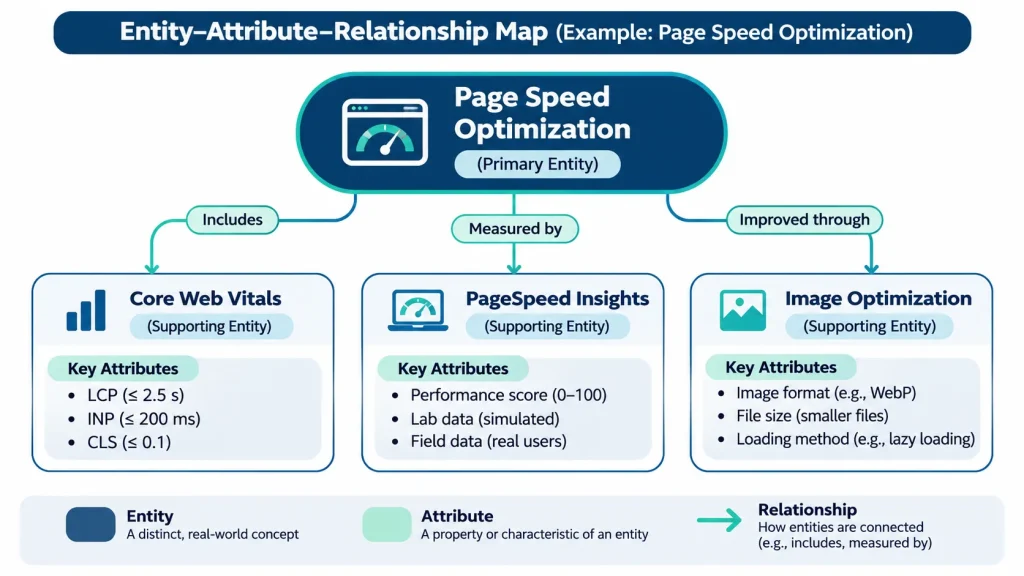
An entity-attribute-relationship map connects important concepts with their properties, related topics, and user questions. It helps writers turn research into an organised content plan.
Identify Essential Attributes for Each Entity
List the main entities and the information readers need about them.
| Entity | Essential attributes |
| Page speed optimisation | Purpose, methods, benefits, measurement |
| LCP | Definition, threshold, causes, fixes |
| INP | Definition, threshold, interaction delays |
| CLS | Definition, threshold, layout shifts |
| PageSpeed Insights | Data sources, reports, interpretation |
The map should reflect search intent. A broad guide may explain each metric briefly. A dedicated LCP guide needs more detail.
Map Relationships Between Primary and Supporting Entities
Connect each entity to the main topic through a meaningful relationship. For example:
- Page speed optimisation → uses → performance measurement.
- Performance measurement → includes → Core Web Vitals.
- Core Web Vitals → includes → LCP.
- LCP → can be delayed by → slow image loading.
- Image optimisation → may reduce → image loading time.
These connections form a logical path from measurement to diagnosis and improvement.
Connect Entity Attributes to Search Intent and User Questions
Map each important question to the entity and attributes needed to answer it.
| User question | Entity | Required information |
| How fast is my page? | Core Web Vitals | Metrics and thresholds |
| Why does the main content load slowly? | LCP | Causes and diagnostics |
| Why does the page respond slowly? | INP | Interaction delays |
| How can I test performance? | PageSpeed Insights | Testing process |
| How can I reduce loading time? | Image optimisation | Practical techniques |
This step gives each entity a clear editorial purpose.
Classify Entities as Essential, Supporting, or Out of Scope
Classify each entity based on its role.
- Essential entities directly support the primary search intent.
- Supporting entities explain or clarify an essential concept.
- Out-of-scope entities do not contribute enough value to the intended answer.
For example, LCP is essential to a Core Web Vitals guide. Image compression supports an explanation of LCP improvements. Browser history is generally out of scope. This classification prepares the entity map for content planning.
How to Create an Ontologically Optimised SEO Content Outline
An ontologically optimised outline arranges concepts according to their meaning, relationships, and role in the reader’s task. This approach builds on semantic SEO by organising connected ideas into a useful learning path without repeating the same information under different headings.
Structure Content From Macro Context to Micro Context
A practical structure uses three stages.
- Macro context introduces the central topic, its definition, and its importance.
- Contextual border connects general understanding to the main process or decision the reader must make.
- Micro context explains specific methods, applications, examples, and advanced details.
For page speed optimisation:
| Stage | Content focus |
| Macro context | What page speed is and why it matters |
| Contextual border | How to measure and diagnose performance |
| Micro context | How to fix issues and validate improvements |
This progression moves readers from understanding to action.
Map Entity Attributes and Questions to H2 and H3 Headings
Use H2 headings for major questions or process stages. Use H3 headings for distinct concepts that support an H2. For example:
- H2: Which Page Speed Metrics Should You Measure?
- H3: Largest Contentful Paint
- H3: Interaction to Next Paint
- H3: Cumulative Layout Shift
Each subsection explains a different metric under the same parent question. A supporting entity does not need its own heading unless it requires a distinct explanation.
Establish Contextual Borders to Prevent Topic Drift
A contextual border defines the limits of coverage. A page speed guide may explain how JavaScript execution affects responsiveness. It does not need to teach JavaScript programming from the beginning. The boundary keeps the content focused while allowing enough detail to answer the user’s question.
Eliminate Repeated Concepts and Overlapping Headings
Review headings for repeated search intent. For example:
- How to improve website speed.
- Ways to make webpages faster.
- Best methods for faster loading.
These headings may cover the same information. Replace them with distinct tasks, such as diagnosing loading delays, optimising images, reducing JavaScript work, and validating results.
Use an Entity Prioritisation and Heading Decision Framework
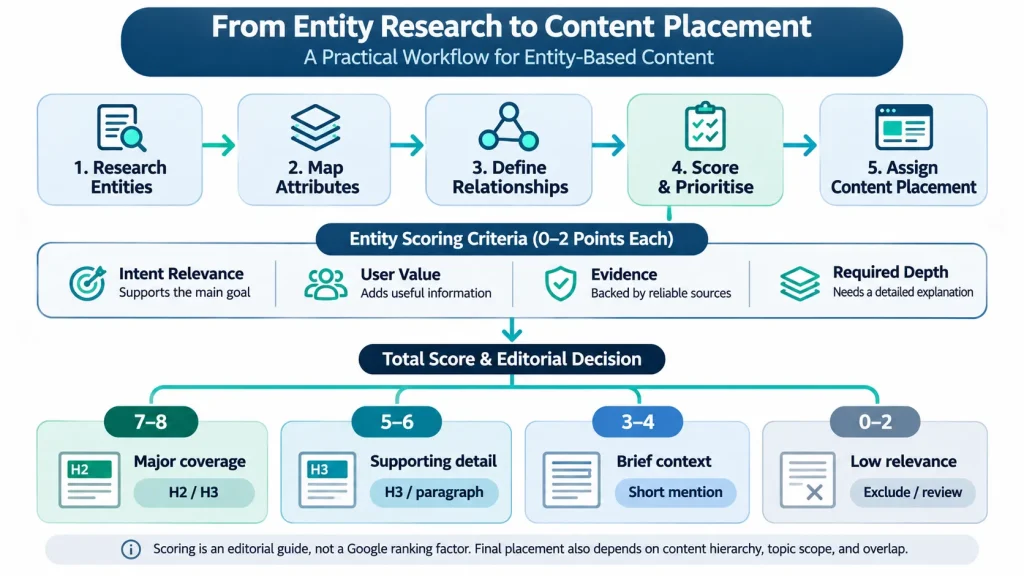
A prioritisation framework helps writers decide which entities deserve detailed coverage. Score each entity from 0 to 2 against four criteria.
| Criterion | 0 points | 1 point | 2 points |
| Intent relevance | Unrelated | Indirectly relevant | Directly supports intent |
| User value | Adds little value | Clarifies a concept | Helps answer or solve a key problem |
| Evidence | Unsupported | Limited support | Reliable evidence available |
| Required depth | No explanation needed | Brief explanation | Detailed explanation needed |
The maximum score is 8. Use the total as an initial editorial guide.
Consider an H2 or H3
Final placement also depends on heading hierarchy, topic scope, and overlap with other sections. A high score does not automatically justify an H2. An entity may score well but belong under a broader parent heading. For example, LCP may deserve an H3 under Core Web Vitals in a broad page speed guide. In a dedicated LCP article, it becomes the central topic. The scoring model supports editorial judgement. It is not a Google ranking factor or an industry-standard metric.
How to Write Entity-Based Content That Satisfies Search Intent
Entity research provides the content structure. Writing turns that research into useful answers. Each section should address a clear question and explain the facts needed to answer it.
Write Answer-First Explanations Using Relevant Entity Attributes
Start with a direct definition or answer. Then add the necessary details. For example:
What is Largest Contentful Paint?
Largest Contentful Paint (LCP) reports when the largest visible image, text block, or video element renders, relative to the start of navigation. A good LCP score is 2.5 seconds or less at the 75th percentile of page visits. This answer includes the metric’s meaning, measurement, and performance target. The reader gets the essential information without searching through several paragraphs.
Explain Semantic Relationships Through Facts and Examples
Explain how entities affect one another. For example, a large hero image may delay LCP if the browser discovers or loads it late. Compressing the image reduces its file size. Prioritising the resource may also improve loading time. This explanation connects a performance metric, a possible cause, and a suitable fix.
Add Information Gain With Evidence, Comparisons and Practical Insights
Information gain comes from adding useful facts, methods, or insights that help readers make better decisions. A page speed article might compare two performance problems:
| Problem | Likely focus | Suitable investigation |
| Poor LCP | Main content loading | Server response, image delivery, rendering |
| Poor INP | Interaction responsiveness | JavaScript tasks, event handlers, rendering work |
The comparison helps readers choose where to investigate first. Original decision frameworks, practical examples, and verified technical findings can add more value than general advice. Google’s guidance also recommends useful, original, non-commodity content for Search and AI experiences.
Maintain Natural Language Without Entity Stuffing
Use technical terms when they help explain the subject. Avoid repeating the same entity name in every sentence. For example, instead of:
“Core Web Vitals optimisation improves Core Web Vitals metrics through Core Web Vitals improvements.”
Write:
“Improving loading speed, responsiveness, and visual stability can improve Core Web Vitals results.”
The second version communicates the same idea more clearly.
Entity-Based Content Example: From Entity Research to Final Outline
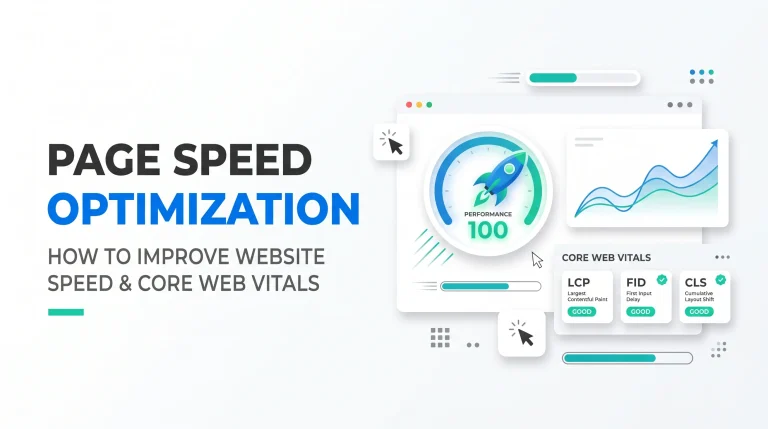
Consider an SEO team creating an article titled “Page Speed Optimisation: How to Improve Website Speed and Core Web Vitals”. The target reader wants to measure page performance, identify problems, and apply suitable fixes. The following example shows how to turn entity research into an editorial plan.
Identify the Main Entities in Page Speed Optimisation
Start with the central topic and group supporting entities by their role.
Page Speed Optimisation
Primary entity
- Measurement
- Core Web Vitals
- PageSpeed Insights
Diagnosis
- LCP delays
- INP delays
- Layout shifts
Improvement
- Images
- JavaScript
- Caching
The three groups reflect the reader’s main tasks. Measurement identifies performance results. Diagnosis explains why problems occur. Improvement covers the actions needed to address them.
Build an Entity-Attribute-Relationship Mapping Table
Now connect each entity with its attributes, relationships, and editorial priority. The scores below illustrate the eight-point framework introduced earlier. They are example editorial judgements, not measured search data.
| Entity | Main attribute or relationship | Score | Decision |
| Core Web Vitals | Measures aspects of user experience | 8 | H2 |
| LCP | Measures loading performance | 8 | H3 |
| INP | Measures responsiveness | 8 | H3 |
| CLS | Measures visual stability | 8 | H3 |
| PageSpeed Insights | Reports performance data | 7 | H3 |
| Image optimisation | Can improve resource loading | 7 | H3 |
| Browser caching | Can reduce repeat-load costs | 5 | Supporting subsection |
| Browser history | Limited relevance to the task | 1 | Exclude |
Although LCP scores 8, it belongs under the broader Core Web Vitals section in this article. This shows why editorial structure matters alongside prioritisation scores.
Convert the Entity Map Into an H2/H3 Content Structure
The map produces the following outline:
H2: What Is Page Speed Optimisation?
H3: Page Speed vs Page Load Time
H3: Why Website Performance Matters
H2: Which Page Speed Metrics Should You Measure?
H3: Largest Contentful Paint
H3: Interaction to Next Paint
H3: Cumulative Layout Shift
H2: How to Diagnose Slow Page Performance
H3: Use PageSpeed Insights
H3: Identify Performance Bottlenecks
H2: How to Improve Website Page Speed
H3: Optimise Images
H3: Reduce JavaScript Delays
H3: Improve Resource Delivery and Caching
H2: How to Validate Page Speed Improvements
H3: Compare Before-and-After Results
H3: Monitor Real-User Performance
The outline moves from understanding to measurement, diagnosis, improvement, and validation. Each section serves a different purpose.
Compare Keyword-Only Writing With Entity-Based Writing
Consider two explanations of page speed optimisation.
Keyword-only example:
“Page speed optimisation helps improve website speed. Businesses can use page speed optimisation techniques to make websites faster and improve page speed performance.”
This paragraph repeats the target phrase without explaining the process.
Entity-based example:
“Page speed optimisation improves how quickly a webpage loads and responds. Core Web Vitals help teams assess loading performance, responsiveness, and visual stability. Teams can then investigate issues such as slow image loading or heavy JavaScript and test suitable fixes.”
The second paragraph connects relevant concepts and explains their roles. It provides more information without adding unnecessary length.
How to Build Topical Authority With Entity-Based Content
Entity-based planning can help websites organise related topics into a useful content library. Topical authority is a common SEO term for a site’s depth of coverage within a subject area. It is not a single published Google ranking score.
Organise Related Entities Into Pillar Pages and Supporting Clusters
A pillar page covers a broad topic. Supporting articles explain narrower subjects that need more detail. For example, a page speed optimisation pillar may connect to guides about LCP, INP, image optimisation, JavaScript performance, and Core Web Vitals monitoring. Each supporting page should answer a distinct question.
Connect Related Topics Through Contextual Internal Links
Internal links help readers move between related explanations. They also support page discovery and site navigation. For example, a broad page speed guide can link to a detailed LCP article when discussing loading delays. Use descriptive anchor text and link only when the destination provides useful additional information.
Prevent Search Intent Overlap and Keyword Cannibalisation
Two articles can cover related entities without serving the same intent. However, pages targeting nearly identical questions may create unnecessary overlap. For example, “How to Improve Page Speed” and “Ways to Make a Website Faster” may answer the same core question.
Maintain Consistent Topical Coverage Across the Website
Use accurate definitions and consistent terms across related pages. Maintain a content map that records each page’s primary intent, supporting topics, and internal links. Update pages when technical standards, user needs, or verified facts change. This helps prevent outdated explanations and gaps in coverage.
How to Audit and Improve Existing Entity-Based Content
An entity-based audit compares what a page currently explains with what readers need to know. The audit should lead to specific content changes. Where content must also serve AI-generated search experiences, generative engine optimisation services can support a wider review of content clarity and search visibility.
Identify Missing Attributes and Underexplained Relationships
Start with the article’s primary search intent. Compare the existing content against its entity map. For example, an LCP article may define the metric but fail to explain its thresholds or common causes. Record each gap and the action needed to resolve it.
| Audit finding | Example | Recommended action |
| Missing attribute | No LCP threshold | Add verified threshold |
| Weak relationship | Image size mentioned without explaining its effect | Explain the loading impact |
| Repeated explanation | Same LCP definition in three sections | Keep one clear definition |
| Missing user question | No guidance on testing | Add a testing subsection |
| Irrelevant content | Unrelated browser history | Remove |
This approach turns the audit into an editing plan.
Evaluate Content Accuracy, Relevance and Information Gain
Check important claims against reliable sources. For technical SEO topics, useful references include Google’s SEO Starter Guide and Core Web Vitals threshold documentation.
Review whether each section provides a new answer, useful evidence, or a practical decision. Remove unsupported claims and unnecessary repetition.
Measure Organic Query Coverage and Content Performance
Use Google Search Console to review relevant queries, impressions, clicks, and click-through rates. Compare suitable periods before and after major updates.
| Metric | What it helps assess |
| Relevant query coverage | Visibility for useful search terms |
| Organic impressions | Search exposure |
| Organic clicks | Traffic from search |
| Click-through rate | Clicks relative to impressions |
| Conversions | Business actions from visitors |
Do not assume a content update caused every change. Search demand, competition, seasonality, and ranking changes can also affect performance.
What Are the Most Common Entity-Based Content Mistakes?
| Common Mistake | Why It Matters | How to Avoid It |
| Adding Irrelevant Entities | Unrelated concepts distract readers and weaken topic focus. For example, JavaScript history adds little value to a page speed guide. | Include only entities that support the reader’s search intent and help answer the main question. |
| Confusing Entity Mentions With Topical Authority | Mentioning many entities does not prove expertise. Entity counts alone cannot replace accurate facts or useful explanations. | Focus on verified information, meaningful relationships, and evidence that addresses user needs. |
| Creating Repetitive Headings and Overlapping Content | Similar headings often repeat the same concepts, making content longer without adding value. | Give each heading a distinct purpose. Merge overlapping sections and use an entity map to organize information. |
Frequently Asked Questions About Entity-Based Content
How Many Entities Should an SEO Article Include?
There is no fixed number of entities an SEO article should include. The right number depends on search intent, topic complexity, and the information readers need. Prioritise useful coverage rather than entity counts.
Can Entity-Based Content Replace Keyword Research?
No. Keyword research identifies search demand and user language. Entity research identifies the concepts and relationships needed to answer those searches. Both methods support effective content planning.
How Do You Decide Whether an Entity Needs Its Own Heading?
Use an H2 for a major question or process stage. Use an H3 for a distinct supporting concept that needs a separate explanation. Keep minor details within paragraphs or tables.
How Often Should an Entity-Based Content Map Be Updated?
Review the map when user needs, technical standards, or important facts change. For stable topics, periodic checks may be enough. Fast-changing subjects may require more frequent updates.
Conclusion
Entity-based content helps SEO professionals organise information around meaningful concepts rather than keyword repetition. The process begins with search intent and entity research. It then moves through attribute mapping, relationship analysis, editorial prioritisation, and content creation.
The key decision is how much attention each entity deserves. Use major headings for essential questions, subsections for distinct supporting concepts, and short explanations for minor details. Exclude information that does not help readers. The approach of combining keyword research, reliable evidence, and clear writing creates a practical foundation for semantic SEO and useful content architecture.