
Your content might have traffic, but that doesn’t mean people are engaging. Readers leave the content that feels robotic, overly formal, or written for search engines.
The rise of AI-generated content has made this problem more obvious. People want accurate information, and also authenticity, clarity, and a human connection.
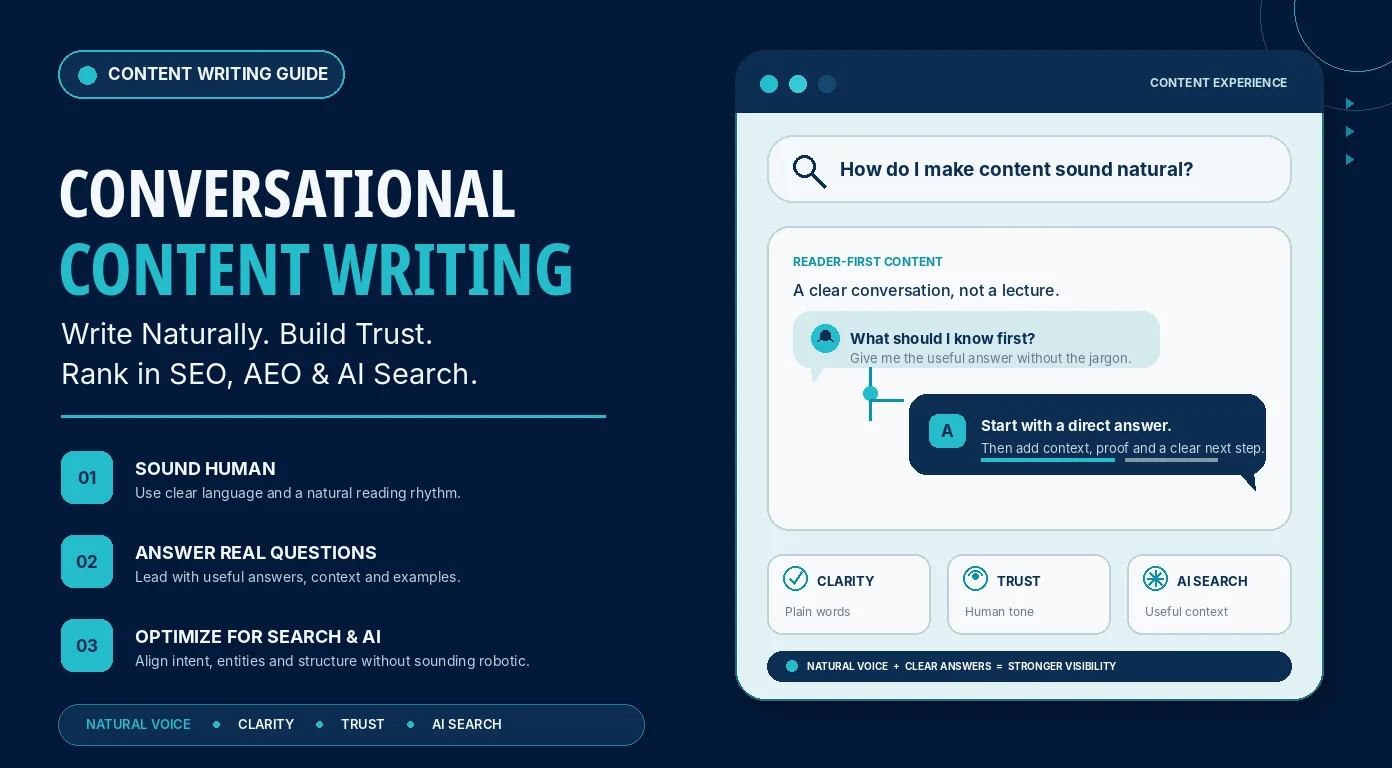
Conversational content writing solves that problem. Instead of writing at readers, you write to them. Writers anticipate questions, simplify complex ideas, and create the feeling of an ongoing discussion rather than a lecture. The result is stronger engagement, greater trust, better conversions, and improved visibility in search engines and AI-powered search experiences.
What Is Conversational Content Writing?
Conversational content writing is the practice of creating content that resembles natural human communication while maintaining professionalism, authority, and accuracy.
The following characteristics define conversational writing:
- Natural communication patterns
- Human-centered language
- Reader-focused explanations
- Direct and accessible wording
- Logical information flow
Conversational writing versus traditional writing
Both have different purposes.
| Traditional writing | Conversational writing |
| Formal tone | Natural tone |
| Company-focused language | Reader-focused language |
| Passive constructions | Active voice |
| Complex terminology | Clear wording |
| One-way communication | Dialogue-oriented communication |
| Dense paragraphs | Scannable structure |
Traditional writing prioritizes correctness and formality. Conversational writing prioritizes clarity and connection. For conversational writing, readability becomes the priority.
Conversational writing versus casual writing
Writers confuse conversational writing with informal writing. Casual writing relies on slang, jokes, abbreviations, and personal opinions. Conversational writing balances friendliness with expertise.
Think of it this way:
- Casual writing says, “Hey, here’s a cool trick.”
- Conversational writing says, “Here’s an approach that works and why it matters.”
Professional friendliness is the target while the authority is kept intact.
Essential characteristics of conversational content
The conversational content combines several elements.
- Clarity
- Simplicity
- Authenticity
- Empathy
- Accessibility
- Personality
- Relevance
Why Conversational Content Matters
Conversational writing improves readability, strengthens trust, increases engagement, and aligns content with the way modern audiences search for information.
Readability, Cognitive Fluency, and Comprehension
Readers prefer information that is easy to process. Researchers describe this principle as cognitive fluency, which refers to the brain’s tendency to favor content that requires less mental effort to understand.
Clear writing reduces cognitive strain and helps readers absorb information quickly.
Several factors contribute to better readability:
- Short, well-structured sentences
- Familiar language
- Clear organization
- Descriptive headings
- Appropriate spacing and formatting
- Practical examples
When these elements work together, readers benefit from:
- Faster comprehension
- Better retention
- Greater engagement
- Reduced confusion
Trust, Familiarity, and Emotional Connection
People don’t remember facts in isolation. They connect information through experiences, patterns, stories, and emotions. This is why a practical example creates a stronger impression than an abstract explanation.
Storytelling, analogies, and relatable examples help readers understand complicated ideas, because they provide context and create familiarity.
Trust grows through familiarity. Readers trust the information that feels approachable, authentic, and natural. Authority develops when complex ideas are explained clearly and confidently.
As digital content evolves, readers want direct answers, supporting information, and a logical flow from one idea to the next.
Engagement, Conversions, and User Experience
Content that sounds natural creates a smoother reading experience. Readers are likely to continue reading because each sentence leads to the next. This reduction in friction leads to improved performance across several engagement metrics, including:
- Average engagement time
- Scroll depth
- Click-through rates
- User interactions
- Conversion rates
SEO, AI Search, and Brand Recognition
Search behavior has become conversational. People no longer rely on short keyword phrases. Instead, they ask complete questions and expect direct, contextually relevant answers.
Modern search engines analyze information through technologies such as:
- Natural language processing (NLP)
- Semantic analysis
- Entity recognition
- Search intent evaluation
As a result, conversational writing is effective for improving visibility in:
- Voice search results
- Featured snippets
- AI Overviews
- Answer engines
- Generative search platforms
A consistent conversational style strengthens brand recognition. Readers begin to recognize an organization’s personality, values, and communication style, which helps establish long-term trust and credibility.
The organizations maintain a balance between accessibility and expertise by emphasizing clarity while preserving technical accuracy. This approach allows content to remain both authoritative and approachable.
Fundamental Principles of Conversational Writing
Conversational writing involves writing content that feels natural, engaging, and easy to understand while maintaining authority and credibility. The following principles form the foundation of effective conversational content writing and help writers establish stronger connections with readers.
| Principle | Purpose | Best Practice | Example |
| Write the way people speak | Create a natural reading experience | Use everyday language and a conversational rhythm. If a sentence sounds unnatural when spoken aloud, rewrite it. | Instead of “Users are advised to proceed,” write “You can move on to the next step.” |
| Focus on one reader instead of an audience | Build a stronger personal connection | Write as though you are speaking directly to a single person. Use second-person language whenever appropriate. | “You might notice an improvement in engagement.” |
| Use active voice | Improve clarity and readability | Place the subject before the action to create shorter, stronger sentences. | Instead of “The report was completed by the marketing team,” write “The marketing team completed the report.” |
| Replace jargon with plain language | Make content easier to understand | Eliminate unnecessary technical language and explain complex concepts simply. | Replace “utilize” with “use.” |
| Use contractions naturally | Reflect everyday speech patterns | Use contractions where they sound natural and fit the brand voice. | You’re, we’ll, it’s, don’t, and they’re. |
| Ask questions strategically | Increase engagement and maintain momentum | Encourage readers to think, reflect, and continue reading. | “Why does this matter?” |
| Keep sentences and paragraphs concise | Improve readability across devices | Break long paragraphs into smaller sections and eliminate unnecessary words. | Two or three short sentences are usually easier to read than a large block of text. |
| Create smooth transitions | Improve the flow between ideas | Build logical connections between concepts instead of relying on repetitive transition phrases. | “Understanding the audience is only the first step. The next challenge is creating a consistent voice.” |
| Balance personality with authority | Establish trust and credibility | Write in a human voice while maintaining accuracy and professionalism. | Use a friendly tone without sacrificing expertise. |
| Use examples, analogies, and stories | Simplify complex ideas | Connect unfamiliar concepts to situations readers already understand. | Explaining a website’s structure by comparing it to a library. |
| Develop a consistent brand voice | Strengthen recognition and trust | Establish clear guidelines for tone, vocabulary, sentence structure, and style. | A law firm may adopt a more professional tone, while a lifestyle brand may sound more relaxed. |
How to Write Conversational Content
Conversational writing is not about adopting a friendlier tone. It involves understanding your audience, anticipating their questions, structuring information logically, and delivering answers in a way that feels natural and engaging.
Step 1: Research Your Audience
Effective conversational writing begins with understanding the people you want to reach. The goal is to identify the language they use, the problems they face, and the information they need.
Useful sources include:
- Customer interviews
- Reviews and testimonials
- Social media platforms
- Search data
- Customer support tickets
- Reddit discussions
- Quora communities
Recurring questions, frustrations, and goals reveal valuable insights into audience behavior and search intent.
Step 2: Understand Search Intent
Every piece of content should serve a clear purpose. Understanding user intent helps determine the structure, tone, depth, and format of your content.
| Intent type | Goal |
| Informational | Learn something |
| Commercial | Compare solutions |
| Transactional | Complete an action |
| Navigational | Find a destination |
Aligning content with user intent makes information relevant and easier to discover.
Step 3: Discover Real Questions
Conversational content mirrors the way people naturally communicate and search for information. Question-based research helps uncover the language and phrasing your audience uses every day.
The sources include:
- People Also Ask (PAA)
- People Also Search For (PASF)
- Quora
- Customer support conversations
- Community forums
These sources reveal topics and concerns that traditional keyword research overlooks.
Step 4: Build a Conversation-Based Structure
Organize information according to the reader’s journey, and not as per the writer’s perspective. A simple framework works well:
- Define the problem.
- Answer the primary question.
- Provide supporting information.
- Address concerns and objections.
- Recommend the next step.
Search intent, semantic relationships, and entity associations should guide the overall structure.
Step 5: Write Naturally and Add Personality
Write as though you are speaking to a single reader. Use clear language, active voice, concise sentences, and practical examples to make complex ideas easier to understand.
At the same time, allow the brand’s personality to emerge naturally. Empathy, storytelling, and relatable examples create a stronger connection because people respond more to authentic communication than to generic corporate language.
Step 6: Optimize for Search and AI Systems
Modern search engines emphasize context, meaning, and user intent.
Focus on the following elements:
- Relevant keywords
- Semantic entities
- Internal linking
- Structured data
- Featured snippets
- Search intent alignment
This improves visibility across traditional search engines, answer engines, voice search platforms, and AI-powered search experiences.
Step 7: Edit for Clarity and Flow
The final step is to refine the content to make it sound natural when spoken aloud.
A simple editing process can help:
- Read the content aloud.
- Simplify complex sentences.
- Remove repetition and unnecessary wording.
- Improve transitions between ideas.
- Verify accuracy and consistency.
Conversational Writing Techniques That Increase Engagement
Effective conversational content doesn’t simplify information. It captures attention, builds trust, and guides readers naturally from one idea to the next. The following techniques help create more engaging content.
Storytelling, Examples, and Analogies
Stories help readers understand and remember information because the brain naturally recognizes patterns, emotions, and relationships. Effective storytelling does not require dramatic narratives. Simple examples and everyday experiences create a stronger connection.
A straightforward framework:
- Introduce the problem.
- Explain the challenge.
- Present the solution.
- Describe the outcome.
Micro-stories, case studies, and analogies are valuable because they transform abstract concepts into what readers already understand.
For example, search engines can be compared to librarians. Their role is not simply to store information but to organize it and deliver the most useful answer at the right moment.
Empathy and Reader Psychology
People engage deeply with content when they feel understood. Empathetic writing anticipates readers’ concerns, questions, goals, and frustrations before they are expressed.
This requires writers to understand:
- What readers want to accomplish
- Which obstacles they face
- Which questions they are likely to ask
- Which actions they intend to take
When content addresses these concerns directly, trust grows naturally.
Sentence Rhythm and Flow
Sentence variety improves readability and maintains attention. Short sentences create emphasis and clarity. Longer sentences provide context and create smoother transitions between ideas. An effective conversational style relies on balanced use of short and long sentences rather than strict rules.
Question-Based Writing
Questions encourage readers to continue exploring the content as they imitate the natural flow of conversation.
For example:
Question: How can I make my content sound more natural?
Answer: Use straightforward language, shorten paragraphs, include practical examples, and read the content aloud before publishing it.
This format supports featured snippets, voice search results, and AI-generated answers.
Natural Calls to Action
The strongest calls to action feel like helpful recommendations and not sales messages.
Instead of writing:
- Download our guide.
- Contact our team.
- Buy now.
Consider using a conversational approach:
- Here’s what to do next.
- Let’s look at the next step.
- You can start with this simple process.
Small changes in wording create a natural and engaging experience.
Conversational Content Writing for SEO, AEO, GEO, and AI Search
Search has become increasingly conversational. For example, rather than searching for “email marketing tips,” a user might search for “How can I improve email open rates without increasing costs?”
Modern search engines and AI systems analyze relationships, context, intent, and meaning, not the individual keywords. As a result, conversational writing aligns with the way information is discovered, interpreted, and delivered.
Conversational Search and Semantic SEO
Traditional SEO emphasized keywords. Modern SEO emphasizes topics, entities, and relationships between concepts.
Search engines evaluate the following signals when determining relevance:
- Search intent
- Context
- Semantic relationships
- Topic depth
- Content quality
- Topical authority
A page about conversational writing should not merely repeat the phrase “conversational content writing.” Instead, it should address related topics such as search intent, semantic search, voice search, natural language processing, entity optimization, and brand communication.
Entity-Based Optimization
An entity represents a person, place, organization, product, concept, or event. Search engines analyze relationships between entities to build a deeper understanding of content.
Effective entity optimization includes:
- Entity extraction
- Topic clustering
- Knowledge graph associations
- Internal linking
- Topical authority development
Voice Search, Featured Snippets, and AI Overviews
Voice assistants and AI search platforms prioritize concise, well-structured answers because users expect immediate responses.
To improve visibility:
- Answer questions directly.
- Use natural language.
- Organize content logically.
- Include descriptive headings.
- Use tables, lists, and structured formatting.
- Optimize for mobile devices.
AEO, GEO, and E-E-A-T
Answer Engine Optimization (AEO) and Generative Engine Optimization (GEO) focus on making content understandable to AI systems that retrieve, summarize, and synthesize information.
Content optimized for these environments includes:
- Clear definitions
- Strong topical coverage
- Semantic relationships
- Supporting examples
- Consistent terminology
- Accurate and trustworthy information
This approach also supports Google’s E-E-A-T principles by demonstrating experience, expertise, authoritativeness, and trustworthiness through clear and comprehensive explanations.
Conversational Writing Examples
Conversational writing can be adapted to blogs, landing pages, emails, social media posts, product descriptions, customer support interactions, and many other content formats. Although the format changes, the goal remains the same: to communicate clearly, naturally, and in a way that feels human.
| Content type | Formal approach | Conversational approach |
| Blog article | Search engine optimization techniques should be implemented consistently to improve website performance. | Consistent optimization helps search engines understand your content and makes it easier for readers to find you. |
| Landing page | Our software includes automated reporting capabilities. | Spend less time creating reports and more time acting on the insights that matter. |
| Email campaign | We are pleased to inform you that your account has been successfully activated. | Your account is ready to go. Here’s what to do next. |
| Social media post | Our latest product update has been released. | We’ve introduced several new features. Which one are you most excited to try? |
| Product description | The device includes a 5,000 mAh battery. | A single charge keeps the device running throughout the day. |
| Customer support message | Your request has been processed successfully. | We’ve processed your request and sent a confirmation email with the next steps. |
| General instruction | It is recommended that users update their settings. | We recommend updating your settings. |
| Customer assistance | Assistance will be provided upon request. | We’ll help whenever you need assistance. |
| Confirmation message | The information has been submitted successfully. | Your information has been submitted successfully. |
| Registration request | Users are required to complete registration. | Please complete your registration. |
Measuring Conversational Content Performance
Measuring the effectiveness of conversational content helps writers understand what resonates with readers, where friction occurs, and which improvements will produce the strongest results.
Readability and Engagement Metrics
Readability tools and engagement data help identify obstacles that affect the user experience. Writers should evaluate how readers interact with the content.
| Metric | Purpose |
| Sentence length | Measures readability and comprehension |
| Reading difficulty | Evaluates content accessibility |
| Bounce rate | Measures immediate exits |
| Scroll depth | Tracks content consumption |
| Average engagement time | Measures reader interest |
| Click-through rate | Evaluates interaction |
Conversion and User Behavior Analysis
Performance needs to be measured against the intended goal. Depending on the purpose of the content, useful indicators include:
- Purchases
- Form submissions
- Downloads
- Newsletter subscriptions
- Consultation requests
Writers examine user behavior to identify patterns that reveal opportunities for improvement. Heat maps, session recordings, user feedback, and A/B testing help uncover areas where readers lose interest or encounter unnecessary friction.
When conducting A/B tests, change one element at a time, such as:
- Headlines
- Calls to action
- Sentence length
- Formatting
- Structure
The small adjustments produce meaningful improvements over time.
Tools for Conversational Content Writing
These tools support the process. They shouldn’t replace human judgment.
| Category | Tools |
| Writing assistance | Grammarly, Hemingway |
| Audience research | Reddit, Quora |
| Keyword research | Ahrefs, Semrush |
| AI writing | ChatGPT, Gemini, Claude |
| Analytics | Google Analytics, Google Search Console |
| Content optimization | Surfer SEO, Clearscope |
Common Conversational Writing Mistakes
Conversational writing feels natural, clear, and engaging. However, certain mistakes weaken readability, reduce trust, and create a poor user experience.
| Mistake | Why it causes problems | Better approach |
| Sounding robotic | Rigid sentence structures, repetitive wording, and overly polished language make content feel artificial. | Use natural language, read the content aloud, and vary sentence length. |
| Being excessively casual | Slang, excessive humor, and informal expressions can reduce credibility. | Maintain a balance between professionalism and personality. |
| Overusing slang and jargon | Unfamiliar language creates confusion and alienates readers. | Choose simple, familiar, and accessible language. |
| Writing without audience research | Content fails to address readers’ questions, concerns, and goals. | Study customer feedback, search behavior, and audience intent. |
| Prioritizing algorithms over readers | Keyword-focused content sounds unnatural and performs poorly over time. | Focus on clarity, relevance, and user experience. |
| Excessive keyword optimization | Repetition disrupts the natural flow of the content. | Prioritize context, entities, and semantic relationships. |
| Writing overly long sentences | Complex sentence structures increase cognitive load and reduce readability. | Use concise sentences and straightforward explanations. |
| Using unnatural transitions | Forced transitions interrupt the flow of ideas. | Create logical connections between sections and paragraphs. |
| Ignoring formatting and structure | Poor organization makes content difficult to read and understand. | Use headings, lists, tables, and adequate spacing. |
Key Takeaways
- Conversational writing focuses on clarity, readability, empathy, and accessibility rather than overly formal language.
- Understanding audience intent, questions, pain points, and search behavior is essential for creating content that resonates with readers.
- Stories, examples, analogies, question-and-answer formats, and natural sentence structures improve engagement and retention.
- Modern search engines and AI systems rely on context, semantic relationships, search intent, and entity associations to understand content.
- Voice search, featured snippets, AI Overviews, Answer Engine Optimization (AEO), and Generative Engine Optimization (GEO) all benefit from conversational language.
- Strong conversational writing balances personality with professionalism while maintaining credibility and authority.
- Regular editing, performance analysis, and user feedback help identify opportunities for continuous improvement.
Frequently Asked Questions
What is an example of conversational writing?
A conversational sentence might read, “We’ve received your request and will contact you shortly,” instead of, “Your request has been processed successfully.” The goal is to sound natural, clear, and approachable without sacrificing professionalism.
What is the difference between conversational writing and conversational copywriting?
Conversational writing focuses on making information easier to understand, while conversational copywriting uses natural language to persuade readers and encourage specific actions.
Can conversational writing be professional?
Yes. Conversational writing emphasizes clarity and accessibility rather than informality. Writers can maintain authority and professionalism while using language that feels natural and engaging.
Does conversational writing work in B2B industries?
Yes. Healthcare organizations, law firms, software companies, financial institutions, and technology businesses frequently use conversational writing to explain complex ideas more clearly and build stronger relationships with their audiences.
How can I tell whether my content sounds natural?
A simple test is to read the content aloud. If a sentence feels awkward, overly formal, or difficult to say in a conversation, it will probably feel unnatural to readers as well.