
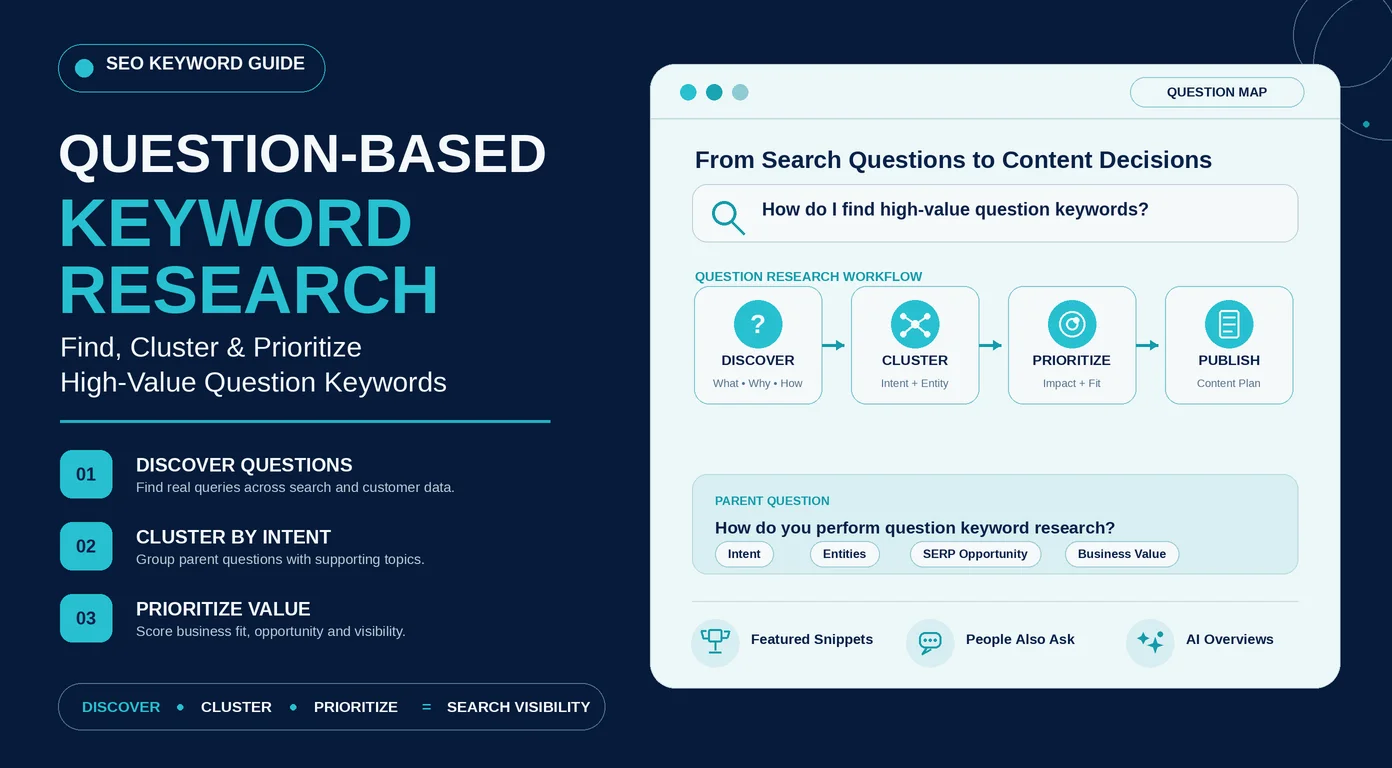
Search has become conversational. Users now ask “How do I find low-competition keywords?” or “Which CRM is best for startups?” instead of searching with fragmented phrases like CRM software or SEO tools.
Google, AI Overviews, People Also Ask (PAA), Featured Snippets, voice assistants, and AI search engines interpret intent, entities, and context to deliver direct answers. Question-based keyword research identifies, evaluates, and clusters these queries to create content that matches user intent, builds topical authority, and increases visibility across search and AI-powered answer engines.
What Is Question-Based Keyword Research?
Question-based keyword research is the process of discovering, evaluating, and prioritizing natural-language search queries to create content that answers specific user questions. Unlike traditional keyword research, which emphasizes search volume and keyword variations, it focuses on user intent, underlying problems, and expected answers.
| Traditional Keyword | Question Keyword | Primary Intent |
| Keyword research | How do I perform keyword research? | Learn a process |
| Local SEO | Why isn’t my business ranking locally? | Solve a problem |
| CRM software | Which CRM is best for small businesses? | Compare solutions |
| FAQ Schema | How do I implement FAQ Schema? | Complete a task |
Question keywords provide context that standalone keywords cannot. They reveal:
- User objective
- Search intent
- Expected answer format
- Funnel stage
- Commercial potential
Rather than targeting isolated questions, build content around parent questions supported by related questions that address the complete decision-making journey.
Why Question Queries Matter in Modern Search
Modern search engines and AI answer engines interpret entities, intent, relationships, and context, not just exact-match keywords.
For the query “How do I improve Core Web Vitals?”, Google identifies multiple search signals before ranking content.
| Search Signal | Example |
| Entity | Core Web Vitals |
| Intent | Learn how |
| Expected Answer | Step-by-step guide |
| Related Entities | LCP, CLS, INP, PageSpeed Insights |
Content is more likely to appear in AI Overviews, Featured Snippets, People Also Ask, and voice search when it:
- Answers the primary question immediately.
- Covers related entities and follow-up questions.
- Uses a logical heading hierarchy.
- Demonstrates topical completeness.
Where Question Keywords Fit Across the Customer Journey
Different questions represent different stages of the buying journey, so each requires a different content format.
| Journey Stage | Example Question | Best Content |
| Awareness | What is semantic SEO? | Beginner guide |
| Consideration | How does semantic SEO work? | Tutorial |
| Evaluation | Semantic SEO vs traditional SEO | Comparison |
| Decision | Which semantic SEO tool is best? | Buying guide |
| Post-purchase | How do I implement semantic SEO? | Documentation or tutorial |
Publishing comparison pages for awareness-stage users—or beginner guides for purchase-ready users—creates an intent mismatch that limits rankings and conversions.
Classify Questions Before Creating Content
Every question should belong to a single primary intent.
| Intent | Common Modifiers | Best Content Format |
| Informational | What, Why, How | Guide or tutorial |
| Comparative | Best, Vs, Difference | Comparison page |
| Problem-solving | Why, Fix | Troubleshooting guide |
| Transactional | Which, Cost, Worth | Buying guide |
| Local | Where, Near me | Local landing page |
| Support | Setup, Configure, Reset | Help documentation |
Questions with different intents should rarely target the same page. Instead, group related questions into a topic cluster and assign one primary intent to each page to avoid keyword cannibalization.
Types of Question Keywords
Question keywords represent different user goals. Classifying them by search intent helps prioritize content, choose the right page type, and avoid mixing multiple intents on one page.
| Question Type | User Goal | Common Modifiers | Best Content Format |
| Informational | Learn a concept or process | What, Why, How | Guides, tutorials, explainers |
| Comparative & Evaluation | Compare solutions before deciding | Best, Vs, Difference, Worth | Comparison pages, reviews |
| Problem-Solution | Resolve a specific issue | Why, Fix, Troubleshoot | Troubleshooting guides |
| Transactional & Decision | Make a purchase or hire a service | Which, Cost, Pricing | Buying guides, service pages |
| Local | Find nearby products or services | Near me, Best in, Where | Local landing pages |
| Post-Purchase & Support | Use, maintain, or troubleshoot a product | Setup, Configure, Renew, Migrate | Documentation, FAQs, knowledge base |
Match Content to Search Intent
Each question type requires a different content structure.
| Question Type | Content Should Prioritize |
| Informational | Clear explanations, examples, step-by-step guidance |
| Comparative | Features, pricing, pros and cons, use cases |
| Problem-Solution | Diagnosis, causes, solutions, prevention |
| Transactional | Pricing, ROI, alternatives, decision criteria |
| Local | Service areas, local information, FAQs, trust signals |
| Support | Setup instructions, troubleshooting, product documentation |
Questions with different intents should rarely target the same page. For example, “What is keyword clustering?” and “Which keyword clustering tool is best?” require different content because they serve different stages of the customer journey.
Prioritize Questions by Business Impact
Search volume alone doesn’t determine value. Prioritize questions that strengthen topical authority and support business goals.
| Evaluation Factor | High Priority | Low Priority |
| Business relevance | Supports products or services | Unrelated topic |
| Search intent | Matches target audience | General curiosity |
| Conversion potential | High commercial intent | Low buying intent |
| Topical relevance | Expands an existing cluster | Standalone topic |
| SERP opportunity | Weak or incomplete competitors | Highly saturated results |
Prioritization workflow
- Identify the question’s search intent.
- Evaluate business relevance and conversion potential.
- Check whether it strengthens an existing topic cluster.
- Analyze SERP competition and search features.
- Publish high-value questions before high-volume questions.
How to Discover High-Value Question Keywords
High-value question keywords rarely come from a single source. Combine Google Search features, first-party customer data, SEO tools, community discussions, and competitor research to uncover questions that keyword databases often overlook.
Mining Google Search Features
Google’s search results provide the most reliable source of real user questions and reveal how topics are semantically connected.
People Also Ask (PAA)
People Also Ask (PAA) exposes follow-up questions users commonly ask after an initial search. Expand multiple levels instead of collecting only the first four questions to uncover the complete topic hierarchy.
What is keyword research?
↓
How do you find keywords?
↓
Which keyword tool is best?
↓
How do you prioritize keywords?
↓
How do you cluster keywords?
Use PAA to:
- Build FAQ sections
- Identify supporting questions
- Expand topic clusters
- Discover comparison topics
Google Autocomplete
Google Autocomplete predicts popular searches as users type. Search using question modifiers such as how, what, why, when, where, which, can, and should, then repeat the process with:
- A–Z modifiers
- Year modifiers
- Location modifiers
- Industry modifiers
This method uncovers long-tail question variations that keyword databases may not capture.
Related Searches
Related Searches reveal semantically connected entities and adjacent topics rather than simple keyword variations.
Use them to identify:
- Supporting entities
- Related problems
- Missing subtopics
- Future supporting articles
Entities that appear repeatedly often deserve dedicated coverage within your topic cluster.
AI Overview Question Mining
AI Overviews summarize information from multiple authoritative sources. Instead of copying the generated answer, analyze it to identify:
- Frequently mentioned entities
- Recurring subtopics
- Missing explanations
- Cited sources
- Unanswered follow-up questions
These gaps often reveal opportunities to publish more comprehensive content than existing search results.
Analyzing Google Search Console Queries
Google Search Console reveals question-based queries your website already ranks for, making it one of the fastest ways to identify optimization opportunities.
| Step | Action |
| 1 | Export the Performance report |
| 2 | Filter queries containing how, what, why, when, where, which, can, should |
| 3 | Sort by Impressions |
| 4 | Prioritize queries ranking between positions 8–20 |
| 5 | Improve existing pages before creating new content |
Pages already receiving impressions usually require optimization rather than replacement.
Using Question Research Tools
No single platform captures every question. Combining multiple tools improves coverage and validates opportunities.
AnswerThePublic
Best for discovering broad informational questions and long-tail variations during the initial research phase.
AlsoAsked
Visualizes People Also Ask relationships, making it useful for building topic clusters and identifying supporting questions.
Semrush & Ahrefs
Use Semrush to discover question keywords and analyze SERP features. Use Ahrefs to identify parent topics, competitor content gaps, and keyword overlap.
KeywordTool.io
Expands Google Autocomplete into hundreds of question variations using modifiers, alphabet expansion, and localized searches.
Finding Questions from Real Users
Keyword tools capture existing demand. Real users reveal emerging demand before it appears in search databases.
Reddit, Quora & Industry Forums
Analyze recurring discussions rather than individual viral posts. Questions repeated across multiple threads often indicate sustainable search demand.
Customer Reviews
Reviews highlight common pain points, comparison criteria, missing features, and customer language that can be converted into content ideas.
Support Tickets & Live Chat
Support conversations uncover implementation issues, troubleshooting topics, and recurring product questions that make valuable support content.
Sales Conversations
Sales calls reveal pricing concerns, buying objections, feature comparisons, and decision-making questions that are highly valuable for commercial content.
Identifying Competitor Question Gaps
Competitor research should identify unanswered questions, not duplicate existing content.
Evaluate competing pages for:
- Missing subtopics
- Weak comparisons
- Outdated examples
- Thin FAQ sections
- Unanswered follow-up questions
The strongest opportunities usually come from expanding overlooked questions instead of targeting entirely new keywords.
Finding Zero-Search-Volume (ZSV) Questions
Zero-search-volume (ZSV) questions often represent emerging topics that keyword databases haven’t accumulated enough data to measure.
Common sources include:
- New product launches
- AI workflows
- Regulatory changes
- Technical implementation challenges
- Industry-specific issues
Validate ZSV opportunities using multiple signals.
| Source | Validation Signal |
| Recurring discussions | |
| Customer reviews | Repeated pain points |
| Support tickets | Frequent implementation issues |
| Sales calls | Common objections |
| Google Trends | Emerging interest |
Publishing before demand becomes measurable can establish topical authority before competitors recognize the opportunity.
Question Discovery Workflow
Follow a structured workflow instead of collecting disconnected questions.
| Stage | Action |
| Collect | Gather questions from Google, SEO tools, competitors, and customer data |
| Clean | Remove duplicates and consolidate similar questions into a parent query |
| Classify | Assign search intent and customer journey stage |
| Cluster | Group questions by entity and related intent |
| Prioritize | Score questions based on business value, competition, and SERP opportunities |
| Map | Assign each cluster to an existing page or create a new content brief |
This workflow transforms individual questions into scalable topic clusters that improve topical authority, reduce keyword cannibalization, and support long-term organic growth.
How to Evaluate & Prioritize Question Keywords
Question discovery generates opportunities. Prioritization determines which questions deserve content first. Evaluate every question using business value, search opportunity, topical relevance, and competitive feasibility instead of relying on search volume alone.
Measuring Business Value
Search volume is only one ranking signal. A low-volume question with strong commercial intent often generates more revenue than a high-volume informational query.
Score each question against the factors below.
| Evaluation Factor | What to Measure | Priority |
| Business relevance | Supports products or services | High |
| Search intent | Matches target audience | High |
| Conversion potential | Likelihood of leads or sales | High |
| Topical relevance | Strengthens an existing cluster | Medium |
| Search demand | Existing or emerging demand | Medium |
| Competition | Strength of ranking pages | Medium |
| SERP opportunities | Featured Snippets, PAA, AI Overviews | Medium |
Prioritization score
| Score | Recommendation |
| 22–30 | Publish immediately |
| 15–21 | Add to the content roadmap |
| Below 15 | Monitor or merge into an existing page |
Questions that directly support revenue should usually outrank higher-volume informational topics.
Search Demand vs Opportunity
Search volume measures demand—not ranking potential.
| Search Demand | Opportunity | Recommended Action |
| High | Strong competitors | Support with cluster content |
| Medium | Weak competitors | High priority |
| Low | Strong commercial intent | Publish |
| Zero | Validated by customer data | Publish if strategically relevant |
Questions repeated in customer reviews, support tickets, or sales conversations often outperform keyword database estimates because they reflect real user problems.
Assessing SERP Feature Opportunities
Question keywords can earn visibility across multiple search experiences. Review the SERP before deciding whether a question is worth targeting.
| SERP Feature | Content Format |
| Featured Snippet | 40–60 word direct answer followed by supporting details |
| People Also Ask | Question-based headings with concise answers |
| AI Overviews | Comprehensive entity coverage and supporting context |
| Video | Step-by-step demonstrations |
| Local Pack | Location-specific answers and service information |
Questions eligible for multiple SERP features generally provide greater visibility than standard organic results alone.
Competition & Ranking Difficulty
Keyword difficulty scores are directional—not definitive. Evaluate the search results manually before discarding a topic.
Review whether competing pages:
- Answer the question completely
- Cover related entities and follow-up questions
- Use current examples and evidence
- Target Featured Snippets or AI Overviews
- Provide greater depth than surface-level explanations
Weak page-one results often present ranking opportunities even for keywords with high difficulty scores.
Selecting Questions That Build Topical Coverage
Question research should expand topic clusters, not create isolated articles.
Instead of publishing separate pages for:
- What is schema markup?
- Why is schema markup important?
- How does schema markup work?
Create one comprehensive pillar page that answers the foundational questions. Publish standalone pages only when a question introduces a different search intent or requires substantially deeper coverage.
Question Prioritization Workflow
Apply the same evaluation process to every question before adding it to your content roadmap.
| Stage | Action |
| Identify | Define the parent entity or topic |
| Classify | Determine search intent |
| Evaluate | Score business value and conversion potential |
| Analyze | Review SERP quality and competition |
| Validate | Check for existing content or keyword overlap |
| Assign | Publish as a pillar page or supporting article |
A structured prioritization workflow reduces redundant content, strengthens topical authority, and focuses resources on questions with the highest business impact.
Building Question Keyword Clusters
Search engines rank topical coverage, not isolated keywords. A cluster groups related questions around a shared entity and search intent, improving semantic relevance and reducing duplicate content.
Creating Parent Question Clusters
Start with one broad question that can support multiple subtopics.
Parent question: How do you perform keyword research?
Supporting questions
- What are keyword types?
- How do you evaluate keywords?
- Which tools should you use?
- How do you group keywords?
- How do you prioritize keywords?
Supporting questions should expand the parent topic, not compete with it.
Organizing Supporting Questions
Arrange questions in the order users naturally ask them.
| Sequence | Question |
| 1 | What is question-based keyword research? |
| 2 | Why does it matter? |
| 3 | How do I find question keywords? |
| 4 | Which tools work best? |
| 5 | How do I prioritize them? |
| 6 | How do I cluster them? |
| 7 | How do I measure success? |
This structure improves readability, crawlability, and internal linking.
Grouping Questions by Entity
Cluster questions around the primary entity, not just similar wording.
| Parent Entity | Supporting Questions |
| Google Search Console | How do I find question keywords? • Which report should I use? |
| People Also Ask | How do I extract PAA questions? • How often do they change? |
| AI Overviews | How are sources selected? • How do I optimize content? |
| Featured Snippets | Which questions trigger snippets? • What answer format works best? |
Entity-first clustering captures semantic variations without creating duplicate pages.
Handling Multi-Intent Questions
Some queries contain multiple intents.
Example: Which keyword research tool is best?
Possible intents:
- Beginner recommendations
- Enterprise comparison
- Pricing
- Feature comparison
- Free alternatives
Decision rule
- If Google ranks comparison pages, create one comprehensive comparison.
- If Google ranks separate pages by intent, create dedicated pages.
The SERP determines the architecture.
Preventing Keyword Cannibalization
Cannibalization occurs when multiple pages target the same intent.
Poor architecture
- Keyword Research Guide
- How to Do Keyword Research
- Keyword Research Tutorial
Better architecture
| Pillar | Supporting Pages |
| Keyword Research Guide | Keyword Research Tools |
| Keyword Clustering | |
| Search Intent Mapping | |
| Competitor Keyword Analysis |
Each page should have one primary intent.
Entity-Based Clustering Framework
Use this framework before creating a new page.
| Step | Example |
| Parent entity | Question-Based Keyword Research |
| Parent question | How do I perform question keyword research? |
| Supporting entities | Search Intent, PAA, AI Overviews, Featured Snippets |
| Supporting questions | How do I cluster questions? • Which tools work best? |
| Content type | Pillar + Supporting Articles |
This framework strengthens topical authority while minimizing duplication.
Turning Question Research into Content
Question research creates a list of opportunities. Content architecture turns that list into a scalable publishing system.
Creating Content Briefs from Question Clusters
Build the brief around the cluster, not a single keyword.
| Component | Purpose |
| Parent question | Defines the primary topic |
| Supporting questions | Determines heading hierarchy |
| Search intent | Guides content depth |
| Target entities | Improves semantic relevance |
| Competitor gaps | Creates information gain |
| Internal links | Connects related pages |
| SERP features | Defines answer formatting |
A cluster-based brief prevents keyword stuffing and keeps the content focused on solving the user’s problem.
Structuring Question-Based Content
Use the BLUF (Bottom Line Up Front) structure.
| Section | Goal |
| Direct answer (40–60 words) | Win Featured Snippets |
| Brief explanation | Add context |
| Step-by-step process | Satisfy implementation intent |
| Example | Improve comprehension |
| Related questions | Expand topical coverage |
This format aligns with Featured Snippets, AI Overviews, and voice search.
Using Questions as H2 and H3 Headings
Question-based headings mirror real search behavior.
| Generic Heading | Better Heading |
| Keyword Clustering | How Do You Cluster Question Keywords? |
| Internal Linking | How Should Related Question Pages Be Linked? |
Natural-language headings improve topical relevance without keyword stuffing.
Creating Dedicated Question Pages vs Pillar Content
Not every question deserves its own page.
| Create a New Page When | Keep It Within the Pillar When |
| Search intent is unique | Intent overlaps |
| Topic requires substantial depth | The answer fits within one section |
| Google ranks dedicated pages | Google ranks comprehensive guides |
| Commercial value is high | The query is primarily informational |
Always validate the decision against the SERP.
Building Comprehensive FAQ Sections
FAQs should expand coverage, not repeat the article.
Strong FAQ topics
- Exceptions
- Edge cases
- Common misconceptions
- Implementation questions
- Product-specific scenarios
Weak: What is keyword research?
Strong: Can multiple question keywords target one page?
The second adds new information instead of repeating the introduction.
Internal Linking Between Related Question Pages
Use a hub-and-spoke structure.
Pillar Guide
↓
Supporting Article
↓
Related Supporting Article
↓
FAQ / Resource
↓
Return to Pillar
Every supporting page should:
- Link back to the pillar.
- Link to at least one related supporting page.
- Use descriptive anchor text.
- Avoid orphan pages.
This reinforces topical relationships and distributes authority across the cluster.
Content Architecture Validation Checklist
Before publishing, validate the page against these questions.
| Stage | Validation Question |
| Parent question | Is one primary intent defined? |
| Supporting questions | Are duplicates removed? |
| Entity coverage | Are all core entities explained? |
| Heading structure | Does every H2 answer a question? |
| Internal linking | Is the page connected to its cluster? |
| Information gain | Does the page add something competitors missed? |
If any answer is No, revise the page before publishing.
Optimizing Question-Based Content for Search Features
Question-based content performs best when answers are direct, structured, and semantically complete. Optimize each page for the search features most likely to surface question-based content.
Optimizing for Featured Snippets
Featured Snippets favor concise definitions, lists, tables, and step-by-step answers.
Use the BLUF (Bottom Line Up Front) Structure
| Section | Purpose |
| Direct answer (40–60 words) | Answer the question immediately |
| Supporting explanation | Add essential context |
| Steps, list, or table | Improve scannability |
| Example | Reinforce the answer |
Example
Question: What is question-based keyword research?
*Question-based keyword research identifies, evaluates, and clusters natural-language queries to create content that matches user intent and improves visibility in Featured Snippets, People Also Ask, AI Overviews, and other answer-focused search experiences.
Expand the explanation only after the direct answer.
Optimizing for People Also Ask (PAA)
People Also Ask reflects question relationships, not isolated queries. Structure content around the complete question tree instead of answering a single question.
How do I find question keywords?
├── Which tools should I use?
├── How do I prioritize them?
├── How do I cluster them?
├── How do I measure success?
└── Can AI tools find question keywords?
This approach expands topical coverage while reducing the need for thin supporting pages.
Optimizing for AI Overviews
AI Overviews prioritize content that answers the primary question and explains related entities within the same page.
| Primary Entity | Supporting Entities |
| Question Keywords | Search Intent |
| Search Intent | NLP |
| NLP | Entity Recognition |
| Entity Recognition | AI Overviews |
| AI Overviews | Featured Snippets |
| Featured Snippets | FAQ Schema |
To improve AI Overview visibility:
- Answer the primary question immediately.
- Cover related entities and follow-up questions.
- Support claims with examples or evidence.
- Connect concepts instead of explaining them in isolation.
Optimizing for Voice Search
Voice searches use conversational, question-based language.
| Typed Search | Voice Search |
| Keyword research | How do I perform keyword research? |
| Schema markup | What is FAQ Schema? |
| Local SEO | Why isn’t my business ranking locally? |
Optimize by:
- Using natural-language headings.
- Answering questions in the opening paragraph.
- Keeping definitions concise.
- Writing in conversational language.
Implementing FAQ Schema Markup
FAQ Schema helps search engines understand question-and-answer relationships, even though FAQ rich results are now displayed more selectively.
Use FAQ Schema only when:
- Questions appear on the page.
- Answers are original and complete.
- FAQs extend the topic instead of repeating existing sections.
- Questions aren’t duplicated on other pages.
Its primary value is improving machine readability, not guaranteeing rich results.
Search Feature Optimization Checklist
| Search Feature | Best Practice |
| Featured Snippets | 40–60 word direct answer |
| People Also Ask | Question-based heading hierarchy |
| AI Overviews | Comprehensive entity coverage |
| Voice Search | Conversational phrasing |
| FAQ Schema | Visible, original FAQs |
Measuring the Success of Question Keyword Research
Question keyword research is an ongoing process. Monitor visibility, engagement, conversions, and content freshness to identify opportunities for optimization and expansion.
Tracking Question Queries in Google Search Console
Google Search Console is the primary source for measuring question-based search performance.
Filter Performance reports using question modifiers such as how, what, why, when, where, which, can, and should, then monitor:
- Impressions
- Clicks
- Click-through rate (CTR)
- Average position
Queries with high impressions but low CTR usually require stronger titles or meta descriptions rather than new content.
Monitoring Featured Snippets & People Also Ask Visibility
Track visibility across answer-focused SERP features.
| Metric | Optimization Signal |
| Featured Snippets | Direct answer quality |
| People Also Ask | Question coverage |
| Rich Results | Structured data performance |
| Ranking Stability | Content freshness and competition |
When visibility declines, compare your answer structure, entity coverage, and content depth with the current top-ranking page before making major revisions.
Measuring AI Overview Visibility
AI Overview visibility is still evolving, but several indicators can measure performance.
Monitor:
- Queries appearing in AI Overviews
- Organic visibility for conversational searches
- Referral traffic from AI platforms
- Branded search growth
Review AI-generated answers periodically to identify missing entities, outdated information, or unanswered follow-up questions.
Tracking Conversions from Question-Based Content
Traffic alone doesn’t measure success. Prioritize business outcomes.
| Metric | Why It Matters |
| Leads | Revenue impact |
| Demo requests | Commercial intent |
| Trial sign-ups | Product interest |
| Sales | Direct ROI |
| Assisted conversions | Multi-touch attribution |
High-intent question pages often generate greater business value than higher-traffic informational content.
Refreshing Question Clusters
Search behavior evolves, so question clusters should be reviewed regularly.
Update:
- Statistics and examples
- Internal links
- Supporting questions
- Emerging AI- and search-driven queries
Expand high-performing clusters before creating new ones to strengthen topical authority and preserve existing rankings.
Common Mistakes to Avoid
| Mistake | Why It Hurts | Best Practice |
| Creating a separate page for every question | Causes keyword cannibalization and fragmented topical authority. | Consolidate related questions with the same search intent into a pillar page. Create standalone pages only when the intent is distinct. |
| Prioritizing search volume over business value | High-volume keywords don’t always generate qualified traffic or conversions. | Prioritize questions based on business relevance, search intent, conversion potential, and topical fit. |
| Publishing thin or duplicate answers | Creates overlapping content and weakens topical authority. | Ensure every page adds unique insights, entities, examples, or implementation guidance. |
| Ignoring first-party customer data | Misses high-intent questions that keyword tools often overlook. | Incorporate insights from support tickets, reviews, live chat, sales calls, and customer interviews. |
| Neglecting existing question clusters | Outdated clusters lose relevance, rankings, and internal link equity. | Refresh existing clusters with new questions, updated information, improved internal links, and expanded coverage before creating new content. |
Best Tools for Question-Based Keyword Research
| Tool | Primary Use | Best For |
| Google Search Console | Existing question queries | Content optimization |
| AnswerThePublic | Question discovery | TOFU research |
| AlsoAsked | PAA visualization | Topic clustering |
| Semrush | Question research & SERP analysis | Competitive research |
| Ahrefs | Parent topics & content gaps | Topic expansion |
| KeywordTool.io | Autocomplete mining | Long-tail discovery |
| ChatGPT | Question expansion & clustering | Content planning |
| Gemini | Entity and topic expansion | Semantic coverage |
| Perplexity | Research validation | Fact-checking |
Recommended Workflow
| Stage | Primary Tool |
| Discover | Google Search, AnswerThePublic, AlsoAsked |
| Validate | Google Search Console, customer data, community platforms |
| Analyze | Ahrefs or Semrush |
| Cluster | ChatGPT or spreadsheets |
| Optimize | Google Search Console |
| Measure | Google Search Console + Analytics |
No single platform provides complete coverage. Combining multiple data sources produces more accurate question clusters and better content decisions.
Key Takeaways
- Question keywords reveal user intent, making them more valuable than standalone keywords.
- Discover questions using Google Search features, customer data, SEO tools, community platforms, and competitor research.
- Prioritize topics based on business value, search intent, topical relevance, competition, and SERP opportunities rather than search volume alone.
- Organize content around parent questions, entities, and topic clusters to improve semantic coverage and prevent keyword cannibalization.
- Structure answers using the BLUF framework to improve eligibility for Featured Snippets, People Also Ask, AI Overviews, and voice search.
- Measure performance through Google Search Console, SERP features, AI visibility, and conversions, then continuously refresh existing clusters before creating new content.
Frequently Asked Questions
What is question-based keyword research?
Question-based keyword research identifies and prioritizes natural-language search queries to create content that directly answers user intent and improves visibility in Featured Snippets, People Also Ask, AI Overviews, voice search, and other answer-focused search experiences.
How do I find question keywords?
Use Google Search features (People Also Ask, Autocomplete, and Related Searches), Google Search Console, SEO tools, community platforms, customer reviews, support tickets, and sales conversations to discover real user questions.
Which tools are best for question keyword research?
Google Search Console, AnswerThePublic, AlsoAsked, Semrush, Ahrefs, KeywordTool.io, ChatGPT, Gemini, and Perplexity each support different stages of question discovery, validation, clustering, and content planning.
How do I prioritize question keywords?
Prioritize questions based on business relevance, search intent, conversion potential, topical fit, SERP opportunities, and competition rather than search volume alone.
How do I cluster question keywords?
Group related questions by parent entity and search intent, organize them into pillar pages with supporting content, and connect them through strategic internal linking.
What are zero-search-volume (ZSV) question keywords?
Zero-search-volume (ZSV) questions show little or no recorded search demand but represent real user needs identified through customer feedback, community discussions, product reviews, or emerging industry trends.
Can question keywords improve AI Overview visibility?
Yes. Content that answers the primary question, covers related entities, and addresses follow-up questions is more likely to appear in AI-generated search experiences.
Should every question have its own page?
No. Create standalone pages only for questions with unique search intent or substantial depth. Closely related questions should be consolidated into a comprehensive pillar page.
How often should I update question keyword research?
Review question clusters every 3–6 months, or sooner if search trends, products, regulations, or customer behavior change.
What is the difference between long-tail keywords and question keywords?
Long-tail keywords are specific search phrases. Question keywords are a subset of long-tail keywords written as natural-language questions that reveal clearer intent and frequently trigger answer-focused SERP features.